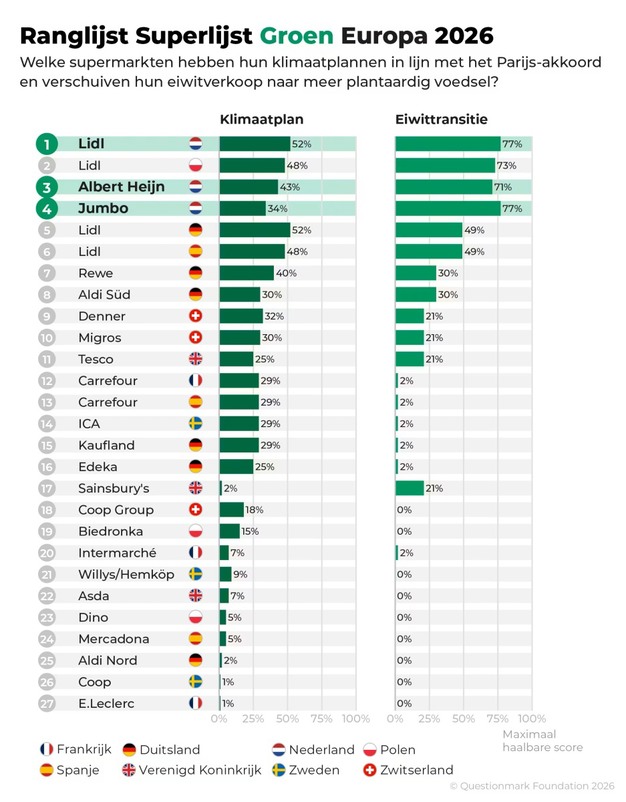
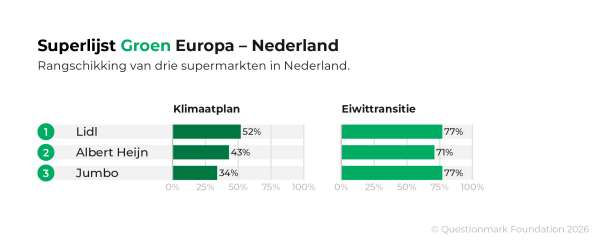
Dutch supermarket chains Albert Heijn, Lidl, and Jumbo are among Europe's leaders in planning for a more sustainable food system, according to the Superlijst Groen Europa 2026 published by think tank Questionmark. Lidl and Albert Heijn score particularly high for translating climate goals into concrete plans. At the same time, total CO₂ emissions continue to rise for both retailers, while Jumbo shows only a modest decrease. Overall, the sector has not yet achieved the targets set by the Paris Climate Agreement.
 © Questionmark Foundation
The Superlijst Groen Europa 2026 compares 27 supermarkets across eight European countries. The study, conducted by Questionmark in collaboration with WWF Netherlands, Madre Brava, and ProVeg International, evaluates supermarkets on how well their climate plans align with the Paris Agreement and on their ambitions and monitoring regarding the promotion of plant-based foods.
Questionmark: extra action needed
While Dutch supermarkets perform well compared with their European peers, Questionmark stresses that further action is necessary. Despite measures already taken, emissions are still rising at Albert Heijn and Lidl, with only a slight decrease reported by Jumbo. Progress has also been made in promoting plant-based diets, but current results indicate the need for acceleration.
 © Questionmark Foundation
 © Questionmark Foundation
Charlotte Linnebank, director of Questionmark, says: "Supermarkets have the power to shape a healthier and more climate-friendly food system. Although some chains have published detailed climate plans, the sector as a whole is not yet using its influence to meet the Paris Agreement targets, and there is no clear downward trend in emissions."
All Dutch supermarkets studied have set a goal for 2030 to source 60% of sold proteins from plant-based sources. This is significant because animal products contribute © Questionmark Foundation relatively strongly to global warming. Freya Hiemstra, Corporate Engagement Lead at ProVeg Netherlands, adds: "Dutch supermarkets are showing leadership with their ambitious protein transition goals." She warns, however, that current figures indicate the sector is not yet on track and calls for greater collaboration.
Detailed roadmap for emission reduction
Lidl Netherlands and Albert Heijn are among seven European supermarkets with a detailed short-term roadmap for emissions reduction. Albert Heijn is also the first supermarket worldwide to report methane emissions separately. Despite these initiatives, the Superlijst concludes that none of the Dutch supermarkets are currently on track to meet the Paris Agreement targets.
 © Questionmark Foundation
Source: Questionmark