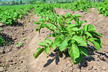
According to information from MiddleAsianNews, two new potato varieties, Darkhan-212 and Darkhan-222, were introduced for commercial cultivation in Mongolia in 2025.
The Ministry of Food, Agriculture, and Light Industry reported that the Institute of Plant Breeding and Agricultural Sciences has developed more than 100 agricultural crop varieties, with over 20 adapted to local conditions. The Darkhan-212 and Darkhan-222 potato varieties have recently entered cultivation.
Within the agricultural sector, around 400 to 450 tons of high-quality seed from early-maturing potato varieties Darkhan-160 and Darkhan-131 are cultivated and used each year. These are supplemented by medium- and late-maturing varieties Darkhan-190 and Darkhan-144. In total, five new potato varieties have been developed, 14 varieties have been adapted to local conditions, and 16 varieties have been identified as promising and are currently in the cultivation phase.
The institute produces between 80,000 and 100,000 healthy microtubers annually, accounting for approximately 40 per cent of the country's total potato seed material. In addition to potato breeding, technologies for sowing leek seeds have also been developed, aimed at reducing costs and labour requirements.
Institute scientists noted that many countries focus on preserving the genetic material of rare and endangered plant species through regulated scientific methods with preservation periods extending up to 100 years.
During a visit by Nyamzhav Baasansuren, Deputy Minister of Food, Agriculture, and Light Industry, attention was drawn to the need for further analysis of soil conditions and fertility across Mongolia. The visit also highlighted the need to establish a laboratory for the preservation of rare plant seeds in line with international standards.
A research program covering the period from 2025 to 2030 has been developed, with a focus on improving crop rotation practices and strengthening a science-based approach to agricultural development.
Mongolia's agricultural development dates back to 1956, when collective farms were established, and the first grain harvest was collected from 2,000 hectares. In 1959, the government launched its first virgin land campaign to increase domestic cultivation of wheat, potatoes, and vegetables. A second campaign in 1976 expanded cultivated land to 1.2 million hectares, allowing domestic demand for grain, potatoes, and vegetables to be met.
In 2025, Mongolia harvested 101.9 thousand tons of potatoes and 208.6 thousand tons of vegetables.
Source: Open.kg