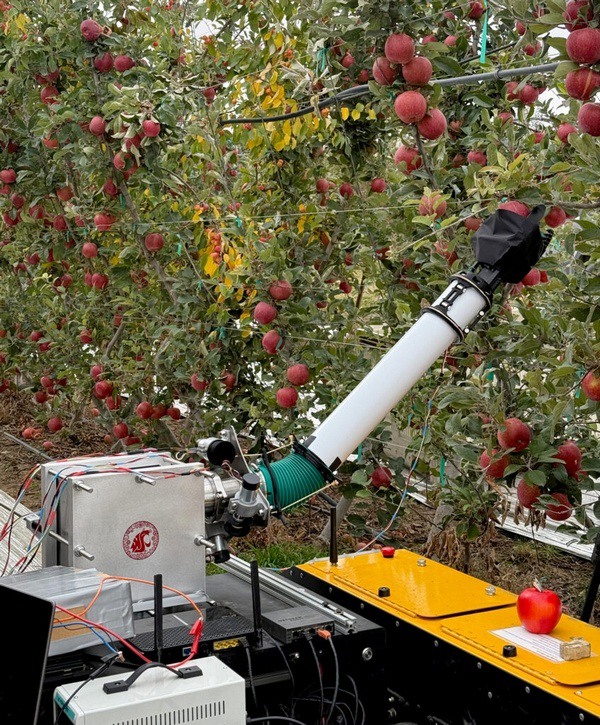
Researchers at Washington State University have developed a low-cost robotic apple picker arm that could support harvesting and other orchard tasks in the future. The prototype is designed as a soft, inflatable arm that can visually identify an apple and then extend and retract to pick the fruit. One picking cycle takes around 25 seconds.
The arm weighs less than 50 pounds, including its metal base, and measures about two feet in length. It is made from a fabric structure filled with air, allowing it to remain lightweight while being strong enough for orchard use. The research was recently published in the journal Smart Agricultural Technology by scientists from WSU's School of Mechanical and Materials Engineering.
 © WSU
© WSU
The project team is working with researchers at the Prosser Research Extension Center and with Manoj Karkee at Cornell University to integrate the arm onto an automated mobile platform designed to move through orchard rows.
"The uncomplicated nature of the design makes it low-cost, easy to maintain, and highly reliable for a soft robot," said Ming Luo, Flaherty Assistant Professor in WSU's School of Mechanical and Materials Engineering and corresponding author of the study.
Labour availability continues to be a constraint for tree fruit growers, particularly during harvest. Washington State is the leading apple and sweet cherry producer in the United States, and orchards depend on large seasonal workforces for tasks including pruning, thinning, and harvesting. Reduced labour availability has resulted in unharvested fruit in some orchards.
Current robotic harvesting systems tend to be large and costly, limiting their adoption. The materials used for this inflatable arm cost approximately US$5,500. Its low weight reduces the risk of damaging fruit or branches and allows it to operate safely near people. The design targets modern orchards with planar or V-trellis training systems.
According to Ryan Dorosh, PhD candidate and lead author, "Having this very low-cost, safe robotic platform is ideal for the orchard environment."
The arm remains slower than human pickers, who can harvest an apple roughly every three seconds. Researchers are refining mechanical elements and improving the detection system, which currently limits performance more than the arm's movement. Additional development aims to adapt the arm for tasks such as pruning, flower thinning, and spraying.
The research team is working with WSU's Office of Innovation and Entrepreneurship on intellectual property protection and potential commercialisation. Funding was provided by the National Science Foundation, the USDA National Institute of Food and Agriculture, and the Washington Tree Fruit Research Commission. Field testing took place at Allan Brothers Fruit in Prosser, Washington.
For more information:
Ming Luo
WSU
Tel: +1 509 335 4034
Email: [email protected]
www.news.wsu.edu
Ryan Dorosh
WSU
Emiail: [email protected]
Tina Hilding
WSU
Tel: +1 509 335 5095
Email: [email protected]