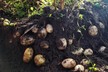
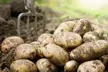
A rumour that a farmer was giving away free potatoes led locals in the southern Polish village of Dąbrowica to remove around 150 tons of crops in one day. The claim, spread through social media, proved false.
The potatoes, worth about US$16,300, had been purchased the previous day by distillery owner Piotr Gryta, who had temporarily stored them in his field. Within 24 hours, hundreds of people arrived to collect them, many using cars and trucks. Local official Tadeusz Łapka told Polsat News that he received a call claiming the potatoes were free to take. "By the time I reached the field, I saw cars, tractors, and people filling their bags," he said.
Gryta described the incident as theft. "If someone took a sack, fine, maybe they needed it. But tractors? They'd better come talk to me, because I'll speak with the mayor, and if this isn't resolved voluntarily, the prosecutor will have to step in," he told Polsat News. Some residents have since returned the potatoes after learning they were not free.
The confusion reflects the rise of direct sales and self-harvesting schemes in Poland. These have expanded as some crops produced higher-than-expected yields, leading certain farmers to give away produce when the cost of harvesting exceeded potential profit. Intermediaries have been offering farmers very low purchase prices, sometimes ten to twenty times below retail levels.
Earlier this month, a Polish farmers' organisation warned that without government intervention, more producers, particularly those growing potatoes and paprika peppers, may turn to direct sales to survive. Some growers reported that intermediaries had threatened further price cuts if they began selling directly to consumers. Despite the current oversupply, food prices in Polish retail markets have not shown a corresponding decline.
Agriculture minister Stefan Krajewski acknowledged the pressures facing rural producers, noting that crop production had risen by 6%, while fruit growers had been affected by cold weather earlier in the year. "On the one hand, weather conditions have affected many producers; on the other, we're seeing overproduction of certain crops and a lack of contracts that would ensure stable prices," Krajewski told reporters.
He said the agriculture ministry had asked the competition and consumer protection authority (UOKiK) to investigate potential price-fixing and that measures to stabilise the market would be introduced.
Farmers also remain concerned about increased competition from Ukrainian produce and the potential impact of the EU-Mercosur trade deal. Many argue that Ukraine and Mercosur states are not subject to the same environmental and production standards as EU members, adding to their market challenges.
Source: Brussels Signal