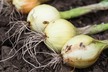
The Philippine government is expected to impose a temporary suspension on onion imports by February 2026 to prioritize the local harvest and protect farmers' incomes while maintaining a stable market supply.
Agriculture Secretary Francisco Tiu Laurel Jr. said the suspension would take effect about a month before peak harvest. "For onions, definitely we will stop importation one month before harvest, which is around February," he stated during the 47th ASEAN Ministers on Agriculture and Forestry (AMAF) meeting.
Imports of white onions began as early as September, helping reduce retail prices to about 100–120 pesos (US$1.70–2.05) per kilogram, down from 160 pesos (US$2.73) before imports. Shipments of red onions are also scheduled to arrive starting October 15 to stabilize supplies during the holiday period. Prices of red onions recently rose to 140–160 pesos (US$2.39–2.73) per kilogram, which prompted the government to authorize early shipments.
Tiu Laurel estimated that the volume of red onion imports could reach between 3,000 and 5,000 metric tons.
According to the government's onion industry roadmap for 2021–2025, the target is to raise national onion production to 279,270 metric tons, up from 229,539 metric tons, through expansion of cultivated areas and improved yields.
The roadmap notes that the Philippines has about 35,000 onion farmers, most of whom cultivate small plots averaging 0.5 hectares per household. Production relies heavily on family labor, with estimated earnings of 5,100 pesos (US$87) per man-day for bulb onions and 2,100 pesos (US$36) for shallots.
Data from the Philippine Statistics Authority (PSA) for 2020 identified Ilocos, Cagayan Valley, Central Luzon, and the Mindoro-Marinduque-Romblon-Palawan region as the country's main onion-growing areas. Bulb onions account for 79% of the total cultivated area at 14,453 hectares, while shallots cover 21% at 3,938 hectares.
Between 2011 and 2020, PSA data show onion production increased at an average annual rate of 10.72%, reaching 229,539 metric tons from 128,837 metric tons. During the same period, the area planted grew by an average of 4.91% annually, rising from 14,641 hectares to 18,391 hectares.
Source: Philstar Global