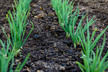
Potatoes are one of the most consumed vegetables, and the market is dominated by some well-known varieties, but there are many more. The Spanish region of Galicia produces varieties like the Kennebec, known as the Galician cachelo, the Agria, or the Fina de Carballo, among others, but with special features due to the soil and climate. The Galician cachelo, which can be identified by its white flesh, is a little-known product on an international level with characteristics that make it unique.
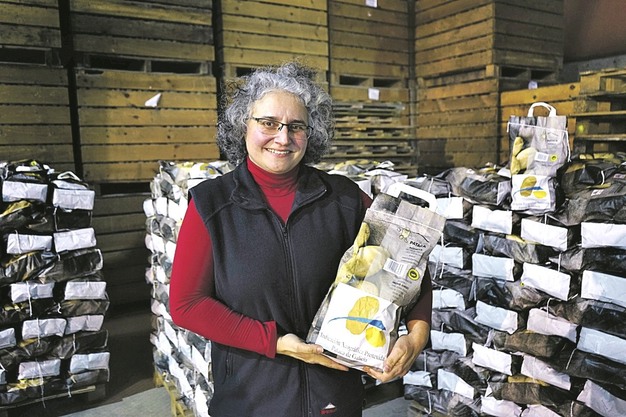
"The harvest of Galician potatoes starts between September and October. They are grown in land that is rich in minerals and with a climate that makes these varieties something quite special. We specialize in the Kennebec and Agria, both of which can be used for boiling or frying. The Kennebec, which is white on the inside, is preferred for boiling, while the Agria, which is yellow, is preferred for frying, as it ends up crispy on the outside and soft on the inside," says Antonia Calvo, manager of A Casa da Pataca.
 © A Casa da Pataca
"Our Kennebec wins many culinary competitions in Galicia. Caterers prefer the Agria potato, but Spanish omelette championships are won with our Galician Kennebec in early October in Alicante. The Kennebec is also the one mainly used for home cooking," says Calvo.
"This year we have sown very late. We would normally be finished with that in May, and we did at the end of June, because it rained a lot," says the manager. "This means that we'll be harvesting in November with rain again, so we will have to be very careful. It is becoming difficult for small and medium-sized companies to keep up, due to the pressure from large potato companies," she says.
"We will be harvesting in October and storing until April. Depending on the weather, we could be able to continue until late May. We see the restrictions on the use of treatments as a threat to the sector, as pests are on the increase, production is decreasing, costs are rising, and consumer prices are also affected by this," says the manager.
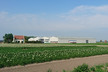
A Casa da Pataca has 200 hectares devoted to the production of potatoes, onions, and cereals. You need rotation between potato and cereal crops, because the tuber can only be grown on one out of every four years.
 © A Casa da Pataca
"We grow under the seal of the IXP Protected Geographical Indication, which gives us extra quality. There are years when we reach 1.5 million kilos, depending on rainfall and pests," says Calvo. "We are currently supplying the domestic market and are looking into possible commercial relations with Europe," she says.
"A lot of the work with early potatoes is done by hand because the skin is very thin. This is a handicap for medium-sized companies, because labor costs are very high," says Calvo.
 © A Casa da Pataca
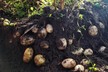
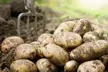
"Galician potatoes could be successful in Europe, but they are still not very well known. One of their identifying features is that they cannot be washed, so you must learn to expect them to have this rustic, earthy appearance," says Calvo.
Besides, "while we still have domestic production, potatoes are also allowed to be imported from third countries with no treatment restrictions whatsoever and very low labor costs. We are thus unable to compete with them in terms of prices, so we need more support from the public administration or, at least, for things to be made easier, without obstacles placed in our way," says the manager.
Manager Antonia Calvo won the 2nd National Award for potato growers, organized by Campo magazine. "This award highlights the value of our production in A Limia and our efforts to encourage the consumption of local products," says the manager.
For more information:
Antonia Calvo
Manager
A Casa da Pataca
Tel.: +34 617 31 52 98
[email protected]
www.acasadapataca.es