Mario Salazar Vergaray, president of the Association of Exporters' Agroindustries, Food, and Beverage Committee, said that Peru has the potential to compete with leading countries in the global export of frozen strawberries, such as Egypt and Poland. "We need to improve cultivation techniques and close the technology and knowledge gap among small growers," he said.
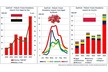
According to the World's Top Exports website, Egypt led the world's frozen strawberry exports in 2024 with sales totalling $392 million, accounting for 27% of global trade. It was followed by Mexico ($186 million), Poland ($126 million), and Chile ($112 million). Peru ranked eighth with $56.8 million and a 4% share.
To boost the sector's competitiveness, ADEX will hold the "Strengthening the strawberry export chain in Peru" conference on July 22, at the Universidad Católica in Huaura. The event will bring together representatives of the public sector, technical experts, academics, and growers.
Peru grows strawberries from Barranca to Ica, as well as in Cusco, Lambayeque, Ancash, and parts of Callejón de Huaylas. This wide geographical adaptability allows small producers to establish crops near urban centers, reducing logistics costs and facilitating access to the local market.
Despite the growth in exports, Salazar warned that strawberry cultivation in Peru presents important production and health challenges. In Spain, for example, the plants yield up to 3 kilos of fruit. Meanwhile, the plants in the Peruvian coast barely produce 1 kilo, and in the mountains, 700 grams. "We need to improve cultivation methods to become more productive," he stressed.
He also stressed the need to guarantee the safety of the product, both for export and for domestic consumption. The sector is working with experts and the government to comply with standards that ensure strawberries are free of chemical residues.
The conference on July 22 will include five technical presentations focused on improving the sector's capacities and promoting sustainable production. The topics will cover commercial opportunities in the international market, crop nutrition, pesticide use, maximum residue limits (MRLs), and integrated pest and disease management.
According to ADEX Data Trade, in 2024, Peruvian strawberry exports (in all presentations) amounted to $61 million. The United States and Canada accounted for 76.7% of the total, with purchases of $30.2 and $16.7 million, respectively. The other top ten buyers were Japan, South Korea, Mexico, Guatemala, Spain, Panama, Chile, and Germany.
Frozen strawberries were the most demanded presentation, with $56.8 million (93% of the total), followed by jams and jellies ($3.4 million), and fresh strawberries ($852,000).
Source: agroperu.pe