Shida Kartli, the region surrounding the city of Gori—about 50 km west of Georgia's capital, Tbilisi—is the country's leading area for stone fruit production. However, apple and pear cultivation have also seen strong development. "Pome fruit cultivation may be even more profitable," says Irakli Merkvilishvili, CEO of AgroCom, a company that imports and supplies horticultural inputs to growers in Georgia and Armenia, ranging from tractors and agricultural machinery to irrigation systems, crop protection, seeds, and planting material.
Irakli is more than just a supplier; he's also a grower himself, producing various pome and stone fruit varieties across 16 hectares. He works closely with agronomists, including experts from Italy, to advise growers on orchard establishment and management. That experience puts him in a strong position to guide us through Georgia's apple, cherry, and peach sectors. Unless otherwise noted, all production, import, and export figures mentioned below refer to 2024 and come from Geostat, Georgia's national statistics office.
 © FreshPlaza
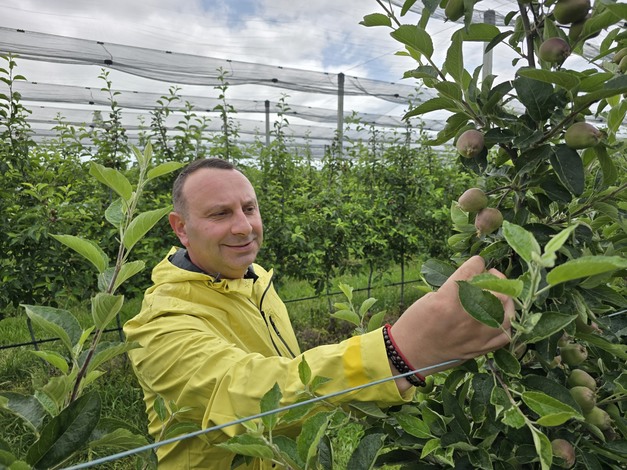
Irakli Merkvilishvili, CEO of AgroCom, inspecting the growth of Golden Reinders apples in the company's orchard near Gori, Georgia
Apple production: high yields, rising exports
"Professional apple orchards in Georgia can yield between 65 and 70 tonnes per hectare, thanks to high-density planting systems with 4,000 to 4,500 trees per hectare, supported by modern irrigation and crop protection," Irakli explains. "Initial setup costs are significant—€50,000 to €60,000 per hectare, not counting land prices, which range from €7,000 to €13,000 per hectare." To ease this burden, the government offers subsidies of €4,000 per hectare through its Invest in Future program, along with low interest rates of just 2–3%. AgroCom is also active here, working with the Bank of Georgia to help growers secure favorable loans.
AgroCom is Georgia's main supplier of young pome and stone fruit trees, mostly sourced from Belgium, Italy, and the Netherlands. Before founding his company, Irakli spent six months working at a major nursery in the Netherlands.
 © FreshPlaza
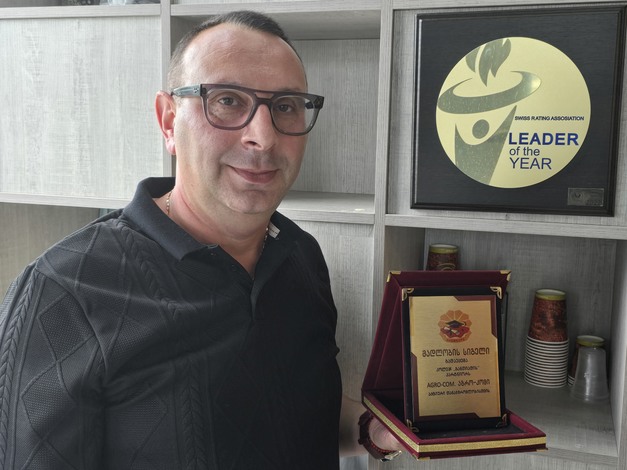
Irakli shows a certificate of gratitude for offering students the opportunity to intern at AgroCom
In 2024, Georgia's total apple production reached 76,400 tonnes, with popular varieties including Golden, Red Delicious, Jonagold, Jonaprince, Gala, Pinova, and Granny Smith. Of that total, 17,200 tonnes were exported to Russia, mainly to Moscow (2,000 km away) and St. Petersburg (2,700 km). That's 7.5 times more than in 2023.
Export pricing and market dynamics
Russia receives mainly Georgia's higher-quality apples, but even so, overall export volumes remain modest. That's no surprise: Russia itself produces around 2.08 million tonnes of apples annually and imports another 660,000 tonnes, of which just 17,200 tonnes come from Georgia. Russian apple exports are negligible at only 2,000 tonnes (source: FAOstat, 2023).
According to the Ministry of Agriculture, Georgia's average export price for apples between August 2024 and April 2025 was €0.56 per kilo. "However, outside the harvest season, prices for cold-stored apples can reach up to €2 per kilo. Prices have steadily increased over the past three years," Irakli notes.
Certification and Class III apples
"Since nearly all of Georgia's apple crop is sold domestically or in Russia, GlobalGAP certification is still limited—only about 3% of orchard area is certified," says Irakli. "But more growers should aim for certification. It significantly improves orchard management quality."
To ensure that growers of lower-grade fruit still receive a fair price, the government subsidizes processors: €0.03 per kilo when they purchase Class III apples at a minimum price of €0.08. In 2024, this scheme helped process 21,800 tonnes of apples, according to News Georgia. Based on production, export, import, and processing data, annual per capita fresh apple consumption in Georgia is estimated at 11 kilograms, comparable to countries like the Netherlands.
Marketing and cold storage
The apple harvest runs from mid-August through November. "In the early months, supply is high and prices are low—around €0.40 per kilo. Professional growers store their best apples in cold storage for later sales," says Irakli. However, mechanical cooling and ULO storage capacity remain limited, at roughly 20,000 and 15,000 tonnes respectively for all fruits, though both are expanding year by year.
 © FreshPlaza
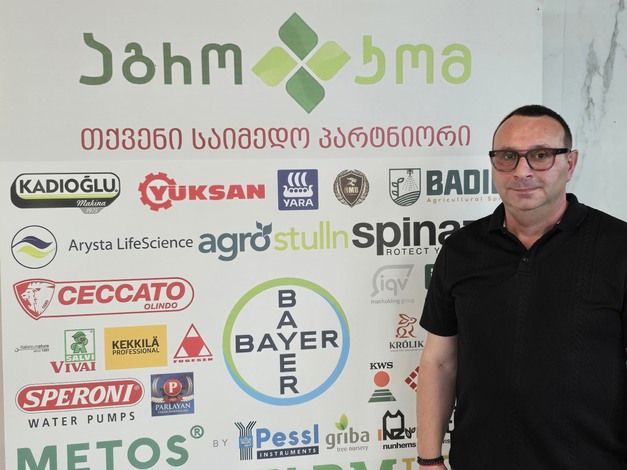
Irakli poses at a sign listing suppliers of horticultural inputs to AgroCom
From May onward, domestic supply tightens and imports pick up, mainly from Turkey and Ukraine. "To avoid market dumping, a minimum import price applies," Irakli explains. With 4.6 million tonnes of apples produced annually—60 times more than Georgia—Turkey is a major player (Faostat, 2023). Although Turkey's population is about 20 times larger, its per capita apple production is still three times higher. Official imports from Iran stand at 326 tonnes, though the actual figure may be higher. "An open border with Iran could seriously threaten Georgian apple growers," Irakli warns.
Cherries: Early varieties and export potential
Georgia's early cherry harvest begins in May in the eastern region of Kakheti, with varieties like Gisela 5 and 6, Sweet Aryana, and Sweet Lorenz. In June and July, the focus shifts to central regions like Imereti and Shida Kartli, where Regina, Kordia, and Areko varieties are grown. In 2024, total cherry production was 6,200 tonnes, with 262 tonnes exported—mostly to Russia.
"Cherry yields are highly weather-dependent. This year, spring frost devastated crops in Shida Kartli. Effective frost protection, such as sprinklers and wind machines, remains costly. Nonetheless, acreage is growing—especially for early-season cherries, which can fetch up to €5 per kilo," says Irakli. Establishing a cherry orchard with 1,200 to 1,800 trees per hectare costs around €35,000.
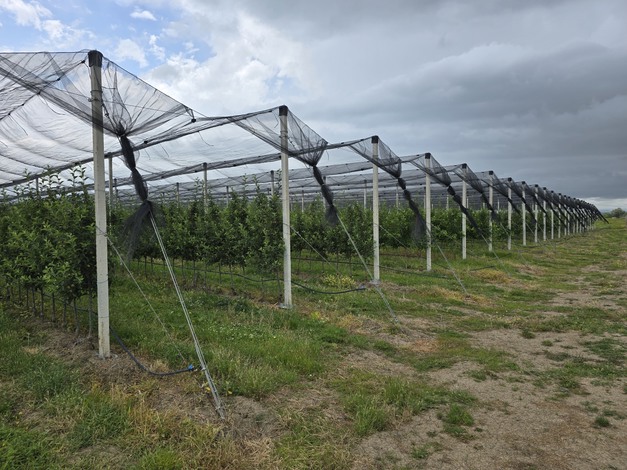 © FreshPlazaThe hail nets remain in place from flowering to harvesting. AgroCom grows apples on an area of 10 ha and pears, cherries, and peaches on 2 ha each.
Peaches: The fastest-growing sector
"Peach production is on the rise," Irakli says. In 2024, the harvest reached 38,400 tonnes—double what it was a decade ago. "Establishment costs are relatively low, at €10,000 to €15,000 per hectare." Peach growers also benefit from government and EU support, and previously from U.S.-funded programs.
A remarkable 73% of Georgia's peach crop is destined for export, mostly to Russia. "Early varieties are shipped straight by truck. Later-season varieties are sold on the domestic market." Russia, by contrast, produces only 43,000 tonnes of peaches per year (Faostat, 2023). "Still, competition from Turkey is intense between June and August," he adds.
Exploring new markets
To reduce reliance on Russia, Georgian fruit exporters are actively scouting new markets through trade fairs in the Gulf region, Madrid, and Berlin. "That's where we learn what varieties, qualities, and packaging formats buyers are looking for," says Irakli. "At the same time, the government is considering minimum import price regulations—similar to those for apples—for peaches and cherries as well. The aim is to shield the domestic market from cheap imports."
"To further boost and scale up domestic fruit production, the government has also begun auctioning agricultural land," Irakli notes. "But as cultivation expands, we must find sustainable solutions to an increasingly pressing issue: the shortage of farm labor. Despite rising daily wages, growers are already turning to seasonal workers not just from neighboring Azerbaijan, but also from Uzbekistan, Turkmenistan, India, Pakistan, and Bangladesh."

For more information:
Irakli Merkvilishvili (CEO)
AgroCom
Tskhinvali Highway 3rd km.
1400 Gori (Georgia)
Tel.: +995 591195885
[email protected]
www.agrocom.ge