The Georgian Farmers' Association (GFA) was founded in 2012 with a clear mission: To support farmers and horticulturalists with guidance on cultivation techniques and market-oriented entrepreneurship, while also advocating for their interests with government and trade partners. "We aim to be the bridge between growers and the markets," says Rati Kochlamazashvili, deputy chairman of GFA. "We do this through our own research projects, by promoting certification and collaboration, and by helping farmers adopt new technologies."
Today, GFA represents around 5,000 members across Georgia, ranging from small family-run farms to larger commercial producers and a few cooperatives. About 1,000 members are involved in fruit growing, although most combine this with arable farming or livestock.
New crops, new markets
One of the most notable developments since GFA's founding has been the rise of new commercial fruit crops. "Over the past decade, we've seen steady growth in the production of walnuts, almonds, hazelnuts, and blueberries," Kochlamazashvili explains. And the harvest figures for 2024 — 7,500 tonnes of walnuts, 43,600 tonnes of hazelnuts, 3,000 tonnes of almonds, and 6,000 tonnes of blueberries — are only expected to rise in the coming years.
 © FreshPlaza
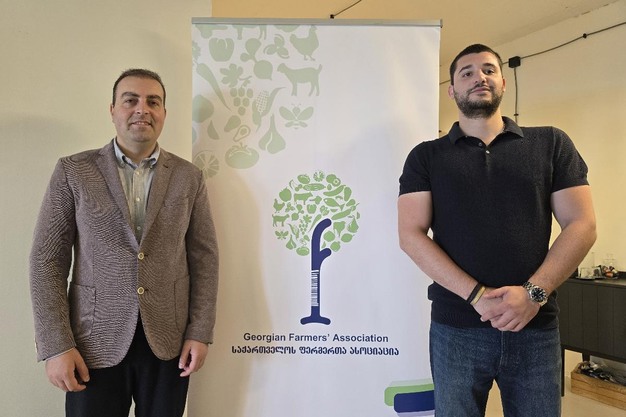
Rati Kochlamazashvili, deputy chairman of Georgian Farmers' Association (GFA), and Aleksandre Gambashidze, junior agronomist
Nut production, in particular, is expanding rapidly. "Domestic demand for walnuts and almonds still exceeds supply," he says, "but once these orchards reach full maturity, exports will be crucial." For blueberries, that moment has already arrived: "There's limited domestic demand for blueberries, so most of the harvest is already destined for foreign markets."
Modernising traditional fruit growing
Alongside these newer crops, Georgia's fruit sector continues to rely heavily on its more traditional mainstays — namely, pome fruits (89,600 tonnes) and stone fruits (76,700 tonnes). In 2024, this included 76,400 tonnes of apples, 11,500 tonnes of pears, 1,600 tonnes of quinces, 13,900 tonnes of plums, 6,200 tonnes of cherries, 3,400 tonnes of apricots, 34,600 tonnes of peaches, 3,800 tonnes of nectarines, and 13,700 tonnes of cherry plums.
While much of this produce still goes to Russia, alternative export markets — particularly in the Gulf States and the EU — are gaining traction. "The development of intensive orchards is helping to stabilise both quality and supply," Kochlamazashvili notes, "which makes our produce more appealing to European buyers."
Grapes are another cornerstone of Georgian agriculture, deeply rooted in the country's cultural history. In 2024, some 320,700 tonnes of grapes were harvested, almost entirely for winemaking. Fresh table grapes, however, are still widely imported from neighbouring Turkey and Armenia. Other significant crops include mandarins (49,800 tonnes) and persimmons (10,800 tonnes), with smaller volumes of oranges, lemons, strawberries, figs, pomegranates, kiwis, and raspberries also being produced.
Land fragmentation hinders growth
One of the major structural hurdles facing Georgian agriculture is land fragmentation. After the fall of the Soviet Union, each household was granted around 1.3 hectares of land, typically spread across three non-contiguous plots. "More often than not, these plots are kilometres apart, and owners are reluctant to sell," says Kochlamazashvili. "This makes it difficult to scale up fruit production."
Still, some progress has been made since 2012. Thanks to government subsidies — and, until recently, support from USAID — joint ventures and larger agribusinesses have begun to emerge. "There's also significant potential in land still owned by local or central government, which is now being sold or leased to farmers depending on the type of cultivation involved."
Foreign investors are permitted to enter the Georgian horticulture sector only through joint ventures, and at least 51% of ownership must remain in Georgian hands.
Labour and technology: A dual challenge
Labour is another critical challenge, particularly in labour-intensive sectors like blueberry farming in western Georgia. "We're facing a shortage of seasonal workers," Kochlamazashvili explains. "We're exploring options for labour migration, particularly from Azerbaijan and Ukraine. But technology will also need to play a bigger role."
Previously, the main difficulty was attracting skilled workers, but since the COVID-19 pandemic, there's a shortage across the board. GFA helps farmers adopt modern technologies both in the field and in packing facilities. "We take them to trade fairs, demonstrate innovations, and support the implementation process," says Kochlamazashvili.
Climate change leaves its mark
Climate change is also affecting Georgian agriculture. In May 2024, a late spring frost hit the Shida Kartli region — a key area for stone and pome fruit — causing significant crop losses. "Most agricultural insurance policies don't cover spring frost," Kochlamazashvili points out.
And in Kakheti, an eastern region traditionally spared from extreme weather, a tornado struck last year — something previously unheard of in the area. "These kinds of events are new for us," he says. "But we need to start preparing for them."
Trust and cooperation: A cultural barrier
While cooperation through formal cooperatives is becoming more important, historical mistrust remains a major obstacle. "For many farmers who lived through the Soviet era, the idea of collective marketing is still loaded with negative associations," Kochlamazashvili explains. "Back then, sovkhozes and kolkhozes were synonymous with corruption and mismanagement."
That mindset is slowly starting to shift. Trust is building, particularly as privately run packing stations begin offering services to multiple local growers. "That's a promising first step," he says. "In the long run, cooperation will be essential if we want to achieve economies of scale, especially for those aiming to supply the European retail market."
Certification as a quality guarantee
To meet the requirements of domestic retailers, GFA launched its own certification system, known as GeoGAP. "It's modelled on GlobalGAP but slightly less stringent," says Kochlamazashvili. Still, the scheme offers important quality assurance. "Retailers specifically ask for it. Farmers with GeoGAP certification definitely have a competitive edge."
A strategic focus on the EU and Middle East
GFA's strategic roadmap for 2025–2029 is already taking shape: It prioritises the promotion of local produce on the domestic market and the strengthening of cooperation between growers to seize export opportunities. Recently, a trade agreement was signed with the United Arab Emirates.
Yet challenges remain. "We need more cold storage infrastructure and improved logistics," Kochlamazashvili stresses. "Standardising quality and scaling up production are also crucial if we want to compete internationally."
For now, Russia remains Georgia's largest export destination, thanks to its proximity and often better price levels. "But Europe is a more reliable market," he concludes. "It offers legal security and contractual stability. That allows for long-term planning — and that's exactly what we need to move forward."

For more information:
Rati Kochlamazashvili (deputy chairman)
Georgian Farmers' Association (GFA)
E. Ninoshvili 64
0102 Tbilisi (Georgia)
Tel.: +995 555 28 08 18
[email protected]
www.gfa.org.ge