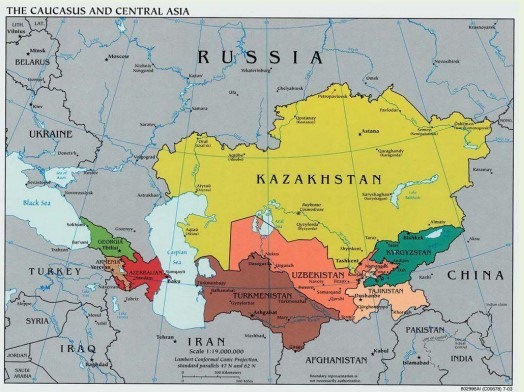
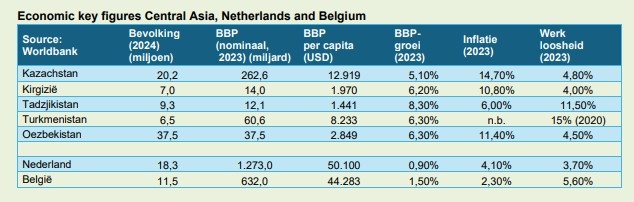
Uzbekistan is by far the most important producer of fruit and vegetables in Central Asia. The 11 million tonnes of vegetables and just under 7 million tonnes of fruit grown there are not far behind the volume produced in Russia. Currently, 14 million tonnes of vegetables and 6.5 million tonnes of fruit are grown there. For comparison, the Netherlands produces 4.8 million tonnes of vegetables and 0.7 million tonnes of fruit, while Belgium produces 2.0 and 0.6 million tonnes respectively. In Central Asia, Kazakhstan also has significant production, with 4.3 million tonnes of vegetables and 3.2 million tonnes of fruit. Tajikistan also plays a role, with 2.4 million tonnes of vegetables and 1.8 million tonnes of fruit. Less is grown in Azerbaijan (technically outside Central Asia), Kyrgyzstan, and Turkmenistan.
 © Fruit and Vegetable FactsAlso exports a lot
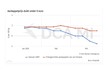
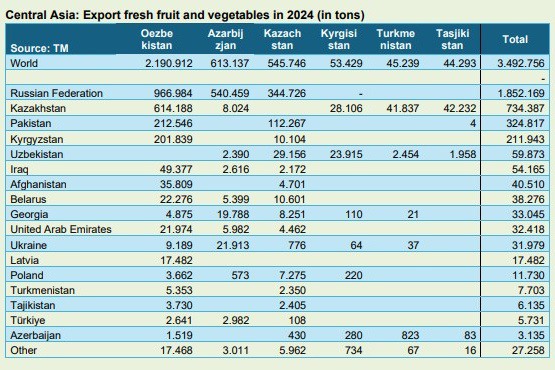
Most fruit and vegetable production is sold on the domestic market. On average, 10 to 15% is exported. Uzbekistan is a major exporter of fresh fruit and vegetables. In 2024, exports rose sharply to 2.2 million tonnes. Azerbaijan and Kazakhstan also export a significant amount of fresh fruit and vegetables, at 0.6 and 0.55 million tonnes respectively.
The countries in Central Asia also import large quantities of fresh fruit and vegetables, particularly from Kazakhstan. Last year, total imports reached 1.2 million tonnes. Uzbekistan (0.9 million tonnes), Azerbaijan (0.6 million tonnes), and Kazakhstan (0.55 million tonnes) also contributed to this figure.
Russia is the most important market
Exports from Uzbekistan, Azerbaijan, and Kazakhstan are heavily focused on Russia. Last year, almost one million tonnes of fresh fruit and vegetables were exported from Uzbekistan to Russia—nearly half of the country's total exports. The half a million tonnes that Azerbaijan sent to Russia accounted for more than 90% of its total exports. Kazakhstan exported 350,000 tonnes to Russia, over 60% of its total exports. Uzbekistan also exported over 600,000 tonnes to Kazakhstan. In addition to Russia, Kazakhstan exported a significant volume (110,000 tonnes) to Pakistan. Exports from the smaller Central Asian exporters—Kyrgyzstan, Turkmenistan, and Tajikistan—were mainly directed to Kazakhstan. About 30% of total exports from Central Asian countries involve intra-regional trade.
Watermelons most widely grown
Watermelons are the most widely grown crop in the six Central Asian countries. With 5 million tonnes, they account for one-third of total fruit production. Uzbekistan and Kazakhstan each produce around 1.5 million tonnes of watermelons annually. Watermelons are also an important crop in Tajikistan and Azerbaijan. Tomatoes and carrots are also major crops in Central Asia, with just under 5 million tonnes combined. Carrots are especially significant in Uzbekistan, with about 3.5 million tonnes grown each year. Onions rank as the fourth most important crop in the region, with about 3.5 million tonnes produced annually—1.3 million tonnes of that in Uzbekistan. Other major products in the region include grapes, apples, cucumbers/gherkins, cabbage, and melons.
Onions are the most exported product
Last year, the countries in Central Asia exported a total of 3.5 million tonnes of fresh fruit and vegetables. Onions were the top export, accounting for just under 0.9 million tonnes. Uzbekistan exported 0.56 million tonnes and Kazakhstan 0.26 million tonnes. Uzbek onions were primarily shipped to Pakistan (0.21 million tonnes) and Kazakhstan (0.13 million tonnes), with Russia receiving 70,000 tonnes. Kazakhstan mainly exported onions to Pakistan and Russia.
Cabbage is the second most important export product. Last year, Central Asian countries exported 0.42 million tonnes of cabbage, of which 0.38 million tonnes came from Uzbekistan. Russia and Kazakhstan were the main buyers. Tomatoes were mainly exported by Azerbaijan—145,000 tonnes last year, almost all of it to Russia. Grapes are another key export product, especially for Uzbekistan, which exported 230,000 tonnes last year, 180,000 tonnes of which went to Russia.
 © Fruit and Vegetable Facts
Persimmons are a major export product for Azerbaijan. The country exported 155,000 tonnes last year, 130,000 tonnes of which went to Russia. Uzbekistan exported 90,000 tonnes of persimmons, 70,000 tonnes of which went to Russia. Despite the massive production of carrots, only a small share is exported. Apples, peaches/nectarines, and watermelons are also fairly significant export products, with export volumes ranging between 100,000 and 200,000 tonnes. Apples mainly come from Azerbaijan, while peaches and watermelons primarily come from Uzbekistan.
Mandarins are the largest imported product
Mandarins are the most important imported product in Central Asia. Bananas rank second, with Uzbekistan importing large quantities. Apples are the third most important imported product, followed by onions, pears, grapes, carrots, oranges, and lemons.
For more information:
Jan Kees Boon
Fruit and Vegetable Facts
[email protected]
www.fruitandvegetablefacts.com