The prime selling window for organic apples from the southern hemisphere starts now and will continue through August. From Chile, the first organic variety, Gala, has arrived on the U.S. East Coast and is available in the market, signifying the start of weekly arrivals. "The majority of organic apples from South America are imported from Chile with some supply from Argentina," says Chris Ford with Viva Tierra Organic. In addition, the first containers from New Zealand are in various states of transit, expecting the first volume to arrive by mid-May. Viva Tierra focuses on bringing in core varieties and Gala will be followed by Granny Smith, Fuji, Pinks, and Honeycrisp. "Chile is our exclusive supplier of organic Honeycrisp, and this variety is expected to see particularly high demand due to a short domestic crop."
 © Viva Tierra
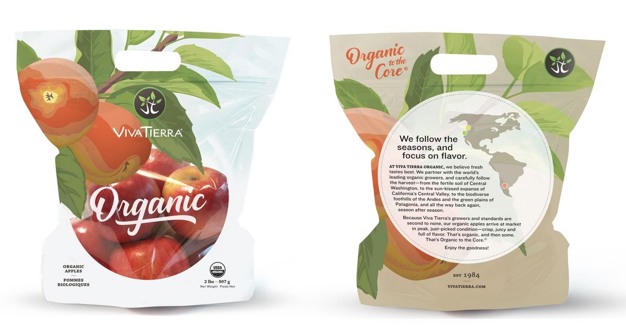
Pouch bags with organic apples.
Smaller fruit for bagging
In addition to high demand for Honeycrisp, smaller fruit for bagging is experiencing strong demand. "We are pleasantly surprised that organic apples have witnessed a resurgence in consumption lately, which is mainly driven by conventional retailers as well as club stores who prefer to sell organic apples in bags," Ford commented. "Bags provide visibility and make organic apples stand out from the conventional category. Additionally, it's easier to ring up, preventing a mix up with conventional product." Within the bagged apple segment, there has been a shift towards smaller bag sizes with 2 lb. bags now being preferred over 3 lb. bags.
Well-versed program
All three countries experienced favorable weather during their growing seasons, resulting in high-color fruit with a good balance of starch and sugar. "New Zealand especially has had a banner quality harvest season with clean fruit. It should be very well received in the market." Programs from the three southern hemisphere growing countries are complementary. "Apples from Chile are smaller and very well suited for bagging while the apples we bring in from New Zealand are larger in size. This allows us to offer our customers a well-versed and high-quality program." Today, consumers have more fresh produce choices than ever to spend their money on and in summer, competition is high from cherries, stone fruit, berries, and table grapes. "As an industry, it's our job to continue to grow consumption and only by offering high-quality, flavorful apples will we have a chance of being preferred over other fruit options," Ford shared.
 © Viva Tierra
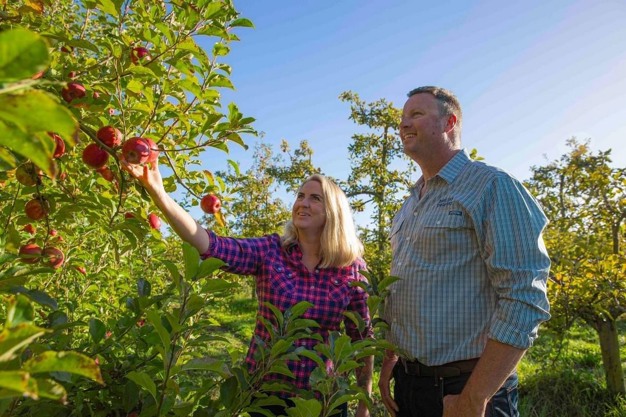
From New Zealand, Viva Tierra represents Bayleaf Organics. Pictured are Craig and Wendy, Balyleafs' owners.
Logistics
While strong demand is expected this import season for organic apples from both Chile and New Zealand, logistics are ever changing. "We are fortunate to bring in apples on the East Coast as clearance times on the West Coast have been longer." Overall, freight rates are up slightly compared to last season.
"We are watching closely to see what impacts the administration's ongoing trade wars will have on perishable logistics," says Addie Pobst, Viva Tierra Import Coordinator. "As import volumes to the U.S. from China plummet, it is likely that in the near term we will see quicker expediting on the west coast for containers coming from South America and New Zealand. However, the disruption in global maritime freight sailings may have knock-on effects that cause other impacts to shipping logistics outside the US-China routes."
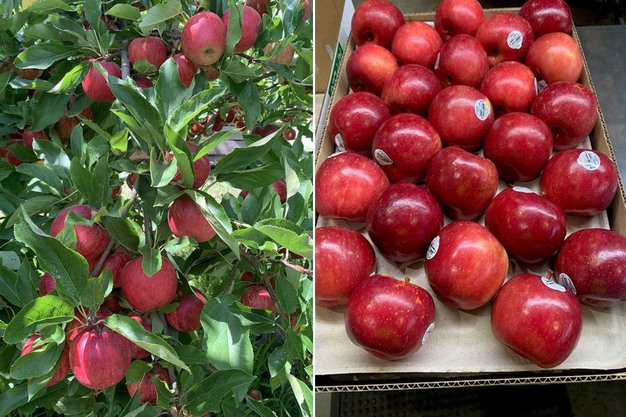 © Viva TierraLeft: organic Gala apples. Right: organic Fuji apples from New Zealand.
Staying relevant
The apple industry globally has been facing difficult times in recent years. "For us, as a small to medium size player in the organic apple category, we need to look at ways to differentiate in order to stay relevant." Just a recent development like the implementation of import tariffs has a big impact as costs go up, putting pressure on the cash flow. "We're in a small margin business and tariffs put more pressure on the supply chain. In an open market with competition, we can't just raise consumer prices to absorb these additional costs, so we are actively streamlining operations even further to help soften the financial blow to growers who get squeezed the most in these circumstances," shared Ford. Nevertheless, many growers have been working with Viva Tierra for a long time, sometimes more than 30 years. How has the company been able to retain their grower base? "Our goal has always been to maximize the return for our growers and help them sell their products by selling the whole tree. We work with a wide variety of outlets, from processors, to wholesalers, retailers, and club stores to maximize our growers' sales."
 For more information:
Chris Ford
Viva Tierra Organic
Tel: 831-917-7321
[email protected]
www.vivatierra.com