Citran was created more than 40 years ago in Seville, in the heart of the Spanish region of Andalusia. It was a brave and determined decision on the part of nine agricultural families who, tired of depending on intermediaries and external operators, decided to take a step forward to regain control over their production, to give it value, and to connect with supermarkets and consumers directly.
"Today, Citran manages more than 1,300 hectares, with citrus fruits as our most important production," says Pedro. "Volumes amount to around 30,000 tons, which we expect to increase to 40,000 in the next four years."
 © Marta del Moral ArroyoCitran's facilities in Brenes, Seville
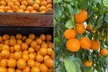
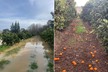
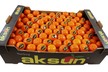
"Of these, around 25,000 tons correspond to oranges. We grow varieties from all cycles, from the M7 to the Valencia group, with which we manage to supply our clients almost all year round, from September to July."
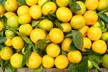
"We also grow 1.2 million kilos of mandarins of the Tango and Nadorcott varieties. The market demand for these varieties has been increasing thanks to their flavor, the fact that they are easy peelers, and the absence of seeds. Thus, little by little, we have decided to focus on them, instead of on other more traditional varieties, such as the Clemenules, Orogrande, etc, and we hope to double our production volume in the coming seasons."
 © Marta del Moral Arroyo
"Grapefruit is another of our most important citrus fruits, with around 1.5 million kilos grown each season. The demand for it is traditionally lower - around 10% of the demand for oranges, for example - but it tends to give us very stable seasons. This year, in particular, the grapefruit season has run from October to March and has been characterized by a predominance of very large sizes. Before the veto, these large sizes went to Russia, where large grapefruits are in high demand. The European market generally prefers medium sizes, but there's still a good demand for large ones in Eastern countries," says Jorge.
"More and more retailers are introducing lines of citrus specialties"
One of Citran's strategic pillars is its commitment to added value. Its organic and biodynamic production keeps growing every year, "with 3 million certified kilos at the moment and the prospect of doubling this volume in four years. We also want to add the Naturland certification to our organic and Demeter certifications."
"Moreover, we are developing a line of pigmented oranges, whose production is expected to double in three years," says Pedro.
 © Marta del Moral ArroyoDemeter oranges packed in biodegradable cotton nets
"Our strategy to grow and compete with other warehouses is based on differentiation and on being able to do something that nobody else is doing. Competitors such as South Africa, for example, are unable to handle organic or Demeter citrus, so we can offer the market something very exclusive; and our specialization in pigmented orange varieties and citrus with high added value is giving us very positive results, even when working with retailers and discounters."
"It should be taken into account that 70% of our production is currently intended for supermarkets, with Lidl being very important for us. This season, we have already launched a Sanguinelli line with them, selling around 200,000 kilos, and we hope this volume to increase in the next campaign."
 © Marta del Moral Arroyo
"Supermarkets are looking for quality, tasty products at a good price; nevertheless, we are seeing more and more retailers introducing specialty product lines in many countries. It's the case of companies such as Marks & Spencer in the United Kingdom, which are leaving room for specialties and innovations. Our focus is on pigmented oranges, for which we aim to become a leader in Europe."
The largest pigmented orange research project in Europe is in Seville
The largest research project on pigmented oranges in Europe is, in fact, being carried out in Citran's fields. In the framework of an agreement with a Citran partner (Agrícola Ruiz Valero S.L.) and the Government of Andalusia, the company has set up a 1.6 hectare trial field where they are evaluating the agronomic performance of different varieties on 12 different rootstocks, including rootstocks imported from the U.S. with potential tolerance to HLB (Huanglongbing).
 © Marta del Moral ArroyoPigmented orange trees in bloom
"The field is divided into different test areas. In one of them, we have introduced the full range of pigmented varieties from Italy, the leading country in this type of citrus in Europe. In another, we are working with a new set of varieties from different continents, from which we hope to obtain very interesting information. In the last trial area, we have grafted the Onix, one of our most innovative citrus fruits, which was awarded the Fruit Logistica 2025 Innovation Award," says Juan Francisco, CEO of the company.
Given the combination of its striking external color, an intense, almost black burgundy color, and its internal coloring, with a delicate aroma and a flavor reminiscent of the traditional Sanguinelli, this orange, which originated in Seville, offers a unique experience "that has made it hugely successful all over Europe in this first commercial campaign."
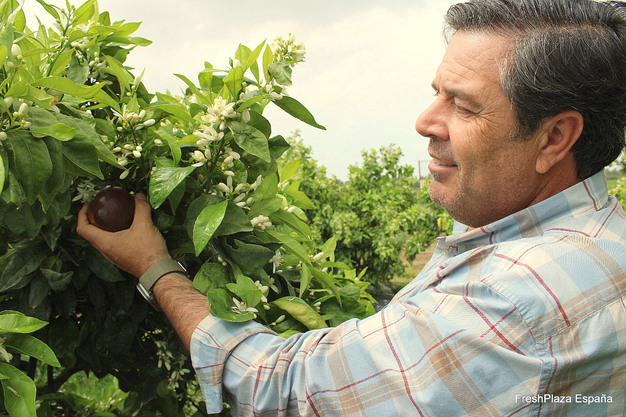 © Marta del Moral ArroyoJuan Francisco showing an Onix orange amongst the orange blossoms
Innovation hand in hand with sustainability
In terms of sustainability, Citran's partner, Agrorugil S.L., has incorporated key innovations such as the use of anti-weed nets, which has allowed them to stop using herbicides and reduce water consumption by 30%, thereby falling in line with the principles of regenerative agriculture, which is their hallmark. "One of the projects we are currently implementing together with Tecnoalgae is the installation of a reactor for the cultivation of microalgae, which will be incorporated into the soil through irrigation to allow the recovery of the soil's microbiota."
"We are convinced that the future lies in integrating technology with traditional practices, seeking living soils and healthier productions, both for the consumer and the environment," says Juan Francisco.
 © Marta del Moral Arroyo
What allows Citran to stand out is its identity. It's not simply a marketer, but a producer. "No export company is as close to the fruit as we are. And this closeness to the product, to the field, to the land, is what guarantees quality and consistency at every stage of the process."
"With an approach that is increasingly oriented towards flavor, sustainability, and adaptation to retail demands, at Citran we are showing that a different agricultural model is possible; one in which value is not lost in the chain, but starts - and stays - at source."
 For more information:
Cítricos Andaluces S.A.T.
Ctra. Camino del Bodegón de las Cañas, KM.1
41310 Brenes, Seville. Spain
[email protected]
https://citransat.com/