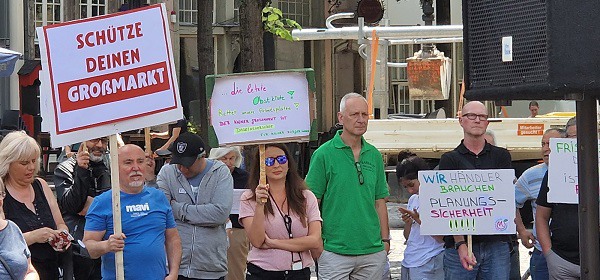
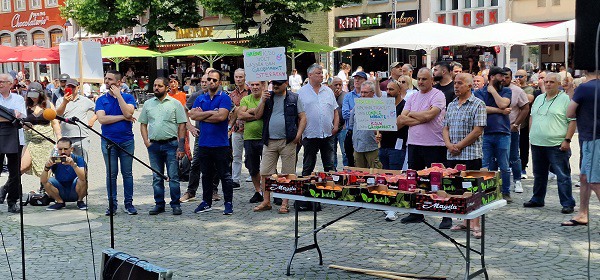
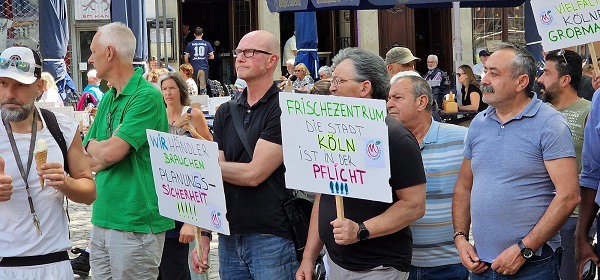
On Thursday, June 15, traders of the Cologne wholesale market called for a protest against the city of Cologne. We spoke with one of the supporters, Jürgen Hubounig, managing director of Zimpelmann Select-Fruit GmbH & Co. KG, about his impressions of the current status of the wholesale market in the run-up to the protests.
He said he was taking part in the protest out of personal conviction. "I'm going there because as a Cologne resident, entrepreneur and partner of the affected businesses, I don't agree with how the retailers are being treated." The criticism is directed not only at the city of Cologne, however, but also at the state of North Rhine-Westphalia and not least at Federal Minister of Agriculture Özdemir. The call was initiated by the managing director of Birkenheyer Fruchthandels GmbH Nevzat Taskiran.
"The result is practically that the wholesale market and thus also the 2,000 employees no longer know how it will continue. After all, an annual turnover of 450 million euros is generated there. The supply security of the city of Cologne and the surrounding area for weekly markets, daycare centers, hospitals, restaurants is no longer given. The Düsseldorf wholesale market is also no longer protected as a going concern after yesterday's ruling."
Cologne-Marsdorf no longer an alternative
"In view of its central location, I would prefer the wholesale market to remain at its current site. At the same time, however, I am also aware that the cities are trying to relocate the wholesale markets as far as possible because of the particulate matter, heavy traffic, etc. As an alternative, the Cologne-Marsdorf location was already offered to the retailers years ago, although the total area there is significantly smaller. Suddenly, the city of Cologne offered half of the area in Marsdorf to the 1st FC Cologne. That, of course, shows the city's attitude toward the wholesale market."
Security of supply played out on the backs of the wholesale stores
According to Hubounig, something similar could be observed at the Düsseldorf wholesale market. "One could definitely have looked for areas for both wholesale markets. After all, in my opinion, there is hardly anything more important in terms of food supply than distribution via the wholesale markets, as was seen most recently during the pandemic. That would not have been possible through the supermarkets alone. Security of supply has been played out on the backs of the wholesale markets, while they are now being resented."
More than 2,000 jobs dependent on the wholesale market
Hubounig also points out that up to 2,000 jobs are directly dependent on the wholesale market. "The fact that other jobs, for example in restaurants, hotels and even merchants, also depend on the wholesale market is simply ignored. The city is basically letting the site fall into disrepair."
For his own company, he said, a closure would not have a serious impact because he serves customers throughout Germany. "Of course, we would miss out on certain sales if some customers were also lost as a result of the closure. However, for me, security of supply in Cologne in particular is paramount."
In light of the current uncertainty, he said, customer traffic at the Cologne wholesale market is declining. "There is no longer any possibility of acquiring new customers or even for new businesses to gain a foothold here. Businesses are more likely to be abandoned or sold, especially since it is no longer possible to find new personnel. Companies such as Birkenheyer and Co. that would still be willing to invest something are put many obstacles in the way."
Break with the food retail trade
For a long time, the company maintained a close partnership with food retailers until the old buyers retired, some of whom had done the job for 30 years. "With the new buyers came the philosophy of tightened thumbscrews. You can't have a good partnership with that." He said there was also a big difference in terms of quality, for example in the flying mangoes compared to the produce in the grocery store.
He finds the concentration of the grocery market on the four large chains extremely worrying. "The final break with food retailers came after they put a gagging contract in front of us that we couldn't accept," Hubounig says. "As an importer for flight goods, our sales are significantly lower than those of the big players in the industry. Nevertheless, we have always offered high-priced goods that not everyone can handle. Fortunately, we have been able to absorb the lack of sales. Those retailers, however, who rely on food retailers are extremely vulnerable to extortion."
During the demonstration
Hubounig himself gave a short speech at the demonstration and was present in the public gallery at the Cologne City Council. "Several politicians from the SPD and FDP also took part in the demo and support motion to temporarily preserve the wholesale market. Afterwards, I followed live the discussions of the parties before the vote in the City Council. The Left Party, AfD, SPD and FDP were in favor of the extension until 2028. The Greens and the CDU wanted to give the wholesale market a grandfather status only until 2025 - instead, they would rather promote real estate projects. In the end, the Greens and the CDU won the vote without offering alternatives to the wholesale market. Thus the whole is driven explicitly before the wall."
Zimpelmann Select-Fruit GmbH & Co. KG
The company Zimpelmann Select-Fruit GmbH & Co. KG has been active in the wholesale market for 30 years. Hubounig then took over the business in 2013. "Apart from the Corona period, we were able to expand our business thanks to the acquisition of new customers as well as the long-standing partnerships."
Images: Jürgen Hubounig/Zimpelmann Select-Fruit GmbH & Co. KG
Further information: Jürgen Hubounig
Zimpelmann Select-Fruit GmbH & Co. KG
Raderberger Str. 202
50968 Köln
Tel: +49 (0)221 - 36 79 47 0
Fax: +49 (0)221 - 36 79 47 99
Email: [email protected]
Webseite: https://www.select-fruit.de