The green spotted bug, also known as Nezara viridula, has been destroying vegetable crops for several years. “It is the most famous of these bugs, recognizable by the three white spots on its back,” explains Philippe Parageaud of Bioplanet France. “It travels easily, which means that it is now present almost everywhere in the world. Very polyphagous, it can be found on about 200 species. Its favorite crops include legumes, solanaceae and cucurbits such as beans, tomatoes, eggplants and cucumbers. It attacks the plants mainly by pricking the flowers, which affects the shape of the fruit and makes it fall prematurely. Sometimes, the flower even falls off. This phenomenon inevitably leads to lower yields.”
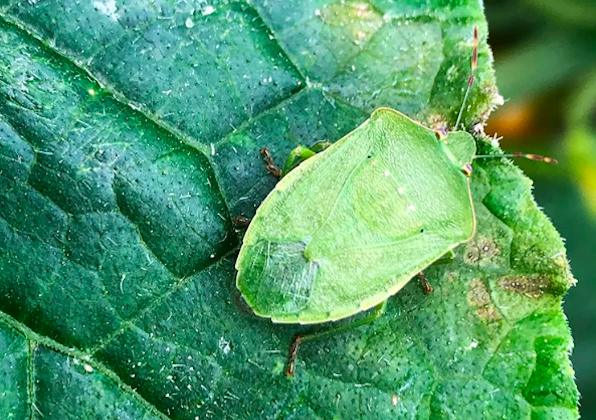 Green spotted bug - Nezara viridula
Trissolcus basalis, a parasitoid that attacks the eggs of the bug
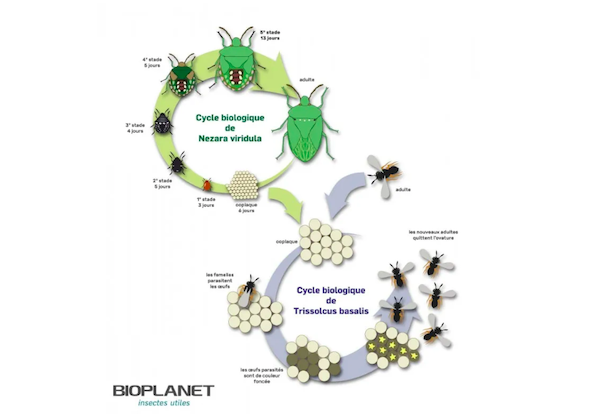
Specialized in biological control, Bioplanet is now able to market the parasitoid that can regulate the Nezara viridula populations. “Trissolcus basalis is a parasitoid that attacks the eggs of the bug and therefore reduces the adult population that creates the most damage. It is a solitary parasitoid.”
The female stalks the adult bugs in order to lay an egg inside their newly laid eggs. The entire egg mass is then parasitized. Inside its host egg, the Trissolcus undergoes a metamorphosis in three larval stages and a pupal stage. The presence of the parasite becomes evident within a few days through the change in color of the affected eggs, which first turn gray, and then black when the adult is about to emerge.
Each female can lay up to 250 eggs over a period of two weeks. At the optimal temperature of 27°C, the cycle takes place in about 12 days. The phenomenon is easily observable in the wild in France and Europe.
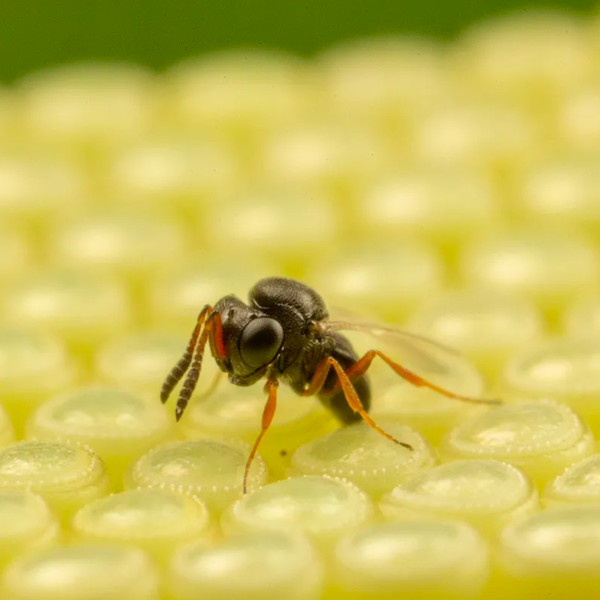 Trissolcus basalis
Very promising results in the field
The difference in terms of the effectiveness of the solution between the tests in the lab and the reality in the field may be surprising, but the first tests carried out with our producers have been very promising. “We tested the Trissolcus basalis on 3.9 ha, over 6 production sites of the Mediterranean basin (Montauban, Nice and Tarascon in France), on both conventional and organic crops. By releasing the parasitoid in late May/early June (minimal temperature of 15 °C needed to develop), we observed a drastic reduction of the bug population due to their inability to reproduce. All the producers were satisfied with the effectiveness of our solution and want to repeat the operation this year.”
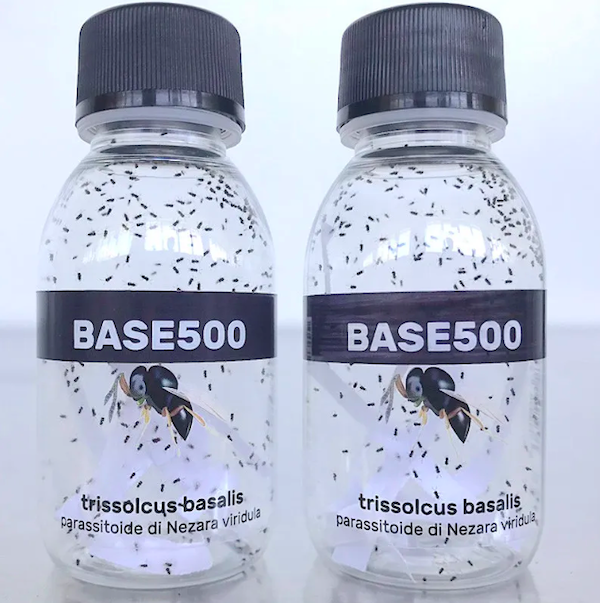
Already available in Italy, this solution will be in the hands of French producers in May of this year, with 500 adults per package.
Developing a solution against stink bugs
In addition to breeding of Trissolcus basalis, Bioplanet is also working on a similar solution to reduce the population of stink bugs, a real nuisance for horticulturists. “We are waiting for the authorization to use the Anastatus bifasciatus, another parasitoid that attacks the eggs of the Halyomorpha halys stink bug, very present in the orchards of stone fruit, pears, kiwis and hazelnuts. Italian producers have already been using it for three years and the solution will be available in France from 2023.”
For more information:
Philippe Parageaud
Bioplanet France
Phone: +33 6 267 217 73