Vertical farming is, for the time being, not suitable for every crop. We are unlikely to see lemon trees growing in a warehouse in Amsterdam any time soon, but tomatoes do not appear ready to move from greenhouse to container cultivation either. Lettuce and herbs, however, are well suited to the concept. At the same time, these crops are still widely grown outdoors in Murcia, Spain, and then transported to supermarket shelves in northern Europe. Which of the two systems, indoor cultivation in the Netherlands or outdoor cultivation in Spain, is more sustainable? We explored several studies on carbon emissions to find out.
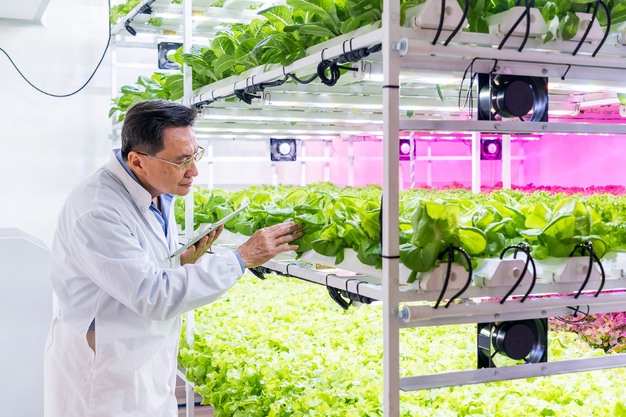
Vertical farming, the cultivation of crops in stacked layers within a controlled environment, offers several major advantages over outdoor production. It uses less water thanks to closed recirculation systems, requires far less land, and can be established almost anywhere: in cities, deserts, or cold climates, close to the consumer. Because the growing environment is fully climate-controlled, weather conditions no longer affect production, resulting in stable year-round output. The closed environment also largely eliminates the need for plant protection products and delivers a cleaner product. Thanks to optimized growing conditions, yields per square meter and the number of harvest cycles per year are also higher.
 © ID 370287371 © Artitwpd | Dreamstime
Still, vertical farming is not a universal solution. Energy consumption remains its biggest drawback: artificial lighting and climate control require enormous amounts of electricity. In addition, investment costs are high and, as mentioned earlier, the method is currently only suitable for leafy vegetables, herbs, and small fruits.
We focus here on lettuce cultivation. The studies consulted regarding environmental impact all contain the abbreviation LCA in their titles. A Life Cycle Assessment, also known as a life cycle analysis, is a method used to map the environmental impact of a product throughout its entire life cycle, from cultivation to consumption, and often even beyond, including agricultural inputs and waste disposal.
CO₂-equivalent
Environmental impacts are varied. The cultivation and marketing of fresh produce can, to a greater or lesser extent, contribute to pollution and the depletion of water, soil, and the environment. Examples include overuse of water in arid regions, the application of fertilizers and plant protection products, and plastic pollution. This article focuses on differences in CO₂-equivalent (CO₂-eq) emissions between indoor and outdoor cultivation systems. CO₂-eq is a unit used to summarize the climate impact of different greenhouse gases, including carbon dioxide, methane, nitrous oxide, and others. Greenhouse gas emissions contribute to global warming.
To get straight to the point: according to several of the studies consulted, the carbon dioxide equivalent associated with growing, storing, transporting, and serving lettuce from a vertical farm in Amsterdam in a Dutch catering establishment can be comparable to that of lettuce harvested from a field in Murcia. An initial reaction might be: "That makes sense, because you save more than 2,000 km of truck transport." Yet the situation is not that straightforward.
Transport kilometers
Transport from Spain to the Netherlands represents only part of the overall footprint. In several studies, transport accounts for less than half of the total carbon footprint from cultivation to the retail shelf. Assuming an average diesel consumption of 40 liters per 100 km for a 15-ton refrigerated truck transporting lettuce from Murcia to Amsterdam over a distance of 2,100 km, and a CO₂-eq emission factor of 3.468 per liter of fuel, based on Dutch emission factor data, transport emissions amount to 0.20 kilo CO₂-eq per kilo of lettuce. At present, truck transport from Spain still relies on internal combustion engines, but if electrification advances in the sector, transport-related CO₂ emissions could decrease substantially.
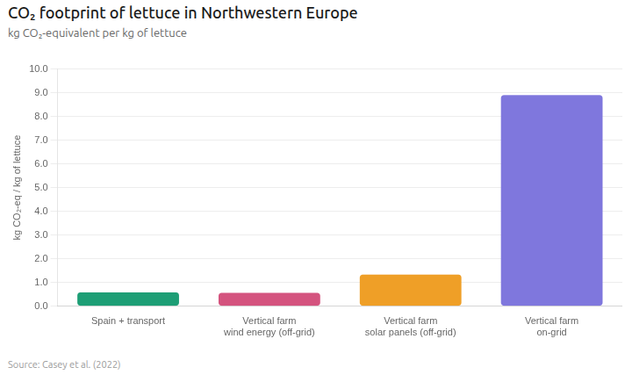
Several studies estimate CO₂-eq emissions for outdoor-grown lettuce in Spain at around 0.20 to 0.25 kg per kilo of product. Emissions arise from fertilizer production and application, plant protection products, and irrigation, among other factors. Combined cultivation and transport to the Netherlands therefore amount to roughly 0.45 kilo CO₂-eq per kilo of lettuce. Casey et al. (2022) report emissions of 0.68 kilo CO₂-eq up to the distribution center in the UK, which translates to approximately 0.58 kilo CO₂-eq for a Dutch distribution center. In this study, packaging is included.
For lettuce grown in a vertical farm using grid electricity, Casey et al., referring to the UK electricity mix of gas-fired generation, nuclear power, and renewable sources, calculated emissions up to 15 times higher: 8.9 kilograms of CO₂-eq per kilogram of lettuce. The study assumes electricity consumption of 15 kWh per kilo of product for lighting, climate control, and irrigation, with cultivation taking place at or near the point of consumption and therefore involving no transport emissions.
 © ID 245300940 © Hilda Weges | Dreamstime
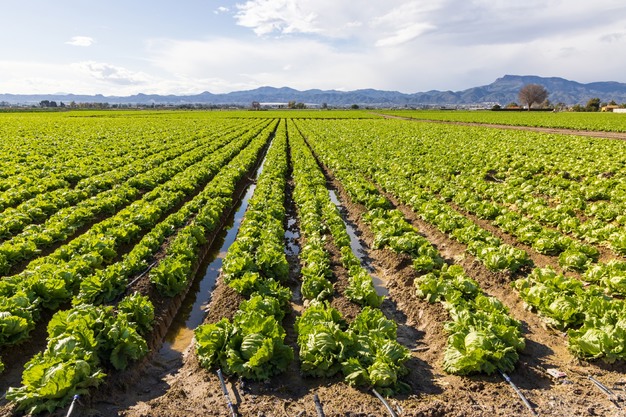
Field cultivation of iceberg lettuce in Murcia
Full-field cultivation, greenhouse, or vertical farm
A study by Blom et al. (2022) uses similar figures. It compares outdoor lettuce cultivation, greenhouse cultivation in soil, hydroponic cultivation in a greenhouse, and cultivation in a vertical farm, all within the Netherlands. The study includes the upstream and end-of-life phases of the farm life cycle, such as materials and transport associated with constructing an agricultural shed, greenhouse, or vertical farm. It also includes the upstream, core, downstream, and end-of-life stages of the crop life cycle, ranging from agricultural inputs to transport to the final destination. Packaging is not included.
Blom et al. quantified emissions during cultivation itself at 0.36 kg CO₂-eq per kilo of lettuce, slightly higher than the average figure of 0.25 kg CO₂-eq for Spanish cultivation. For the entire process, including the farm life cycle and distribution within the Netherlands, emissions amount to 0.49 kilo CO₂-eq. Full-ground greenhouse cultivation results in 1.21 kilo, hydroponic greenhouse cultivation in 1.45 kilo, and vertical farming, again assuming 15 kWh per kilo of product and grid electricity, in 8.18 kilo CO₂-eq per kilo of lettuce.
The order of magnitude is therefore similar in both studies: emissions from vertical farming are many times higher than those from outdoor-grown lettuce, regardless of whether cultivation takes place in the Netherlands or Spain.
Electricity consumption as the major challenge
In all cultivation methods examined, most emissions stem from agricultural inputs and fuel or electricity consumption during cultivation itself. For vertical farming, this means there is significant potential for improvement if renewable energy sources are used for lighting and climate control. Blom et al. evaluated vertical farming powered by solar panels and a ground source heat pump. Under this scenario, greenhouse cultivation in soil results in emissions of approximately 0.60 kg CO₂-eq per kilo of lettuce, hydroponic greenhouse cultivation in around 0.75 kg, and vertical farming in roughly 2.40 kg. This represents a major improvement. In this scenario, greenhouse cultivation approaches or matches the sustainability level of lettuce imported from Murcia, although vertical farming still lags behind.
Casey et al. also examined wind energy as an energy source in addition to solar power for vertical farming. The study reports emissions of 1.33 kilograms of CO₂-eq per kilogram of lettuce when energy is supplied through an 85 kWh battery charged by solar panels in an off-grid system. Despite differences between the figures reported by Casey et al. and Blom et al., the trend is clear: the energy source is a decisive factor. When wind energy is used for battery charging, Casey et al. report emissions as low as 0.56 kilograms of CO₂-eq per kilogram of lettuce.
 © image generated by Claude
These emissions, like those from greenhouse cultivation powered by renewable energy, are comparable to those associated with outdoor cultivation in Spain and transport to the Netherlands. Moreover, rapid advances in solar technology, combined with the circular reuse of end-of-life materials, are expected to further reduce these emissions over time toward the levels associated with wind-powered systems.
Increasingly cleaner energy mix
Several studies therefore suggest that lettuce from vertical farms currently has a larger carbon footprint than imported lettuce from Spain. However, if vertical farming systems make use of appropriate renewable energy sources, they could become competitive in terms of greenhouse gas emissions. In addition, not only due to climate concerns, but also because of geopolitical developments such as the wars in Ukraine and Iran, the electricity mix in European countries is steadily shifting toward a larger share of renewable energy sources. In the Netherlands, natural gas and coal together still accounted for 60% of electricity generation in 2022, the year referenced in the studies mentioned above, but this had fallen to 48% by 2024 in favor of wind and solar energy, according to figures from the Central Bureau of Statistics. The National Energy Dashboard states that by 2030, 70% of all electricity should be generated sustainably.
The energy source is not the only factor that matters. Energy efficiency also plays a role: the more efficient the lighting and climate control systems, and the higher the crop yield per m², the more sustainable the cultivation method becomes. At the same time, energy efficiency differs between locations. A vertical farm in a country with an extreme climate will consume more energy than a comparable facility in a temperate region.
A few additional advantages
Vertical farming offers another advantage in terms of carbon footprint: lower food waste. In outdoor cultivation, adverse weather conditions can damage crops. The carbon footprint of a head of lettuce that ultimately ends up as animal feed is still considerable. Because vertical farms are usually located close to consumers, there is also less need for cold storage, and lettuce arrives fresher and keeps longer, reducing waste in shops and households. This matters, as every head of lettuce discarded unused represents emissions generated for no purpose. Some studies, therefore, use the kilo actually consumed, rather than the kilo produced, as the unit of measurement.
There are further environmental benefits. Vertical farming eliminates the need for plant protection products, reducing chemical pollution of soil, water, and air. It also uses significantly less water than conventional outdoor cultivation. Casey et al. estimate water use at 1.6 liters per kilo of lettuce in vertical farming, compared with 58.2 liters for outdoor cultivation in Murcia.
Nevertheless, it is important to also consider water scarcity impact, a concept that goes beyond simple water volume measurements by accounting for the relative scarcity of water in the region where it is consumed. When this factor is included, the picture becomes more nuanced. Casey et al. calculated a water scarcity impact of 111 m³ for vertical farming powered by solar panels, 18 m³ when powered by wind energy, and 13 m³ for outdoor farming in Spain. Because most solar panels are manufactured in China, often in regions where water is relatively scarce, and because large quantities of ultrapure water are required to clean silicon wafers during production, solar-powered systems score relatively poorly on this index. The study notes that water scarcity impact calculations are not yet fully reliable, but the overall trend appears clear.
Finally, vertical farming requires significantly less land than conventional outdoor cultivation. If the freed-up land is reforested, this contributes to carbon sequestration, the process through which forests absorb and store atmospheric CO₂, thereby helping mitigate climate change. However, according to Blom et al. (2022), this effect is relatively limited: only 0.09 kg CO₂-eq per kilo of lettuce if the field previously used for lettuce cultivation is converted into forest.
We conclude as we began, by noting that vertical farming is currently suitable only for leafy vegetables, herbs, microgreens, and certain other crops that require limited space. Another limitation is profitability. Only crops that grow quickly, have a high market value, and require relatively little energy per kilogram of yield are currently suitable for this type of production.