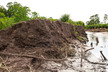
Fruit and vegetable producers in Western Australia's Gascoyne region are reporting losses above $25 million (US$16 million) following Tropical Cyclone Narelle. The category three system impacted Carnarvon, 890 kilometres north of Perth, a production area supplying domestic and export markets valued at almost $1.5 billion (US$960 million) annually.
Initial results from a grower impact survey indicate infrastructure damage and crop losses. Carnarvon Growers Association president Phil Frzop said the impact was "huge" and expects losses to increase.
"It's going to have a big impact across the board through employment, and some growers probably might not even be able to continue," Mr Frzop said.
Grower Tam Chinnery reported wind gusts of up to 133 km/h affecting citrus production. "A lot of the fruit just dropped on the ground, and we'd already lost a bit of fruit from the previous cyclone," she said.
"What didn't drop on the ground was just absolutely bruised, scratched [or] pummelled."
Some fruit was redirected to juice markets, but reduced quality affected returns. "No one wants to buy an orange that's got big bruises and scars all over it," she said.
"It's costing us a lot of money to send it down on the odd hope that someone's going to buy it and use it for juice."
Ground crops were also affected by wind damage, followed by flooding along the Gascoyne River. The event follows Cyclone Mitchell and a heatwave earlier in the year.
Government support includes grants of up to $5,000 (US$3,200). Mr Frzop said this level of support is limited. "If you have a look at Queensland and areas like that, when they flooded last year, they were given about $70,000 per farm," he said.
In Fiji, the Western Division recorded the highest number of applications under the TC Vaianu Farm Support Initiative following Tropical Cyclone Vaianu. The Ministry of Agriculture, Waterways, and Sugar Industry received 638 applications, with 559 from the Western Division.
Ba recorded 357 applications, followed by Nadroga/Navosa with 133 and Ra with 69. Additional applications included 56 from Kadavu in the Eastern Division and 23 from Naitasiri in the Central Division.
Applications were submitted by farmers producing cassava, eggplant, yaqona, banana, papaya, and longbean. Cassava recorded 209 cases of losses, followed by eggplant with 92, yaqona with 54, banana with 36, papaya with 31, and longbean with 31.
The Ministry confirmed that field verification will begin immediately and is expected to be completed within one and a half weeks, with support to follow. Officials will contact farmers directly to verify application details.