Air freight rates increased in March against the backdrop of the ongoing Middle East conflict, higher fuel prices linked to the closure of the Strait of Hormuz, and logistical disruption in the Gulf.
Following the start of U.S. and Israeli military action in Iran at the end of February, the resulting regional disruption led to airspace closures and flight cancellations across the Gulf.
The effective closure of the Strait of Hormuz, a key transit route for about 20 per cent of global oil supply, pushed the price of Brent crude from about US$72 per barrel before the outbreak of the war to about US$118 per barrel by the end of March. Jet fuel prices increased further. On April 8, prices for jet fuel, kerosene-based, FOB U.S. Gulf Coast, stood at US$4.19 per gallon, slightly below the March peak of US$4.45 per gallon, but still up 126 per cent quarter-on-quarter and 117 per cent year-on-year.
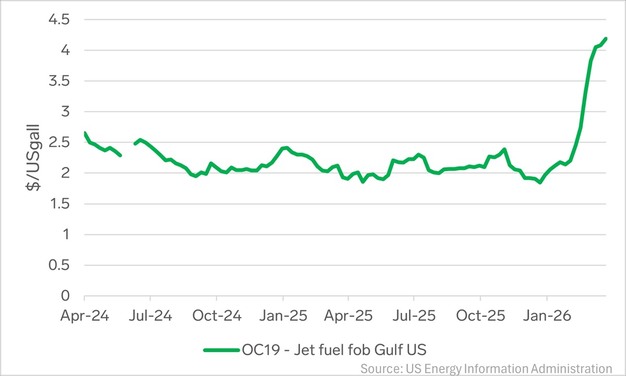 © U.S. EIA
As a result, air freight rates rose during March. As of April 8, the Air Freight Baltic Index stood at 2,519, up 25.2 per cent month-on-month and 15.8 per cent year-on-year.
DHL reported that global air cargo capacity fell by 22 per cent on March 1 due to Gulf airspace closures, with Asia–Middle East capacity down by 50 per cent. The company noted that rerouting and backlogs were affecting scheduling. U.S.–Middle East air freight remains volatile as network disruptions continue. Market sources indicate a gradual recovery in capacity and expect air freight rates to ease, although the pace remains slow.
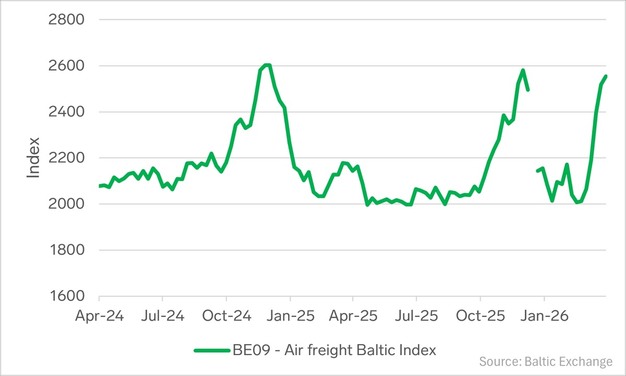 © Baltic Exchange
Air freight remains a key component of Gulf food supply chains. Air Cargo Week states that the region "remains heavily reliant on imported food, with a significant share of perishable and premium goods transported by air. Fresh produce, dairy, seafood, and specialized items depend on short transit times and controlled handling, making airfreight indispensable."
In March, Reuters reported that shipments of fresh produce were left in limbo on aircraft due to the impact of the disruption on air cargo capacity and rates. Drewry indicates that further pressure on air freight rates could arise from shifts of strategic commodities such as fertiliser to air transport.
Source: Mintec/Expana