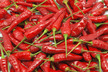
Quang Ngai is one of Vietnam's largest chili-producing regions, with more than 1,000 hectares under cultivation. Currently, around 765 hectares have entered early harvest, with average yields exceeding 82 quintals per hectare.
At the same time last year, chili prices ranged around VND50,000/kg (US$2.00), at times exceeding VND70,000/kg (US$2.80). This season opened at about VND14,000/kg (US$0.56) and has since declined to VND5,000 to VND7,000/kg (US$0.20 to US$0.28).
According to growers and traders, the market remains heavily dependent on exports to China. This year, demand from that market has declined, while transport costs have increased. Container movements have been reduced, limiting exports and leading to oversupply in the domestic market.
In An Phu commune, grower Nguyen Thi Hien said falling prices have affected returns. Her family planted about 5,000m² of chili. Production conditions were favourable, with strong plant development and fruit quality. However, low prices have impacted profitability. "This price is not enough to compensate for seed money and fertilizer money. My family also does not dare to hire people to harvest because we cannot afford the labor costs," she said.
Other growers report similar conditions. Prices that previously reached VND50,000 to VND80,000/kg (US$2.00 to US$3.20) are now around VND5,000/kg (US$0.20). Producers face a situation where harvesting does not cover costs, while leaving fruit unharvested leads to losses.
A representative of a chili export purchasing and packing facility in An Phu commune said demand has been weak since the start of the season. Daily procurement continues at more than 10 tons, but prices remain below previous levels due to higher transport costs and slower export movement.
Large-scale growers are also affected. Nguyen Duy Phuoc in Binh Son commune said daily harvest volumes reach nearly 2.5 tons, sold at about VND5,000/kg (US$0.20). "Income has decreased sharply, not enough to cover investment costs, fertilizer, and care labor," he said.
Along Truong Sa road, on the south bank of the Tra Khuc River, farmers are drying chili peppers over a stretch of nearly 2 km. This area passes through An Phu commune, a key production zone. As prices decline, more products are being dried in an effort to store supply and sell later if market conditions improve.
Source: Lao Dong