The 11% tariff on Brazilian grape exports to Europe will be eliminated from May 1, when the provisional agreement between Mercosur and the European Union takes effect. With the Brazilian government confirming the entry into force, grapes are among the products set to benefit from tariff reductions.
The Mercosur-European Union agreement, ratified by South American lawmakers, has supported expectations in the sector regarding tariff adjustments. A survey by Abrafrutas, the Brazilian Association of Fruit Producers and Exporters and Derivatives, estimates reductions of 4% to 14% across Brazilian products. Grapes will receive immediate tariff exemption once the agreement is implemented.
Guilherme Coelho, president of Abrafrutas, said grapes are leading a broader trend of tariff reductions for fruit exports. "This reduction guarantees strategic predictability for producers, in addition to increasing Brazil's competitiveness relative to other countries that already have zero or reduced tariffs on sales of the same fruits exported by Brazil," he said.
The tariff exemption is expected to affect Brazil's position relative to exporters such as Peru, Chile, and South Africa, which already supply fruit to the European Union under reduced or zero tariffs.
 © DataLiner
Brazil has also expanded access to Asian markets, including shipments of grapes to China. Paula Soares, agribusiness coordinator at ApexBrasil, said diversification of export destinations remains a focus. "We have been studying the best ways to open new markets for several years. We opened the grape market in China, the citrus market in India, and we continue with special missions for that purpose. These are markets where we already operate, but we are seeking new destinations, regardless of the shifts caused by the tariff hike," she said.
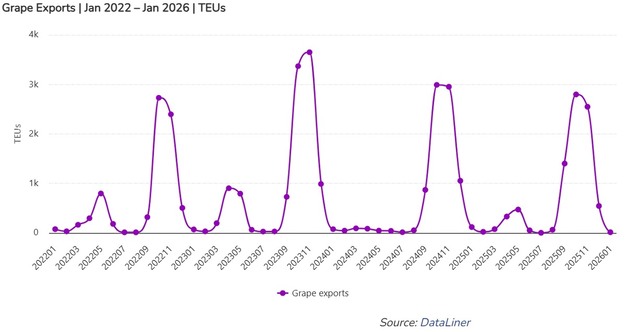
Datamar data shows that Brazilian grape exports follow a cyclical pattern, with peak shipments typically starting in September. In January 2026, shipments totaled 16 TEUs, representing an 86.7% year-on-year decline compared to January 2025.
In the broader fruit sector, Brazilian exports reached a record in 2025, totaling US$1.45 billion, up 12% in value and 19.6% in volume compared to 2024. Exports to Europe of mangoes, melons, limes, watermelons, grapes, and papayas increased by 12.8% in value and 19.1% in volume. Overall shipments to Europe rose by 6.2% in value and 3.4% in volume.
These six fruit categories generated US$967 million in 2025, compared to US$857.6 million in 2024. Brazil exported 949,000 tons of fruit to Europe, up from 796,600 tons a year earlier.
ApexBrasil projects fruit farming revenue to increase by 40% to US$1.8 billion by 2029. In 2025, Brazil exported 1.2 million tons of fresh fruit, generating approximately US$1.3 billion in revenue.
Source: CNN Brasil / DatamarNews