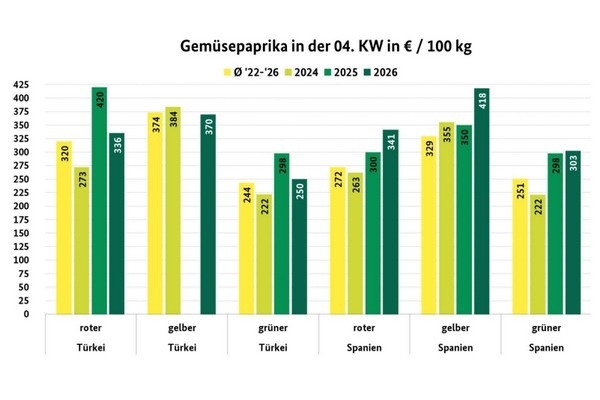
Spanish pepper deliveries apparently predominated. Although their presence had expanded slightly overall, their availability was relatively limited according to the German BLE. The high prices of the previous week thus remained unchanged or even rose slightly. Demand was therefore rather limited. As a result, the prices of red and green Spanish peppers fell in some cases. The presence of yellow peppers remained limited for the most part, so the fixed prices remained in place.
 © BLE
© BLE
In Munich, due to the increased entry requirements, no further orders for yellow loads were placed after Thursday. Turkish imports were generally handled in a relatively uneventful manner. Interest in them was quite favorable, as the products were also noticeably cheaper than their Spanish competitors. Deliveries from Italy, Morocco, and Belgium played a supplementary role at most but could usually be accommodated without difficulty.
Click here for the full market and price report.
Apples
Domestic supplies dominated the market: Elstar, Jonagold, Boskoop, and Braeburn continued to be the main varieties available. Tenroy, Pinova, and Topaz followed in terms of importance but played only a minor role overall.
Pears
As is quite common at this time of year, interest was very limited. Italian and Turkish fruit could mostly be sold without difficulty, but distributors were unable to push through price increases.
Table grapes
The range consisted mainly of imports from Peru, Namibia, and South Africa. In general, the winter weather slowed down demand, limiting storage options.
Oranges
In the case of Spanish oranges, the dominant Navelina variety was now increasingly flanked by Navel. Turkish Washington Navel oranges were now arriving in 10 kg plastic crates in addition to the usual 15 kg packages.
Small citrus fruits
Mandarins now dominate the market, with Spanish offerings apparently expanding their presence. Deliveries from Turkey and Morocco also intensified.
Lemons
Spanish Primofiori dominated the market. There were occasional price increases due to slightly limited availability.
Bananas
Demand was not particularly strong and could be met without difficulty. Traders occasionally lowered their prices to speed up turnover.
Cauliflower
Italian loads dominated, with French and Spanish loads supplementing the market. Availability was sufficient to meet demand.
Lettuce
The presence of Spanish iceberg lettuce was slightly reduced. Nevertheless, demand was generally met. As the quality was not always entirely convincing, a wide price range established itself in some places.
Cucumbers
The high prices of recent weeks inevitably affected the customer buying mood: demand was rather limited, but it was easily met.
Tomatoes
Many countries were involved in marketing, particularly Spain, Belgium, and the Netherlands, followed by Turkey, Morocco, and Italy in terms of importance.
Source: BLE