Researchers are evaluating how postharvest storage conditions affect fruit quality in ANABP 01 apples, marketed domestically as Bravo and internationally as Soluna™, with a focus on maintaining quality during medium- and long-term storage.
ANABP 01 apples are characterised by red skin colour and firm texture, but not all fruit lines are suitable for extended storage. Storage performance depends largely on harvest maturity and internal quality. Fruit harvested at an appropriate maturity stage is better able to tolerate controlled atmosphere (CA) and dynamic controlled atmosphere (DCA) conditions without developing storage disorders.
 © APAL
Agriculture Victoria Research conducted trials at the Tatura SmartFarm to assess the effects of CA and DCA storage on ANABP 01 apples. The study compared standard cold storage, CA, and DCA to determine how each system influenced weight loss, firmness, and external appearance following extended storage.
Apples continue to respire after harvest, which leads to moisture loss and softening over time. Cold storage slows this process through temperature control, while CA and DCA further reduce respiration by adjusting oxygen and carbon dioxide levels. In CA, gas concentrations are kept constant, while DCA adjusts oxygen levels dynamically based on physiological signals from the fruit, allowing oxygen to be maintained near the minimum tolerance level.
 © APAL
The trial stored fruit for five months at 1°C under three conditions: air (control), CA with fixed low oxygen levels, and DCA with continuously adjusted ultra-low oxygen levels. Fruit was harvested at commercial maturity based on skin colour, firmness, and internal quality, then pre-cooled to 4°C before transfer to storage chambers. Carbon dioxide levels were maintained at 2 to 3 per cent, which previous observations showed to be tolerated by ANABP 01. The researchers noted that other cultivars may respond differently and require adjusted protocols.
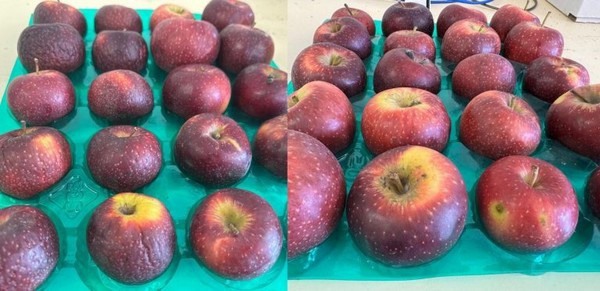
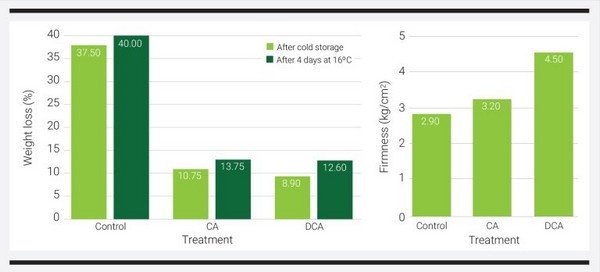
At packout, apples stored in air showed visible shrivelling and high weight loss. Fruit stored in CA and DCA retained smoother skin and firmer texture. Measured weight loss after storage was 37.5 per cent for control fruit, 10.75 per cent for CA, and 8.9 per cent for DCA. After four days at 16°C, total weight loss increased to 40 per cent for control fruit, 13.75 per cent for CA, and 12.6 per cent for DCA.
 © APAL
Firmness measurements followed a similar pattern. After shelf-life simulation, DCA-stored apples averaged 4.5 kg/cm², compared with 3.2 kg/cm² for CA fruit and 2.9 kg/cm² for control fruit.
The results indicate that DCA, and to a lesser extent CA, can reduce moisture loss and maintain firmness in ANABP 01 apples when applied to fruit harvested at suitable maturity. Researchers emphasised that CA and DCA settings are cultivar-specific and require careful monitoring, as responses may vary between varieties and production blocks.
 © APALFor more information:
APAL
Tel: +61 3 9329 3511
Email: [email protected]
www.apal.org.au