After a challenging first half of the season, the pear market appears to have found its way back up. "The lesser lots have largely disappeared from the market by now. Sales have clearly picked up, and there is currently strong demand from all corners of the market," says Christophe Van Haelst of VHM Fruit Trade.
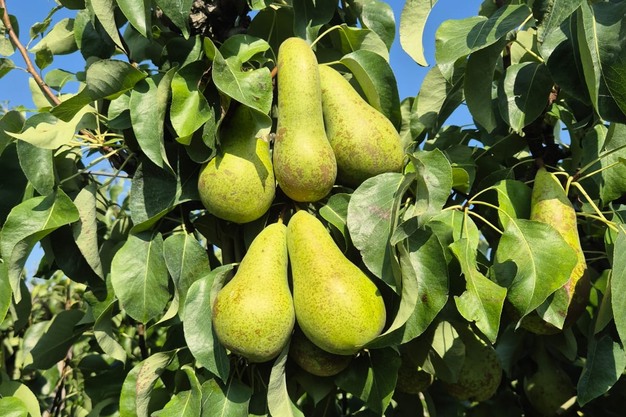
"Lukassen and Doyenné de Comice are selling very well. Those stocks are now really running down, even faster than expected. We thought Lucas would put pressure on the market well into March, but that has not been the case. Probably many pears were already shipped to Poland and Eastern Europe immediately after picking, which kept market pressure lower," continues the grower and trader from Verrebroek.
 © VHM Fruit Trade
"Conference is also moving remarkably fast. Stocks are turning over, culling is good, and demand is strong. Still, it remains a matter of caution. Outages are higher than in other years, which means the total volume coming out of storage is lower than normal. That remains a point of attention. This is partly due to the picking time, but also to the drought. Although most growers can irrigate, this is not comparable to natural precipitation. As a result, you see differences between plots and growers."
Belgians inclined to cull a little earlier
At Christophe's operation, the pears seem to be holding up well in storage. "For us, quality is holding up well for the time being, although of course everyone is dealing with some additional fallout. In the end, we are all in the same boat." Whether culling the lesser lots will also have a positive effect on prices remains uncertain. "I do think that in terms of price, we have more or less reached the ceiling. What will happen in April and May is very difficult to predict. That will depend largely on how much volume is still available. In Belgium, culling is already quite extensive, and this is also the case in the Netherlands, especially in Zeeuws-Vlaanderen. In the centre and north of the country, however, there is still quite a lot of product."

"So it remains a matter of wait and see. Much will depend on whether growers are satisfied with the current price or decide instead to slow down. Only in early or mid-April will it become clear whether there is still room for further increases. In Belgium, growers tend to cull a little earlier, mainly because of quality considerations. People prefer to play it safe, as drop-out rates in April, May, and June can rise considerably. In that case, it is often wiser to secure your yield earlier. On the positive side, we are now achieving the picking price, including storage. The full storage fee, however, has not yet been recovered, and it remains uncertain whether this will be possible in April or May. That remains a case study."
China's growth market
With its Deliscala brand, China has also proven to be a growth market for VHM Fruit Trade in recent years, alongside European destinations. "Exports to China are running well again this year. The only point of concern is the long transport time, so because of the lower shelf life, we have slightly reduced volumes to limit risks. Demand is definitely there, but we are not serving it fully because of the quality risk."

"We only sell top quality there. That is the reputation you have built up and must protect. In principle, of course, we try to sell good pears within Europe as well, but pears from heavier, better soils that are certified for China are destined exclusively for that market. When there is any doubt about quality and the long transit time, we do not take the risk. If conditions cooperate and shelf life improves, we definitely see opportunities to further expand sales to China. In any case, the demand is there."
VHM Fruit Trade will also be present at the upcoming Fruit Logistica; Hall 27, Stand A-40
For more information:
Christophe Van Haelst
Van Haelst Fruit / VHM Fruit Trade
Kieldrechtsebaan 85
BE-9130 Verrebroek, Belgium
Tel: +32 (0) 3 336 16 47
[email protected]
www.vanhaelstfruit.be