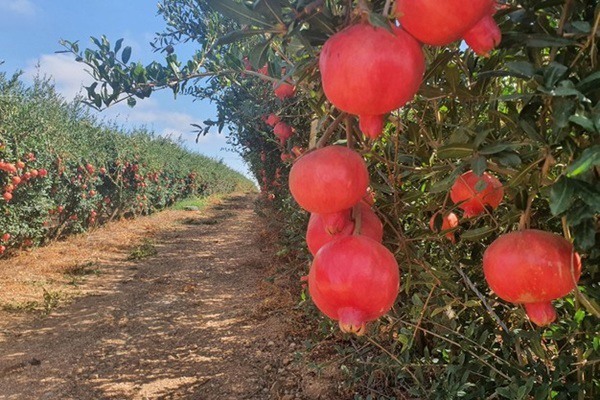
Bright prospects for South African pomegranates are expected in 2026; exports have been improving and as recently established orchards come into full production, a further strong rise in export volumes is expected over the next five years' time.
"Recent developments in Türkiye and Italy have contributed to a positive outlook for South African exporters. Türkiye has experienced a poor harvest this season, which means Turkish pomegranates will exit the market earlier than usual. Similarly, Italy's harvest did not meet expectations, resulting in reduced availability of their produce. South Africa could therefore be in a good position to start packing into a relatively empty market," says Kai-Uwe Molzahn, chairperson of pomegranate industry organization POMASA.
Given these circumstances, he says, Turkish pomegranates are expected to sell out faster, leaving a gap in the market. This situation presents South Africa with an advantageous opportunity to commence packing and exporting into what is anticipated to be a relatively empty market.
"Although it's early in the season, all regions have shown good flowering and fruit set. All indications are that the harvest should be an improvement on the 2024/25 harvest."
A lot also depends on how Peru is going to produce, he observes. "Their production in the early areas is on the rise and starting to put pressure on our early markets."
 © POMASA
Drastic increase in exports to EU & UK
Kai-Uwe Molzahn reports that the 2025 season marked a significant improvement over the previous year for South African pomegranates. "Both production and revenue increased notably, reflecting the sector's positive momentum. The total crop reached nearly 18,500 tons, demonstrating robust growth in output. Export figures also showed a substantial rise. Out of the total harvest, 11,200 tonnes were exported, representing a 23% increase compared to the 2024 season."
The growth in exports is, he says, impressive. "It underscores the strengthening position of South African pomegranates in international markets and highlights the favorable conditions experienced throughout the season.
Exports to the Middle East, which has traditionally been the primary destination for South African pomegranates, experienced a decrease during the past season of 10% by volume.
"This reduction indicates a shift in market dynamics. While exports to the Middle East saw a decline in market share, South African pomegranates experienced significant growth in other regions. Exports to the European Union increased substantially, capturing 30% of South Africa's total export volume for the season."
Molzahn continues: "The United Kingdom also emerged as a key market, accounting for 27% of total exports. Additionally, the African market showed positive momentum, with its share rising to 7% of total exports."
He remarks that the industry's diversification in export destinations reflects an expanding global demand for South African pomegranates.
"There is a strong demand for South African pomegranates in our current markets and client base. We are currently not entering into new markets, but we are actively busy evaluating new opportunities and markets."
 For more information:
Kai-Uwe Molzahn
POMASA
Tel: +27 71 499 2470
Email: [email protected]
https://www.sapomegranate.co.za/