Four small producer cooperatives, Coobafrio, Asobanarcoop, Emprebancoop, and Coomulbanano, in the Zona Bananera municipality of the Magdalena department, have developed a production model that, despite sector challenges, remains active in European markets and seeks more recognition for bananas grown by peasant families. These organizations currently unite roughly 600 small producers, who manage about 1,800 hectares and supply around 400 containers annually.
The cooperatives emphasize their product's traditional, low-impact farming, noting they haven't used herbicides or insecticides for 15 years. Instead, they use biols, bio-compost, and micro-organisms to boost soil fertility. "Our bananas are fresh, healthy, and ready to eat."
 © Diana Sajami | FreshPlaza.com
This production model is closely tied to the rural family structure. "Each plot is a family unit: parents, grandparents, children, and grandchildren rely on it," they point out, highlighting that the consumption of Colombian bananas supports the growth of their family and community.
These cooperatives also have a history shaped by social and economic challenges. About thirty years ago, many of them emerged after local marketing companies disappeared, prompting producers to unite to maintain exports. "We had to organize ourselves so as not to be left without selling our fruit," recalls one representative.
The impact of the armed conflict also played a role. "We were affected by the conflict, and now we are recovering our land," they said. 'Reaching an optimal standard of living in 15 years is difficult, but we are working on reconstruction.'
While productivity has increased, with yields rising from 33-35 boxes per hectare per week to 43-44 in 2025, significant challenges remain. "Maintaining certifications is costly, and there are too many; they should be standardized," they complain. Additionally, production costs have increased due to higher input prices and fragile rural infrastructure—roads are subpar, and harvesting small quantities on each farm damages the fruit and raises costs.
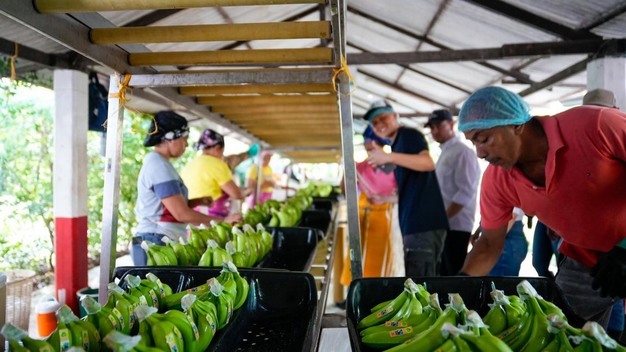 © Asocoomag
They mainly supply Europe with conventional Cavendish bananas, with smaller amounts of organic and Fairtrade bananas.
The cooperatives appeal: "Consuming Colombian bananas supports us and transforms generations through cultivation, education, and roads." They also seek improved institutional coordination: "We ask that the actual production cost of small producers be considered when setting the price of the box."
They are also developing their own brand, Foncho Bananas, which is still in the consolidation phase. Their final message is clear: "We want the world to visit us and learn about our production processes," they concluded.
For more information:
Asociación de Cooperativas de Magdalena
Asocoomag
Colombia
Email: [email protected]
https://asocoomag.com.co/