Auctions for the STS-10 terminal at the Port of Santos and the Port of São Sebastião are scheduled for the first half of 2026. The concessions are intended to ease capacity constraints in Brazilian port logistics, particularly in the Southeast region, which accounts for around half of national economic output.
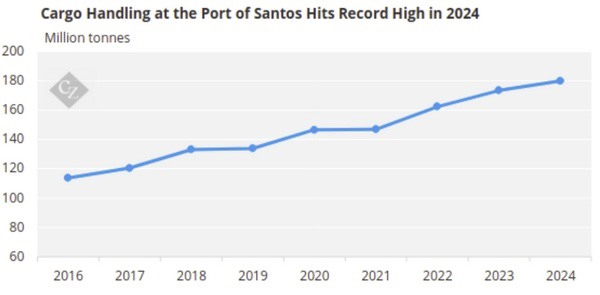
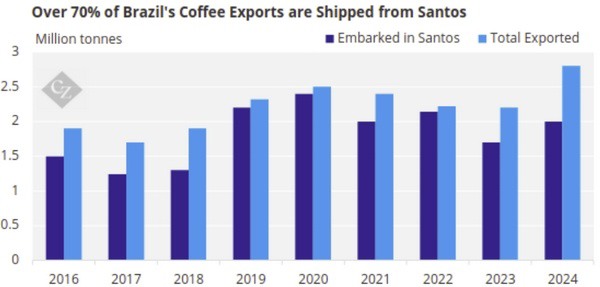
The Port of Santos, the largest port complex in Latin America, is approaching operational limits. In 2024, it handled 180 million tons of cargo, a 34% increase compared with 2019, bringing throughput close to maximum capacity. A large share of Brazil's fruit exports currently moves through Santos due to limited alternative ports, including citrus products.
 © Prt of Santos
Under the STS-10 project, planned investments of BRL 6.4 billion, equivalent to about US$1.2 billion, include the construction of a 1.3-kilometre quay, additional berths, and the modernisation of 622,000 square metres. According to the Brazilian government, these upgrades are expected to raise container handling capacity by 50%, reaching around 10 million units per year. Santos terminals are responsible for close to 40% of Brazil's total cargo handling, and without expansion, capacity constraints are expected to intensify.
Operational congestion has already affected exporters. At the beginning of the year, nearly 60% of vessels calling at Santos experienced schedule changes, resulting in additional storage costs and penalties. By September, this share had increased to 75%.
 © Prt of Santos
The port of São Sebastião, located approximately 140 kilometres from Santos, is expected to take on part of the containerised fruit flows. The planned concession includes investments of BRL 2.5 billion, or around US$470 million, covering the construction of container berths and the modernisation of 426,000 square metres. The terminal is expected to serve as an alternative outlet for fruit exports such as oranges, which are currently transported by truck to Santos for shipment.
"Due to its proximity to agricultural centres, the port is set to start handling significantly more food, especially cargo transported in containers," says Casemiro Carvalho, partner at consulting firm 4Infra and logistics director at the Federation of Industries of the State of São Paulo.
 © Prt of Santos
Fruit shipments that rely on road transport are expected to benefit most from São Sebastião's development. The port does not have a rail connection, and no rail projects are planned. However, a dedicated access road, scheduled to open in March next year, will allow trucks to reach the terminal without passing through the city of São Sebastião.
Uncertainty remains around the auction structure. The bidding model for STS-10 has not yet been finalised, and proposed rules from port regulator Antaq have faced criticism for restricting participation by operators already active in Santos. "The intention is to hold the STS-10 auction first and then grant the concession for the port of São Sebastião," says Frederico Bussinger, partner at Katalysis and former president of the port of São Sebastião. Potential bidders are expected to assess opportunities once the auction framework is defined.
Source: CZ App