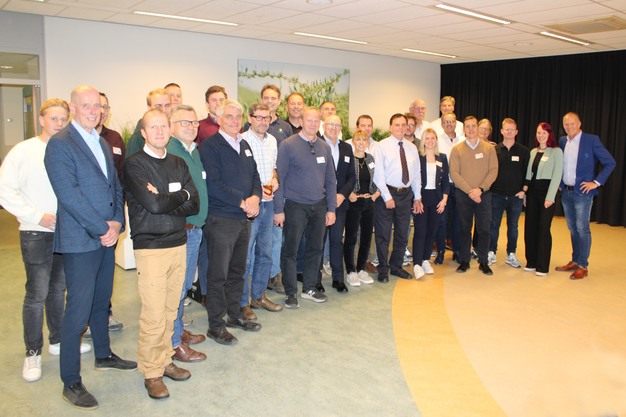
Representatives of major onion growers from across Europe and beyond gathered yesterday at seed company Bejo in Warmenhuizen for the annual European onion congress, Euronion. In addition to European countries, this edition also welcomed representatives from the United States and South America for the first time.
 © Jannes Goedbloed | FreshPlaza.com
Click here for the photo report
Although there are major differences by region, country, and continent, the overall message in the presentations was that last year was a strong year for onion cultivation worldwide. In Europe, despite a decline in acreage, a record-sized onion harvest was achieved, while North and South America also reported large yields.
However, there are also concerns. The rise of diseases and pests such as stemphylium, fusarium, and thrips is particularly worrying for attendees. This challenge is compounded by the loss of crop protection products due to increasingly strict regulations.
The Netherlands set to break export record
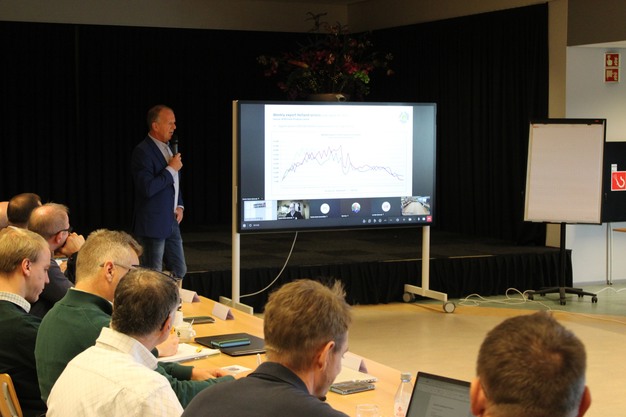
William Nannes of J.P. Beemsterboer spoke on behalf of the Netherlands. He reported that the country achieved a record number of hectares and yield this season. According to the presented figures, approximately 1.7 million tons were produced, and the total available export volume is around 1.45 million tons. So far, about 448,000 tons have been exported; if the trend continues, the 2024/25 season could result in an export record, according to William.
 © Jannes Goedbloed | FreshPlaza.com
He also noted that during periods of lower demand, a surplus can quickly develop, putting pressure on prices. However, the increase in exports to West African countries such as Senegal and the Ivory Coast helps prevent a steep price drop. For growers, there are still uncertainties about price developments from January onwards.
Elsewhere in Europe, and even globally, favorable growing conditions led to higher yields. It was the first time representatives from North and South America attended this European onion congress. Euronion Chairman David O'Connor joked that this edition might need to be renamed "Worldonion." While all attendees reported high yields, there were still significant differences among them.
Differences in climate, irrigation, and acreage development
- The Netherlands: Record acreage and yield (+17% yield per hectare mentioned), good start to the season, but later drought stress and regional differences due to irrigation options (large parts of Zeeland cannot be irrigated because of salty surface water).
- Sweden: After a cold spring, a good growing season followed. Acreage increased by 4–5%, and further growth is expected next year. Yield per hectare was comparable to other years. There are growing concerns about the increase in downy mildew, mainly because only one effective product (Zorvec) is allowed in Sweden. Research on PFAS in crop protection follows Danish regulations.
- Denmark: Heavy rainfall caused a localized increase in disease pressure from stemphylium and fusarium. Moreover, due to strict regulations, there are hardly any products left. The PFAS ban makes control even more difficult. Cultivation is almost entirely for the domestic market, and there is hardly any export. About 20% of cultivation is organic.
- The United Kingdom: Extreme drought this year caused irrigation issues and quality damage, especially as potato cultivation competed for available water during droughts. Fusarium in storage is also on the rise. There are also problems with thrips and weeds. Crop protection products are available, but more and more weeds are becoming resistant.
- Poland: Acreage reduced from 25,000 to 22,000 hectares. Many growers have stopped cultivating onions due to low prices and disappointing harvests in previous years. The import of Dutch onions continues to increase.
- Germany: Large regional differences: good yields in the north, more rain and thus more fusarium, mildew, and bacterial rot in the south. The total area increased to 892,000 hectares. There is also the new threat of the reed glasswing cicada, which can transmit bacteria and other infections. The exact role of the cicadas is still being investigated.
- France: Despite drought, yields are favorable, particularly due to irrigation, although the exact figures are still missing. There are significant differences in quality due to fusarium and bacterial infections. Imports from the Netherlands and Belgium are increasing, while exports remain stable.
- Italy: Large regional differences in yield. Especially in the Piedmont region, there is a sharp decline due to heavy rainfall and soil infections. The total yield is estimated at around 390,000 tons, but exact figures are still missing.
- Spain: Wet conditions during sowing caused issues with mildew. Later in the season, there were problems due to drought and extreme heat. This was the hottest year in Spain so far. The yield is 12.5% lower than last year. Due to weather conditions, Spanish onion cultivation is shifting north in the country.
- The United States: Due to a good harvest, there was an oversupply and therefore low prices until February. Stemphylium and fusarium caused local issues, and there is ongoing research into the effects of extreme rainfall.
- South America: In South America, Brazil is the largest producer, and Peru and Argentina are the main exporters. Argentina mainly exports to Brazil, while Peru exports to the US and Europe. Climate change results in large yield differences due to extreme rain or drought. Fusarium, bacterial rot, and resistance to herbicides are increasing.
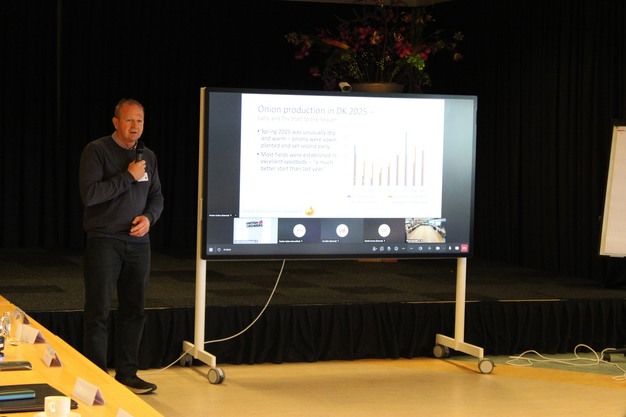
An important theme for all countries represented at Euronion was the increase in fusarium, mildew, and bacterial rot, both in the field and during storage. Attendees described issues with late fusarium development in storage and higher infection rates after rainy periods. "When I started years ago, fusarium was not a big problem," said Jens Kjeldahl (Brdr. Kjeldahl, Denmark). "Now it's worse every year. Why is that?" he asked aloud.
 © Jannes Goedbloed | FreshPlaza.com
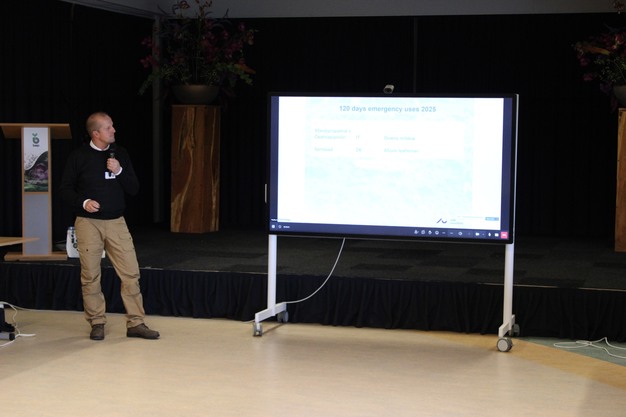
Parallel to this is the loss of many crop protection products. Peter Hartvig of Aarhus University in Denmark gave his annual update on pesticide registrations, as he has done for ten years now. His message was clear: the range of products available to onion growers is getting smaller every year, and there are hardly any genuinely new substances coming onto the market. His presentation featured many red dots, each symbolizing a product that has disappeared or will disappear soon.
The Danish PFAS policy
Many existing products are disappearing due to stricter toxicological requirements or environmental regulations, but the most impactful development comes from Denmark's PFAS policy. PFAS are chemical compounds used in some crop protection products for their stability and water-repelling properties. These same characteristics make them highly persistent in the environment: they barely break down and accumulate in soil, water, and organisms.
 © Jannes Goedbloed | FreshPlaza.com
Denmark, often the first EU country to implement strict environmental policies, has banned PFAS-containing products. Research showed that 'long-chain' PFAS (such as those used in pesticides) can break down into 'short-chain' PFAS, which are subsequently found in ground and surface water. This undermined the argument that pesticides do not contribute to pollution.
According to Hartvig, this research was decisive for stricter policies. However, he questioned how effective this measure would be in reducing PFAS levels in groundwater. "It seems easier to ban PFAS in crop protection products than in pans or firefighting foam, but the effect on agriculture will be much greater," he warned.
Forerunner for the rest of the EU
The Danish ban currently applies to dozens of products and could be a sign of what the rest of the EU may soon face. For onion cultivation, where growers are already struggling with limited control options against diseases such as mildew, thrips, and fusarium, this could have serious consequences.
In Denmark, many of these products may be used for the last time in 2026, while no alternatives are available yet. "There are biological products on the market, but we don't yet know if they are sufficiently effective in practice," said Hartvig.
 © Jannes Goedbloed | FreshPlaza.com
The question from the audience, posed by Euronion Chairman David O'Connor, was also pressing: what can we do against fusarium and mildew in the future? Peter's answer: the solution may lie in resistant varieties and integrated control strategies, but that requires years of research and additional investments.
Innovation: Spot-spray, sorting technology, and AI
On a technological level, innovation emerged as an important tool for improving efficiency and sustainability. Trends mentioned were spot-spray systems, more advanced sorting machines, and the use of AI for detecting abnormalities in onions.
The congress also discussed research projects on fusarium (UIREKA, FUSED) with contributions from the United Kingdom, the Netherlands, and the US. These initiatives highlight the need for international collaboration in research and knowledge sharing, a point that Chairman David O'Connor especially emphasized: the sector cannot continue without additional financial support for research and collective measures.
Opportunities and compelling challenges
Euronion 2025 showed that the European onion sector currently benefits from high yields, but at the same time faces significant challenges: increasing disease pressure, decreasing availability of effective products, and climate-related uncertainties.
Innovations in varieties, machinery, and digital detection offer promise, but according to attendees, the sector needs greater investment in research and alternative control strategies to sustain its current growth.