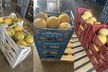
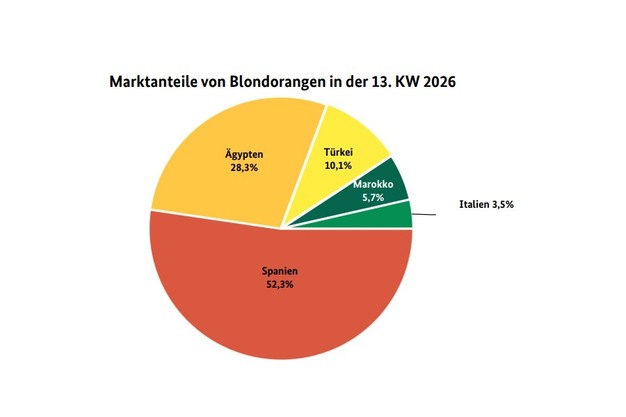
The season was drawing to a close. Availability was declining, and customer demand had also noticeably weakened. Meanwhile, customers were increasingly focusing on other types of produce. Spanish oranges, specifically Navelate and Lane Late, clearly dominated the market, with Egyptian imports—mostly Valencia Late—following in terms of importance. Moroccan and Turkish offerings supplemented the selection but disappeared from the assortment at certain points during the week. Among blood oranges, Italian Moro and Tarocco were the focus of marketing, with Spanish Sanguinelli rounding out the selection. According to the German BLE, prices remained largely at the previous week's level overall. However, volume-driven price increases as well as discounts due to declining quality were also noted.
 © BLE
© BLE
Click here for the full market and price report.
Apples
The assortment continued to be dominated by domestic fruit. In addition, mainly Italian offerings were available. Shipments from France, the Netherlands, Belgium, Austria, and Poland were limited to a supplementary role. Overall, supply had expanded.
Pears
South African Williams Christ, Cheeky, and Rosemarie formed the basis of the assortment. In addition, primarily Italian Abate Fetel, Dutch Xenia, and Turkish Santa Maria were available. Belgium and Germany were involved in the market with only small quantities.
Table grapes
Imports from South Africa clearly dominated, flanked by shipments from Namibia, Peru, and Chile. Indian shipments of Thompson Seedless were sent directly to food retailers. Overall availability was limited.
Small citrus
The season ended uneventfully. Spanish shipments dominated over Israeli ones. Supplies from Morocco, Turkey, and Egypt played only a minor role. Customers had increasingly turned to other product categories, so demand remained quite limited.
Lemons
Spanish Primofiori clearly dominated the market and were available in some cases almost exclusively. Locally, they were accompanied by Turkish and Italian loads. Business was quiet and uneventful. Prices remained mostly stable.
Bananas
Trading was generally quite subdued across the board. In Munich and Berlin, storage capacity had improved, though this did not affect prices. In Frankfurt, prices firmed up slightly. In Hamburg, the effects of the conflict in the Middle East and heavy rainfall in some growing regions were felt.
Cauliflower
Italian and French shipments dominated, but their overall availability had decreased. The reduced shipments, combined with higher purchase prices, led to noticeable price increases in some markets.
Lettuce
Iceberg lettuce came exclusively from Spain. Its quality was inconsistent in Frankfurt, which is why a wide price range established itself there. In Hamburg and Munich, supply was limited, leading to price increases. Berlin reported stable prices.
Cucumbers
The assortment of cucumbers consisted mainly of Dutch, Belgian, and domestic products. Their availability had increased slightly. In contrast, Spanish products played only a minor role, with their supply apparently limited.
Tomatoes
Supply was dominated by Spanish loads. However, their presence had declined, as had that of Dutch and Belgian loads. Moroccan and Turkish produce did not consistently meet quality standards. Domestic and Egyptian loads supplemented the market.
Bell peppers
Spanish loads dominated, followed by Turkish ones in terms of importance. Belgian and Dutch loads gained relevance but played only a supplementary role overall. Demand could not be fully met. Prices climbed, in some cases quite sharply.
Source: BLE