 © SAPPAIn their conversations with other visitors at the recent Gulfood 2026, the emergence of pecan nuts on the global menu was evident, says RP Campher, agricultural economist at the South African Pecan Nut Producers Association, and more markets are looking for it. At the moment, South African pecan nuts are overwhelmingly – 94.7% in 2025 - exported to China, in the shell. Demand for pecans surges prior to the Chinese New Year.
"China's overall pecan requirement has drastically increased as they have developed new products containing pecans," Campher says. "China is also looking at opportunities to export pecans to the Middle East or Europe."
The industry's focus, therefore, largely turned to China, with small volumes of product going to Europe and to the local market, both of which, SAPPA believes, ought to get a bigger share of the South African pecan pie, along with new markets.
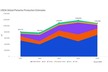
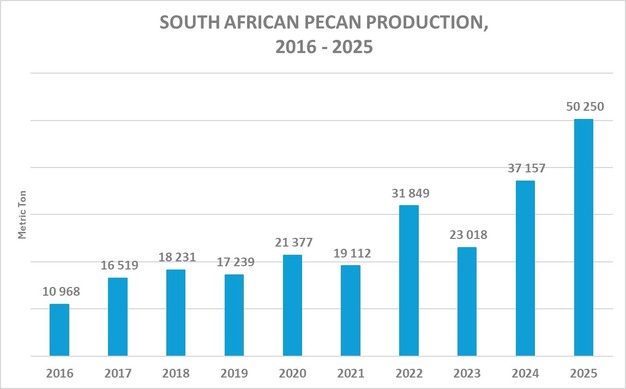
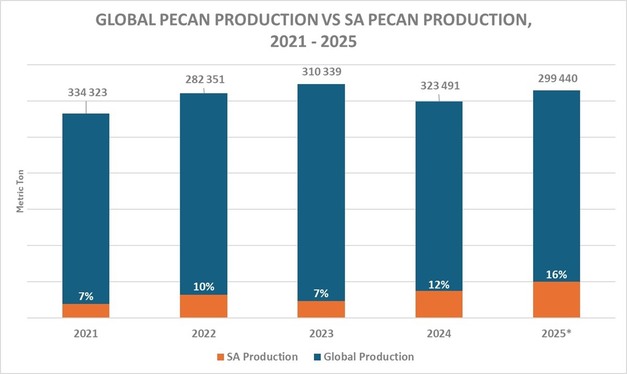
South African pecan production has increased fourfold over the past decade. The South African pecan harvest starts in May, when leaves have dropped, and the first containers typically leave in June.
 © SAPPA
Source: Pecanomics 2025
"As our volumes increase, we are actively looking at developing new markets for pecans from South Africa," says SAPPA's general manager, Cobus van Rensburg. "We're expecting between 52,000 and 55,000 tonnes this year, and there is still a significant number of immature trees not yet at bearing age. We'll be seeing an increase in volumes until 2030 and beyond."
At the same time, the pecan crop from the United States and Mexico has been shrinking for reasons ranging from drought to hurricanes in the US state of Georgia, while worldwide, Van Rensburg says, the consumption of pecans is climbing and creating a fair opportunity for South Africa.
 © SAPPA
In 2025, South Africa grew 16% of the global pecan crop
EU expected to increase nickel maximum residue levels
The South African pecan industry says it is optimistic that pecan exports to the European Union will resume this year. Exports are on ice since the EU brought in new legislation regulating the residue of nickel allowable on pecan nuts.
The EU decided to restrict nickel residue to 3.5 ppm, an untenably low level, SAPPA believes. Nickel is recognized as a micronutrient, and it is crucial for certain physiological processes within the plant.
They have been testing sprayed and unsprayed nuts from orchards across South Africa – some of which had never been sprayed, Van Rensburg remarks - and still testing over the 3.5 ppm limit. He observes that South African soils are naturally high in nickel.
The pecan industries in Argentina and the United States agree with South Africa on this, and together they've made a submission to Brussels for a more lenient level of 10ppm, which applies to other nuts such as chestnuts, pine nuts, walnuts, brazil nuts, and cashew nuts
The matter was due for a vote last month at the European Commission.
"We anticipate being in a position to send our nuts to Europe in 2026," Van Rensburg says. © SAPPA
 For more information:
South African Pecan Nut Producers' Association
Tel: +27 21 250 1692
Email: [email protected]
https://www.sappa.za.org/