New data on British apple sales to UK supermarkets in February 2026 shows a clear difference between retailers in terms of how strongly they support domestic fruit relative to their overall grocery market share.
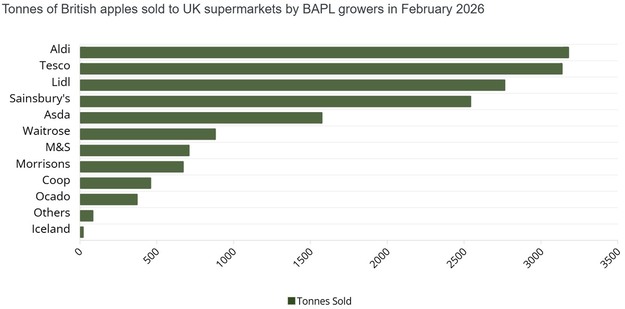
In total volume terms, Aldi purchased the largest amount of British apples from BAPL growers during the month, at just over 3,100 tons. Tesco followed closely with slightly above 3,000 tons. Lidl ranked third with around 2,750 tons, while Sainsbury's purchased roughly 2,550 tons.
Asda recorded purchases of about 1,550 tons of British apples, placing it in the middle of the pack among the major retailers.
 © British Apples&Pears
The remaining retailers bought notably smaller volumes. Waitrose purchased around 900 tons, followed by M&S with roughly 700 tons and Morrisons with about 650 tons. The Co-op bought around 450 tons, while Ocado purchased close to 350 tons. Smaller volumes were sold to other retailers and Iceland.
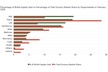
When the data is examined as a share of total British apples sold versus each retailer's share of the UK grocery market, a different picture emerges.
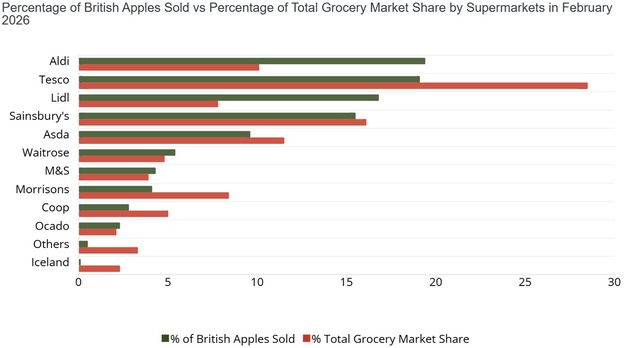
Aldi accounts for roughly 19 per cent of British apple sales despite holding only about 10 per cent of the grocery market. Lidl also shows a higher relative share, purchasing around 17 per cent of British apples compared with an estimated 8 per cent grocery market share.
Tesco remains the largest retailer in the UK grocery market, holding about 28 per cent of total market share. However, its share of British apple sales is lower at roughly 19 per cent.
Sainsbury's accounts for about 16 per cent of British apple sales, closely aligned with its overall grocery market share of around 16 per cent.
 © British Apples&Pears
Several retailers appear to under-index relative to their market size. Asda holds around 12 per cent of the grocery market but purchases about 10 per cent of British apples. Morrisons accounts for roughly 8 per cent of the grocery market but buys only around 5 per cent of British apples.
The Co-op, with an estimated 5 per cent grocery market share, purchased around 3 per cent of British apples. Ocado and Iceland also purchased smaller proportions relative to their market share.
The data suggests that discount retailers continue to play a major role in the distribution of British apples, while some larger supermarket groups rely comparatively less on domestic fruit within their produce assortment.
For UK growers, the figures highlight the importance of retailer partnerships in maintaining shelf space for domestic apples, particularly during the late winter marketing period when stored fruit continues to supply supermarkets.
 © British Apples & PearsFor more information:
British Apples & Pears
Tel: +44 (0) 1507 353778
Email: [email protected]
www.britishapplesandpears.co.uk