Brazilian watermelon exporters are targeting up to fivefold growth in export volume by 2030, supported by new varieties and efforts to expand winter consumption in the Northern Hemisphere.
According to data compiled by Abrafrutas, watermelon recorded the highest growth among the five main fruit varieties exported last year, with volume up 39.9 per cent and revenue up 57.2 per cent. The segment generated US$115.6 million in revenue and shipped 185,500 tons, making watermelon the country's fifth most exported fruit.
"It is possible to quintuple the exported volume over the next five years," says Luiz Roberto Barcelos, partner at Agrícola Famosa and director at Abrafrutas.
 © DataLiner
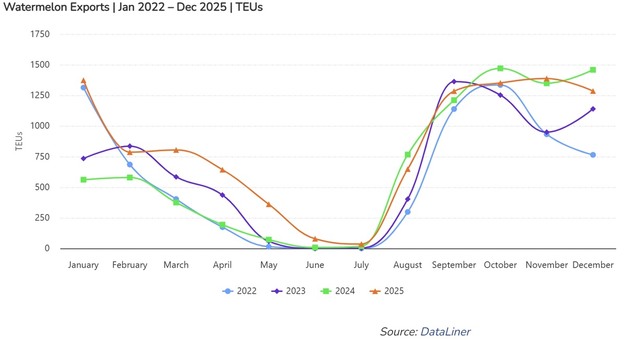
The main target market is Europe, where consumption levels remain below those of other fruits. "We are creating a culture of consumption outside the traditional season. Today, the Brazilian window runs from September to April, exactly during the European winter, before the harvest in Mediterranean countries," he explains.
Exported fruit is positioned differently from the domestic market, with smaller formats between 1.5 kg and 3 kg, predominantly seedless or with microseeds, and adapted sensory characteristics. "In the past, these varieties had a shorter shelf life, inferior flavor, and less pulp resistance. Over the years, there has been genetic improvement and a significant enhancement in the sensory experience," Barcelos says.
Brazil cultivates approximately 110,000 hectares of watermelon, of which 5,000 hectares are dedicated to export-oriented special varieties, mainly to the European Union. Agrícola Famosa cultivates around 2,000 hectares and exports approximately 300,000 tons of fruit of various types per year, equivalent to around 12,000 containers.
According to Max de Aquino of Grupo CMR, production gains have resulted from advances in crop management. The company cultivates about 2,000 hectares in Rio Grande do Norte, producing between 13,000 and 14,000 tons of melon and watermelon annually, including 1,300 tons of watermelon.
"Under good conditions, we reach between 45 and 50 tons per hectare. A good production standard is around 33-35 tons. Ten years ago, these figures were much lower."
Exports are mainly destined for Europe through Spain and the Port of Rotterdam.
The European market applies strict phytosanitary and pesticide reduction standards. Companies report investments in bio-inputs, traceability systems, automation, and drone monitoring. "As for automation in the field and in the packing house, we always seek greater efficiency and a smaller margin of error," says Aquino.
Environmental licensing, water-use permits, and labor standards are also part of export compliance requirements. "These requirements ultimately translate into greater management efficiency and productivity," Barcelos concludes.
Source: Globo Rural / DatamarNews