For port logistics in northern Germany, the new year began where the previous year ended: "Due to the overall weakening of Germany's export economy, we are currently facing a very different competitive situation than we did a year ago. However, we have the advantage of being very broadly positioned as logistics providers. In the fresh produce sector alone, we are involved in both imports, such as early potatoes, bananas, and other overseas fruit, and exports, such as apples to the Middle East and the Far East," explains Jan Zobel, Managing Director of Heuer Transport Logistics GmbH.
Import business for apples and potatoes under pressure
The company, with locations in Bremerhaven and Hamburg, is part of the Heuer Logistics Group, which also includes Heuer Port Logistics GmbH and SSG Quality Services. According to Zobel, the abundant yields for many products are having a corresponding effect on agricultural imports. "From the end of March/beginning of April, the first shipments of overseas apples, for example from Chile and South Africa, usually arrive at the seaports. However, due to high domestic stocks, we expect a later start to the season and lower import volumes overall."
The same applies to early potatoes from Egypt and Israel, which have been one of Heuer's specialties for many years. Zobel: "It's not that this market is completely collapsing. On the contrary, we expect high volumes again this year, especially since many trading companies have contractual relationships with food retail customers that have grown over many years. With potatoes in particular, we are seeing high demand for early potatoes at the start of the asparagus season in April, and these have to be imported. Incidentally, in the long term, we have noticed that early potatoes of Israeli origin have been gaining in importance again in recent years, which is interesting."
 © Hugo Huijbers | FreshPlaza.com
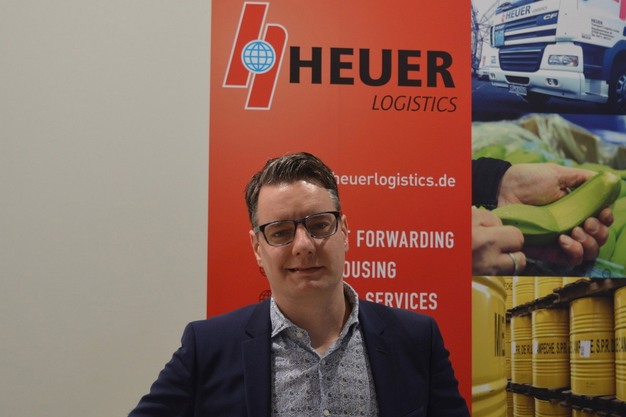
Jan Zobel at Fruit Logistica 2024. After a year's absence, Heuer Transport Logistics GmbH is exhibiting again this year at Fruit Logistica together with four other freight forwarders from around the world. Under the motto "Fresh Heroes", the cooperation partners are jointly covering supply chains.
CA containers with built-in ripening technology
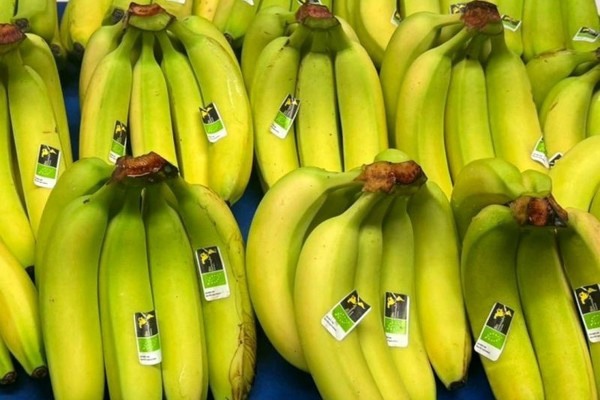
One of the longer-term topics in sea freight is the use of CA (Controlled Atmosphere) containers with built-in ripening technology. Thanks to this process, ripening can be deliberately triggered and controlled by adding ethylene. According to Zobel, the technology could help to shorten the supply chain and reduce costs accordingly. "Normally, bananas are ripened in a ripening center after arriving in Europe and then distributed from there, sometimes over incredible distances. Rising energy and logistics costs are, of course, a decisive factor here. Thanks to CA containers, there are no separate costs for refrigerated transport and ripening; instead, they are compressed extremely efficiently in a single step. This means we not only reduce energy costs but also the time required, which ultimately contributes to significant savings."
The technology has already been used on a modest scale for apples and exotic fruits for several years. Zobel reveals that initial test deliveries of bananas have also been carried out with consistently good results. However, the logistics expert notes that the reduced transit times are a good alternative to air freight, especially for sensitive products. "We are talking about goods where every hour counts, such as berries from Latin America. It is currently difficult to predict whether the technology will also catch on for bananas. I think containers with built-in ripening technology will find their markets. The important thing here is mutual predictability."
On the one hand, ship arrivals and container availability must be predictable. This could also be made more difficult by customs controls, for example. Nevertheless, the receiving warehouse must then also be able to process the bananas securely at a defined time. Zobel: "Once the ripening process has begun, flexibility is severely limited. In this respect, I also think that conventional banana ripening will not lose its importance so quickly. Personally, I find the development of new technologies for the sector extremely exciting."
 © Heuer Logistics
Customs issues offer challenges and opportunities
Another important factor in the global logistics sector is the current customs issue. On the one hand, certain markets are losing relevance and attractiveness due to fluctuating customs rates, but on the other hand, customs policy also offers new opportunities. "Trade agreements such as Mercosur are always worth their weight in gold for us logisticians. We expect customs duties on goods from South America to fall dramatically or even be abolished completely, which in turn will contribute to increased import volumes from these origins. Regarding fruit imports, I am thinking primarily of exotic fruits and apples. But even with citrus fruits, there could be a shift in volume from South Africa to South America as a result of the trade agreement," he concludes.
Visit the company at Fruit Logistica: Hall 26 | D-18
For more information:
Jan Zobel
Heuer Transport Logistics GmbH
Steubenstr. 20
27568 Bremerhaven
Office Bremerhaven: +49 (0) 471 / 48 73-165
Office Hamburg: +49 (0) 40 788 79-42
E-Mail: [email protected]
www.heuerlogistics.de