The import season for stone fruit from Chile started mid-December. It kicked off with peaches and nectarines while the first plums arrived in the U.S. mid-January. "As a result of favorable weather conditions, the season started about seven to ten days earlier compared to a normal year," says Cristian Ramila with Bengard Marketing.
China is main buyer of nectarines
Between the three stone fruit varieties, nectarines are the largest commodity. Until week 2 of this year, 5.8 million boxes of nectarines have been exported from Chile with 47 percent of volume going to the Far East, where China is the main destination. In recent years, Chile has planted many acres of white flesh nectarines for the Asian market, hoping to take advantage of demand for Chinese New Year. "However, the Chinese prefer cherries over nectarines and competition is tough," commented Ramila.
About 25 percent of nectarine volume has been shipped to North America and after China, the U.S. is the second largest destination country for Chilean nectarines. So far, the U.S. has received 1.3 million boxes. Other key destinations include Mexico, Taiwan, the Netherlands, and Canada. Because the season started earlier than normal, year-to-date shipments are ahead of last year by 24 percent. "Last year, 4.7 million boxes had been shipped compared to 5.8 million this year." However, the expectation is for an overall growth of last year's volume of just five percent.
So far, shipped volumes are more evenly distributed compared to last season. The U.S. West Coast market is able to handle about 100,000 boxes/week and if volumes are higher, the market softens. "Most of the volume will be arriving in the next two weeks and prices are expected to go down, starting this week," commented Ramila. "Hopefully, prices will remain stable between $16 and $22/box and won't go below $16," he added.
In mid-December and early January, the bulk of volume for the U.S. arrived on the East Coast. However, volumes on the West Coast have built up in the past few weeks. Overall, about 70 percent of nectarine volume arrives on the East Coast and 30 percent is shipped to the West Coast.
 © Bengard Marketing
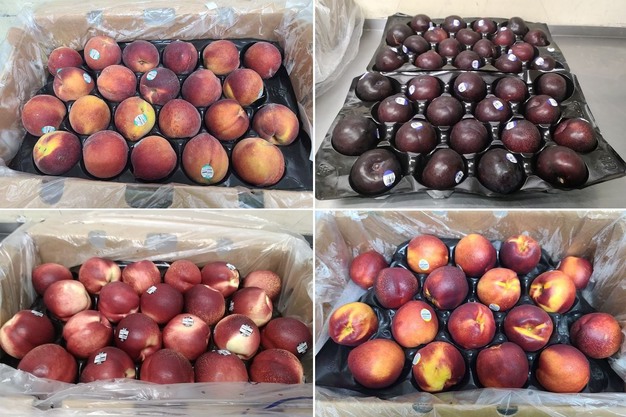
From top left and clockwise: Yellow peaches, black plums, yellow nectarines, and white nectarines from Chile.
Most peach volume comes to North America
Peaches are a more stable commodity; volume is five times lower compared to Chile's nectarine volume. Peaches have also benefited from favorable weather and shipments are 14 percent ahead of the same week last year. So far, one million boxes have been shipped with the majority of peach volume coming to North America as peaches don't travel as well over long distances. Together, the U.S. and Canada have imported 557,000 boxes, equivalent to 53 percent of Chile's total peach export volume so far. Latin America is the second largest destination market with Mexico, Peru, Guatemala, Costa Rica, Ecuador, and El Salvador taking 40 percent of volume so far.
North America prefers black plums
Shipments of plums started more recently and are off to a swift start as they are 68 percent ahead compared to the volume shipped through week 2 of last year. So far, 2.3 million boxes have been exported and with 1.5 million boxes China is the dominant export destination. About 20 percent of volume has entered North America, with the U.S. and Canada importing 379,000 and 70,000 boxes respectively. "It is a very high export volume, which is new to me," Ramila said. At the same time, it is too early in the season to tell if Chile will continue to ship these high volumes. The market can't take as many plums compared to nectarines and peaches. However, plums do last longer in storage.
"The Chinese prefer red fruit because it symbolizes happiness, success, and prosperity," said Ramila. With that in mind, Chile has planted a significant volume of red plum trees for the Asian market. In the U.S. and Canada on the other hand, red plums don't get as much traction and black plums are preferred. For some growing regions in Chile, plums require fumigation prior to entering the U.S. and black plums withstand fumigation much better than red plums.
How long will prices sustain?
All in all, Ramila hopes for a better stone fruit season compared to last year when too much volume was shipped during a short time frame. While prices for peaches and plums are still stable, nectarine prices are starting to come down. Volumes are strong and coupled with ample availability of competing fruits like cherries and grapes, a price decrease is common for this time of year. As more volume arrives in the U.S. market, prices of plums are expected to decline in the coming weeks as well.
Stone fruit volumes from Chile will enter their peak now for the next few weeks. Peaches and nectarines will be available until early and late March respectively while consumers in North America should be able to get their hands on plums until mid-May.
 For more information:
Cristian Ramila
Bengard Marketing
Tel: +1 (310) 605-5105
[email protected]
www.bengard.us