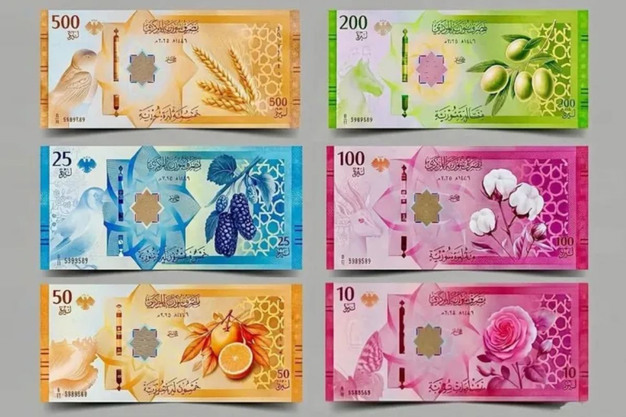
On December 30, Syrian President Ahmed Al-Sharaa, accompanied by Abdulkader Husrieh, Governor of the Syrian Central Bank, unveiled the new Syrian pound, a change that is both symbolic and economic, as the country hopes to emerge from the civil war that has ravaged it since 2011.
The new banknotes move away from historical figures and landmarks to highlight agricultural products such as citrus fruit and berries, cotton flowers, and Damask roses.
This "symbolic neutrality" is necessary and customary when countries emerge from long and painful conflicts. Economist Eric Helleiner, quoted by Al Jazeera, explains that in this context, new currencies deliberately avoid historical figures and geographical landmarks that could cause divisions or evoke painful memories. In this case, currency is not only an economic tool, but also a political and social message that conveys a shared partnership within the country, where no one has a monopoly on symbolism. Herein lies the wisdom of choosing fresh produce.
The new currency comes with a change in the nominal value of the Syrian pound, with two zeros being removed without changing its value or exchange rate. 100 old pounds will therefore be exchanged for one new pound. The Syrian central bank has announced the launch of a renewable 90-day window for the exchange of old banknotes.
Source: Al Jazeera (Arabic)