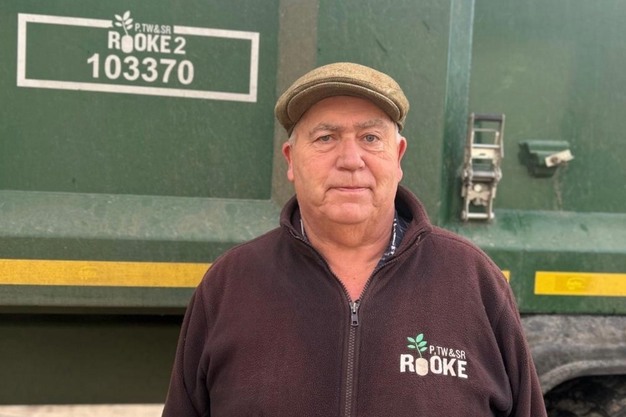
GB Potatoes spoke with North Yorkshire grower Tim Rooke, who farms in partnership with his brother and son and produces around 600 acres (242 hectares) of processing potatoes for the chipping and crisping markets, including King Russet, Pentland Dell, Lady Rosetta, Brooke, and Taurus. He is Chair of the NFU Potato Policy Group and Vice Chair of the NFU Horticulture and Potatoes Board. Rooke reflected on the challenges of the 2024 season and on the importance of aligning production with market requirements.
This year highlighted how unpredictable potato growing can be. Early planting took place in good soil conditions, followed by a prolonged dry spell. Only about 30 per cent of the farm's land can be irrigated, and even that capacity was reduced when river levels fell. The crop developed quickly and finished early, producing good quality but yielding roughly one to one and a half tons below contract. Lifting was completed by 18 October, the earliest on record for the business.
 © GB Potatoes
The previous year presented the opposite conditions. Continuous wet weather delayed planting until late April, resulting in a shorter and slower growing season. Despite the contrasting conditions, both years produced similar yields. Rooke notes this as evidence of increasing weather variability and the reduced relevance of "average" seasons.
Nationally, this variation fed directly into the market. In 2024, limited supply pushed free-buy prices to £600–£700 per ton. This year, the free-buy movement has been minimal.
Rooke stresses the importance of matching production to market demand. Potatoes remain a costly crop to grow, with combined inputs of fertiliser, fuel, power, storage, and labour often reaching £2,500 to £3,000 per acre ( £6,177.50 to £7,413.00 per hectare). About two-thirds of the national crop is grown on contract, offering stability for growers and processors, while the remainder is traded freely.
He adds that understanding the requirements of buyers and communicating throughout the supply chain is essential for maintaining stability, particularly as lower cereal prices and reduced support payments bring more land back into potato production. Expansion, he argues, should only be considered when market demand is secure.
Rooke notes that the sector continues to face several practical challenges. Access to water remains a significant issue, with more coordinated approaches to irrigation likely to become increasingly important. Plant protection tools are another concern, following the loss of several long-standing products without direct replacements. He emphasises the need for regulation that balances safety with practical requirements.
Despite these challenges, he sees the British potato sector as well-positioned, with ongoing investment in storage, grading, and technical improvements. Consumer demand for domestically produced potatoes remains steady, supported by established supply chains.
Looking ahead to 2026, Rooke advises growers to align cropping decisions with clearly defined market needs, to manage production costs carefully, and to maintain strong relationships throughout the supply chain.
 © GB PotatoesFor more information:
GB Potatoes
Tel: +44 (0) 1507 353774
Email: [email protected]
www.gb-potatoes.co.uk