During the conference of the World Union of Wholesale Markets, the WUWM, the central question was how wholesale markets fit into modern urban life. Valérie Vion of WUWM stressed that in a world where more than 70 per cent of people now live in cities, these markets are far more than historic leftovers. They function as strategic public infrastructure that supports food security, helps regulate local economies, encourages sustainable practices, and strengthens social engagement.
Andrea Magarini, director of the Food Policy Department for the City of Milan, shared a practical look at how cities and markets can reinforce each other. Milan has been working with WUWM for three years to link the Milan Urban Food Policy Pact, which is now active in more than 330 cities worldwide, to local wholesale markets. A recent survey among the cities in the pact showed that many food policy departments operate completely separate from their local wholesale market. That gap opens the door to new connections, better communication, and stronger collaboration.
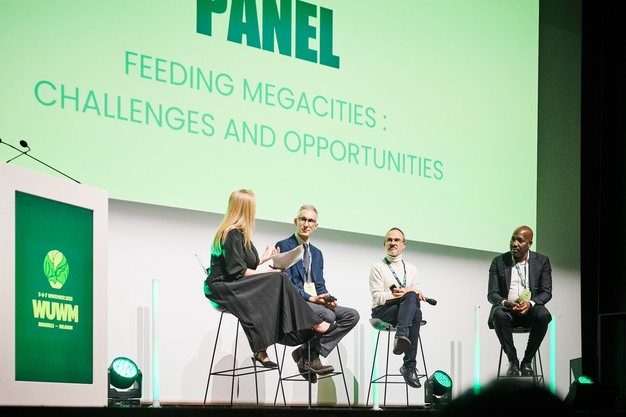 © Benjamin BroletAndrea Magarini in a panel at the recent WUWM conference
Wholesale markets as a living laboratory
"Wholesale markets are not just trading floors", Vion said. "They are public spaces that link production and consumption, city and countryside, economy and solidarity. They redistribute, inform, and innovate."
Andrea added, "In Milan, you can see this literally taking shape. The city is building a central kitchen and storage facility for school meals inside the wholesale market. At the same time, the market works as a living lab for food policy, where city departments and policymakers work side by side with producers and distributors in real time."
Markets also play a key role in reducing food waste. Milan has created permanent food waste hubs where surplus food is redistributed through partnerships with five charities and the city government. A similar example is Mercabarna in Barcelona, which redistributes more than 1,500 tons of food each month through social logistics programs.
Technology
According to Vion, the next generation of wholesale markets is digital, sustainable, well-connected, and essential for food sovereignty. Innovation, however, is more than technology. "It must move together with social innovation, inclusion, and shared governance. In Milan and other cities, public markets are being linked directly to food programs, school meals, and education. As a result, markets are becoming not only economic engines, but also social and educational hubs."
Governance plays a decisive role. Some markets are fully public, while others have mixed ownership. Strong cooperation between municipalities, markets, and community organizations increases the impact of urban food policy and strengthens the social fabric of the city.
A global alliance for food sovereignty
The alliance between WUWM and the Milan Food Policy Pact now connects hundreds of markets and cities worldwide. Together, they pursue one goal: Making food, as a shared public resource, sustainably accessible to everyone. "The infrastructure exists, the technology is ready, and the knowledge is already there", Vion said. "What we need now is the political will to connect it all and make it work for growers, consumers, and communities."
"In Milan, Barcelona, Seoul, and many other cities, we see how markets bring economy and planet together with technology and humanity. They are living laboratories of sustainability where solidarity and food sovereignty take real, practical shape."
For more information:
Andrea Magarini
Food Policy Department Milan
www.milanurbanfoodpolicypact.org
Valérie Vion
WUWM
www.wuwmbrussels2025.com