 © CoJPhotos of an almost unrecognisably clean Johannesburg city centre to show its best face to visiting G20 leaders for the Summit or, as put by veteran journalist Ferial Haffajee, "cleaning up its act for the bwanas'", are flying around social media.
The state of Johannesburg has been the subject of several recent BBC documentaries calling it "a city held hostage" while end October, the Wall Street Journal described tourists to Johannesburg "dumbfounded by the many signs of apathy on display in the city".
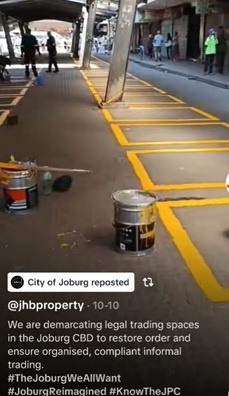
Right: Newly demarcated legal trading spaces in the Johannesburg city centre, "to ensure compliant informal trading' (source: @jhbproperty TikTok)
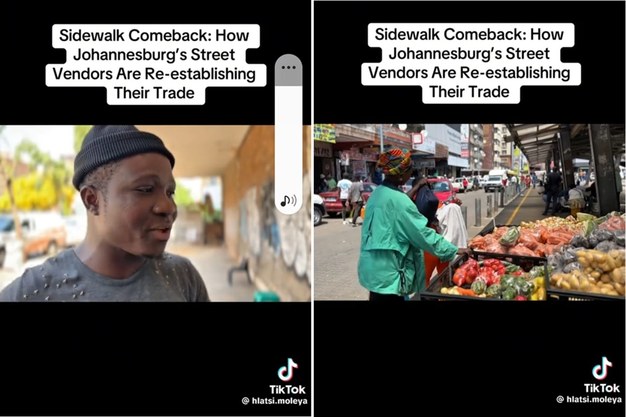
Also absent on the photos, along with rubbish, are the stalls of street vendors who were left to ply their businesses there for decades, and constituting a major part of the clientele at the Johannesburg municipal fresh produce market.
"Unlawful" trader removal
The City of Johannesburg's Informal Trader Verification and Registration campaign is an initiative ostensibly "to restore order" through a paid permit system.
Police officers, so-called crime prevention wardens and allegedly even members of the national taxi council "forcibly evicted informal traders and confiscated their stock and goods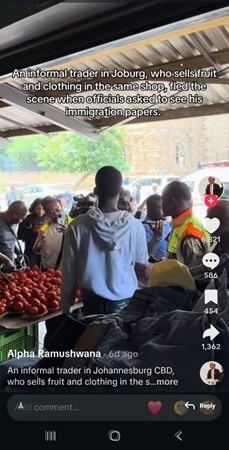 © Alpha Ramushwana from their trading sites [in Johannesburg]," claims the Socio-Economic Rights Institute (SERI). "These forced evictions were carried out without lawful authority (which would be in the form of a court order), without prior notice, and in violation of the Businesses Act, the City's informal trading by-laws, and the traders' constitutional rights."
Right: a trader of "fruit and clothing" fled the scene and abandoned his stock "when asked for immigration papers" (source: Alpha Ramushwana TikTok)
Newly painted trading spaces under overhangs built for street trading appear unoccupied by traders in the many photos circulating of the unknown zeal with which street lights are replaced and flower beds planted in the areas due to be visited by G20 leaders.
"It's clean, it's very nice. We're happy, but on the other side we're crying," says a vegetable buyer at the Joburg Market and re-seller at the adjacent Tshiamo market (formerly called the Mandela Market and still frequently referred to by that name).
She repackages the large quantities bought wholesale and sells it in smaller units, primarily for the many street sellers of Johannesburg, who have dwindled over the past months and more rapidly over past weeks.
"Normally, I sell two pallets of [vegetables] a day; now one pallet takes me four days. Today I sold only ten crates." Most of the street sellers in central Johannesburg are foreigners from all over Africa, drawn to the opportunities in one of the continent's biggest economies, and it's been that way for decades, she says, making up as as much as 80% of her customers. "The market is very quiet because Joburg is being cleaned; they chased those foreigners away. These people are our customers."
Statistics South Africa calls the informal economy "a lifeline for millions", estimated to account for 19,5% of total employment in the fourth quarter of 2024. Nearly 60% of women in this sector cite unemployment as the main driver.
A vegetable farmer who doesn't visit the Joburg Market often says that on a recent visit he was struck by how quiet the market was. His agents told him, he says, it's been getting progressively quieter as municipal along with xenophobic group actions have tightened the screw on street sellers.
A market agent trading in bulk vegetables points out that mid-November traffic is always slower and that recent rainy weather places a damper on trade. That being said, when looking at the longer term, there's no doubt of a steady decline in buyers coming to the market he says and it's rumoured to be the result of heavyhanded tactics against vulnerable street traders.
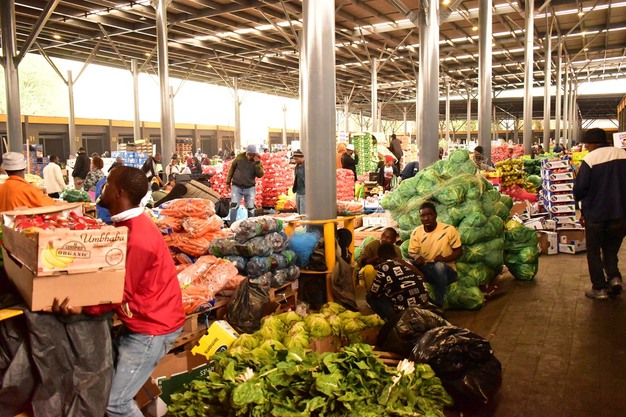 © Carolize Jansen | FreshPlaza.comThe Tshiamo Market (formerly Mandela Market) where stallholders rent space from Joburg Market and resell in smaller units to predominantly street sellers, October 2024
Joburg Market: "No evidence of decline linked to the City's drive"
The Joburg Market says its figures do not bear this out and records an average of 12,000 customers per day still visiting the City Deep precinct. Monthly turnover levels of around R900 million (€45 million), consistent with the historical performance for this period, are maintained and there is no evidence, market authorities say, of a systemic decline linked to the City's verification drive.
The market believes that anecdotal reports of an absence of regular buyers are not substantiated by formal data submissions nor operational reports. "While the City's administrative interventions may temporarily affect informal trading patterns in the wider precinct, there is no verified evidence that this has resulted in a drop in Joburg Market's internal buyer activity or wholesale trading levels," the market comments.
Their internal records reflect stable transactional activity, with agent trading volumes and farmer deliveries remaining within expected ranges.
 © Hlatsi MoleyaSource: Hlatsi Moleya, TikTok