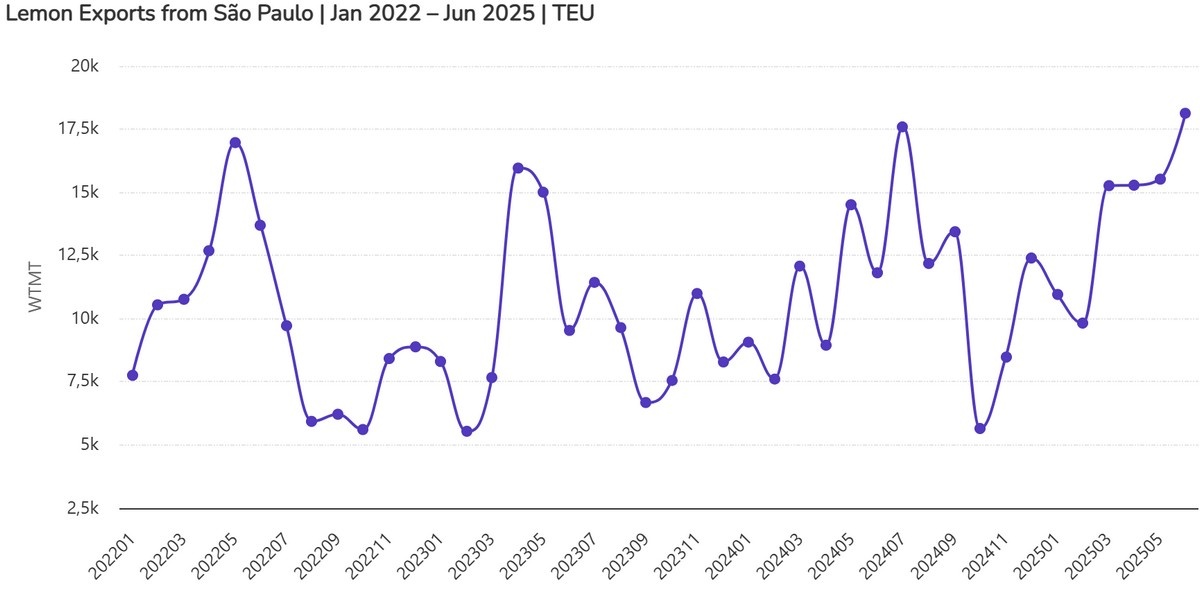
The state of São Paulo is Brazil's largest lemon producer and continues to expand exports. According to the Institute of Agricultural Economics (IEA – Apta), part of the São Paulo Secretariat of Agriculture and Supply (SAA), more than 1.1 million tonnes were harvested in 2024. In the first half of 2025, exports reached 81,000 tonnes worth US$72 million, up 21% from the same period last year.
Europe remains the main destination. The Netherlands imported 62,200 tonnes, using Rotterdam as a hub for EU distribution. Other markets included the United Kingdom (11,600 t), Russia (1,300 t), and Canada (970 t). "Trade between the Netherlands and Brazil is a dynamic example of complementary agricultural markets, with São Paulo playing a central role as the top producer and exporter," said Alf de Wit, Agricultural Advisor at the Consulate General of the Netherlands.
Itajobi, in the São José do Rio Preto region, is considered Brazil's lemon capital and a key producer of the Tahiti variety. The family-run company Pimentel Itajobi, active for 30 years, supplies mainly the UK and EU. "In 2024, we exported more than 4,000 tonnes of Tahiti lemons. The sector experienced a very prosperous year, despite a severe drought. We invested in improvements to our packing house, which increased our production capacity and subsequently boosted our export volume," said Export Analyst Alison Dejavite.
São Paulo's Agriculture Secretariat promoted the sector at Fruit Attraction SP 2025, the leading fruit and vegetable trade fair in Latin America. At the event, the Agricultural Defense Agency (CDA) highlighted phytosanitary certification programs for Tahiti lime groves, reinforcing São Paulo's role as Brazil's top exporter, responsible for more than 70% of national lime shipments. "We continuously invest in phytosanitary certification of origin to ensure São Paulo's products reach international markets with quality and safety," said Alexandre Paloschi, Head of the Department of Plant Health and Inspection (DDSIV).
Support for growers also comes through the Agribusiness Expansion Fund (FEAP). The credit line provides up to R$250,000 (US$45,000) for individuals and R$500,000 (US$90,000) for companies, with repayment terms of up to 84 months and a grace period of 12 months. "For lemon growers, the Sustainable Agriculture of São Paulo line offers financing for orchard renewal and expansion using certified seedlings, efficient irrigation, and other productive investments," explained FEAP Executive Secretary Felipe Alves.
Source 1: Agência São Paulo
Source 2: Abrafrutas (IEA – Apta)