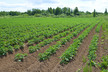
According to agricultural engineer Diego Garcete, coordinator of Production Management at the Ministry of Agriculture and Livestock (MAG), Paraguay's onion cultivation area in 2024 was around 950 hectares, with an estimated output of 20,000 tons. This quantity was enough to meet domestic demand for about 60 to 65 days, while national production typically covers approximately 50 days of consumption. The country's daily onion consumption is around 150 tons.
The crop tolerates cold and frost and can grow in various soil types, but yields are reduced by water shortages and degraded soils. MAG is providing training to address these issues.
There are three production cycles: Early planting from the start of March to April 15, mid-season from April 15 to May 20, and late from May 20 to June 31. Harvesting of the early crop occurs in September and October, followed by mid-season in October and November, and late-season between November and December.
In 2024, MAG distributed 1,130 kilograms of onion seed, enough for 665 hectares, representing 70% of projected national production for 2025. The private sector accounts for the remaining 30%. Combined, production is expected to reach between 1,000 and 1,100 hectares.
Garcete stated that the profitability of onion production is 53%. "The cost per hectare would be around US$43,500, and harvesting 18 tons per hectare would yield an average income of US$69,600," he said. The return would therefore be around US$26,100 per hectare. MAG is working with producer groups to explore the use of onion sorting equipment and drying sheds to store and sell product at preferred times.
The ministry aims to extend the production cycle and lengthen the period in which local onions are available. To avoid simultaneous harvesting, production zoning is being implemented. Departments such as Paraguarí, Itapúa, and part of Caaguazú receive early-season seed, while other departments are supplied with mid- and late-season varieties. The goal is to extend the supply period to 80 or 90 days.
MAG is currently working with 3,800 producers across 14 departments. The main producing regions are Paraguarí, Itapúa, and Caaguazú, followed by Guairá, Caazapá, Misiones, Lower Chaco, Upper Paraná, Central, San Pedro, Canindeyú, Amambay, and Ñeembucú.
Garcete noted, "On average, an onion producer with a quarter or even half a hectare of production provides labor for four families per day. This generates a microeconomy within each district and department."
Most marketing is conducted from family farms through direct buyers or intermediaries. National yields average 12 to 15 tons per hectare, with the target set at 18 to 20 tons per hectare, supported by technical training and regular field visits by MAG staff.
Source: Argenpapa