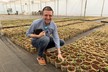
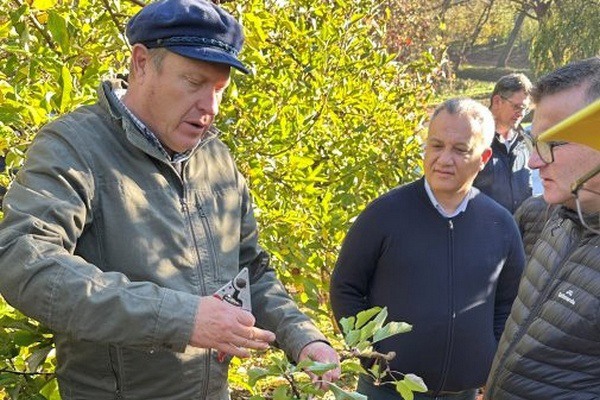
In early June, 21 Australian and international growers and industry professionals took part in the 2025 Future Orchards International Tour to South Africa. The group visited orchards, nurseries, and a packhouse across three regions, examining diverse orchard systems and engaging with South African growers to exchange insights and experiences.
 © APAL
In the Elgin region, growers observed how low winter chill conditions, with just 500–800 chill units, have led to high-yield systems that rely on tightly managed high-vigour rootstocks. South African tree physiologist Dr Nigel Cook described techniques used to compensate for insufficient chilling, such as cold storage of nursery trees, dormancy-breaking applications, girdling, notching, and extensive branch bending. According to Cook, tree bending was central to promoting fruitful branching and minimizing pruning, enabling higher cumulative yields. In this region, fruit is produced with a focus on volume, with markets still accommodating lower-grade fruit. Some orchards reported cumulative yields of over 400 tons per hectare by year five.
The group also toured Kromco, a producer-owned packhouse handling 90,000 tons of fruit annually. The facility exports to the UK, Europe, and African markets, with apples making up the majority of sales. Key varieties include Cripps Pink, Golden Delicious, Granny Smith, Cripps Red, and increasing volumes of Gala. Pears, mostly Packhams and Forelle, are also packed. Kromco presizes apples and packs pears to order, with about 10 per cent of the received fruit graded for juice. Facility managers emphasized that juice-grade fruit brings added logistical costs without value return. The packhouse also outlined its focus on sustainability and energy efficiency.
 © APAL
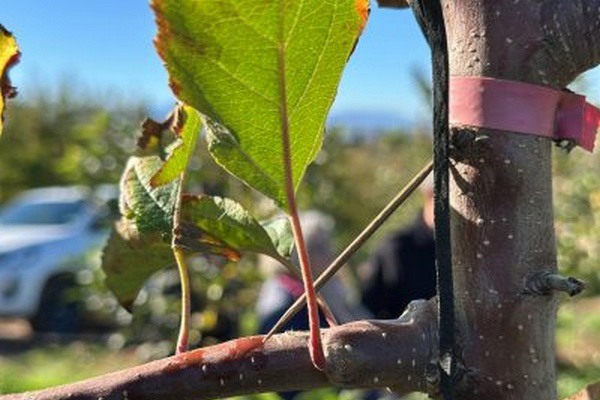
In the Langkloof region, the tour visited Oewerzicht Farm, where emphasis is placed on achieving high-quality fruit. Orchard systems include V-trellis, two-leader planar, and older spindle formats. The trees are being adapted to be more accessible for workers, with platforms already in use. Technical advisor Graeme Krige and grower Kootjie Viljoen noted that labour, though more affordable than in Australia, remains the highest input cost. With farmgate costs estimated at 3,500 Rand ($300) per ton, Class 2 and juice returns are insufficient to cover expenses, reinforcing the focus on maximizing Class 1 fruit.
One block of Cripps Red demonstrated reduced sunburn and increased returns through the combined use of shade netting, reflective mulch, and extensive leaf removal. Growers also explored replicated trial orchards to evaluate performance under local conditions. Overall, the tour highlighted contrasting approaches to profitability, volume versus quality, while offering a comparative look at orchard strategies in a warming climate.
To view the full report, click here.
 For more information:
Apple and Pear Australia Ltd
Tel: +61 3 9329 3511
Email: [email protected]
www.apal.org.au