“Consumption is absolutely key to a successful campaign,” explains Daniel Sauvaitre, president of the French Apple Pear Association (ANPP), a statement echoed by Bruno Darnaud, president of the Peach and Apricot Producers’ Association, at the launch of the Apple Pear campaign. “In the end, the consumer decides, so we have to be logical and make the shelf attractive, legible and consistent in terms of prices.”
The campaign looks promising both in terms of quality and quantity, according to Sandrine Gaborieau, marketing and communication manager of ANPP. “French people have been eating less because of inflation! The figures speak for themselves. “Food prices have risen by 18.4%, while French people’s food purchases have increased by 4.2%.” As a result, purchasing volumes are down by 11.4%. Fruit and vegetables have of course been impacted by this drop in consumption. “Over the last four years, household purchasing volumes (for fruit) have fallen by almost 5% (9% compared to the average of the last 3 years).”
In this context, solutions are being considered to boost consumption. Wholesalers and distributors offered some elements of answers and suggestions following the harvest forecasts.
“Communicating on prices”
According to Guy Bernard Cordier, Réseau Le Saint, “the reality is that there is an economic issue regarding prices.” The solution is to “communicate on prices! Apples are an inexpensive product, and consumers can pay for apples by the unit. We therefore need to focus more on portion prices rather than on 2kg bags, which are much less appealing to consumers.”
"Creating new consumer habits”
Olivier Potel, director of Scafel (E.Leclerc) confirms that price is an important factor. “We need entry-level prices. We have seen a 100% increase in our Eco+ fruit and vegetable sales,” but segmentation is just as important! “It is not on the first prices that we have the most margin, so we also need the heart of the range and the premium, and segmenting is done through packaging.” In this case, “it is difficult to sell in bulk, especially for two-tone apples, as this creates markdowns.” One of the avenues to be explored, according to Olivier Potel, is to “create new consumer habits. We've always sold Gala apples until very late in the season, so maybe we actually need to stop selling them when they start to taste a little less good.”
Training, raising awareness and communicating for distributors and consumers alike
“Our job is to act as a link between production and distribution flows, but we must not forget that we also have a role to play in passing on information,” explains Eric Pelou of Frutas Sanchez, based on the MIN market of Lyon. He is calling for better training for professionals and a better communication of the Eco-responsible Orchards values to consumers. “We need to work hand in hand to set up tools in the stores to train our product distributors. We want to show that through our distribution network and our network of customers, we can also pass on all these values. Today, consumers want to know that the products they buy on markets and in the stores have strong societal values.”
Targeting millennials
For Laurent Grandin, president of Interfel, we need to target the generation that represents “the consumers of tomorrow. We need to seek out the consumer instincts of a generation that is collectively wanting to eat a more plant-based diet.”
“The 15,000 tons of Polish apples are not enough to scare us!”
Daniel Sauvaitre, president of ANPP, wonders what “producers can do in order to stir wholesalers away from Polish apples.” According to Didier Marques, president of UNCGFL, “15,000 tons of Polish apples are not enough to scare us! There are various distributors throughout France, as well as many market wholesalers at our disposal, so we will find solutions together.”
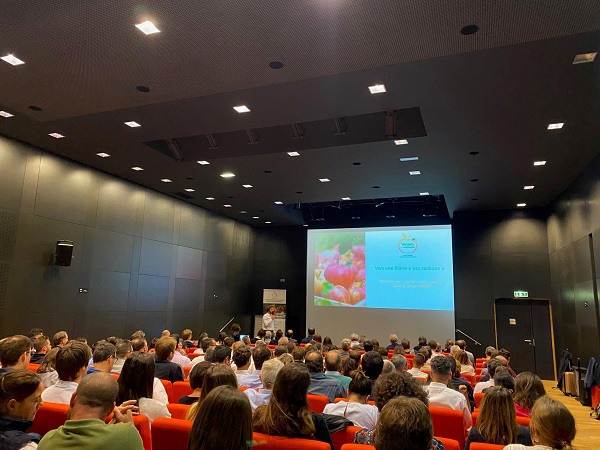
At its August 31st campaign launch, Eco-responsible Orchards unveiled its new communication strategy to boost consumption.