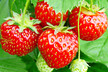
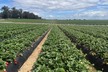
About three years ago, the management of Räss Wildbeeren AG decided to comprehensively restructure the organic fruit growing operation. Both the cultivation of the three main crops strawberries, raspberries and blueberries as well as the fruit processing on the own farm were increased, without losing sight of the niche crops such as rock pears, goji or haskap berries. We spoke to Simon Räss, who runs the company based in Benken (Canton Zurich) together with his brother Christoph, about this year's season and long-term market developments.
The first interim assessment of this year's season is mostly positive, according to the organic berry producer. "Basically, the harvest year got off to a pretty good start with a good spring and summer in terms of weather, so that an average to good harvest volume can be expected overall. In general, organic berry production is particularly demanding and there has also been a stagnation in area development in Switzerland."
 © Räss Wildbeeren AG
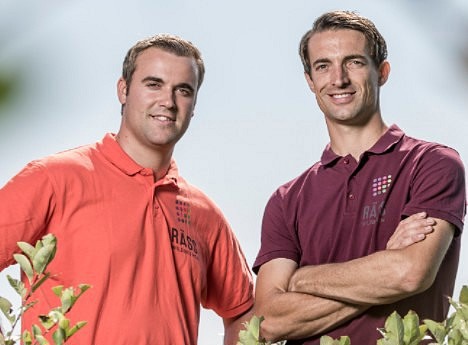
Christoph and Simon Räss jointly manage the organic fruit farm.
Blueberries and raspberries: Opportunities in late marketing
Currently, the harvest of organic blueberries is in full swing, Räss continues. "We are somewhat reluctant to harvest the classic early varieties, which are harvested in July. Instead, we have focused on growing late varieties that start yielding in August, precisely the period when there is less domestic organic produce available in Switzerland. This also fits very well in terms of personnel planning: our other crops, such as blackberries, tend to decline then, which is why we can use the majority of our employees for the blueberry harvest." The peak period for blueberries goes until about week 35, and the acreage is predominantly planted with the Aurora variety.
For raspberries, the farm is also mainly dedicated to later-season crops. "Summer raspberries are extremely demanding, so we have focused exclusively on fall raspberries. We are now in the main weeks, but can harvest fruit into November after the main season ends at the end of September," says Räss, describing the seasonal process. The varieties grown are Enrosadira, Versailles and Paris. A slight price increase could be negotiated for almost all berry crops this year. This is not enough to cover the additional costs in production, but they are an important contribution."
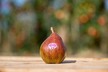
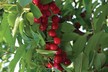
Although the restructuring has clearly focused on the large berry species of strawberries, raspberries and blueberries, numerous niche and special berries continue to grow and thrive on the organic farm. Räss: "We can continue to serve these niches well, although it must also be said that there is relatively little movement on the market in this area compared to the large berry species. This is again due to the fact that there are only a few organic suppliers for most niche varieties and demand is also rather stable." Among his customers, Räss counts food retailers, organic specialty retailers, and traditional wholesalers such as Zurich's Engrosmarkt.
 © Räss Wildbeeren AGIn addition to table cranberry fruit, Räss Wildbeeren AG also produces processed goods, partly for its own farm processing, as well as organic apples and grapes for the wine industry.
Consolidation and professionalization
According to Räss, domestic organic berries continue to be in vogue, with the market segment having stabilized to some extent in recent years. "About five years ago, there was hype and corresponding growth. But we are now seeing that there has been a consolidation and professionalization of the organic berry market."
The biggest challenges are not so much in marketing, but in production, Räss further emphasizes. "On the part of the trade, there was and still is a certain amount of support. Economically, however, organic berry production is still very challenging. The main tasks in the coming years are to reduce costs and at the same time optimize our production. In the end, the main challenge is to produce the appropriate quantities at the desired quality."
Images: Räss Wildbeeren AG
Further information:
Simon Räss
Räss Wildbeeren AG
Im Trügli 267
8463 Benken
+41 52 319 18 02
[email protected]
www.raess-wildbeeren.ch