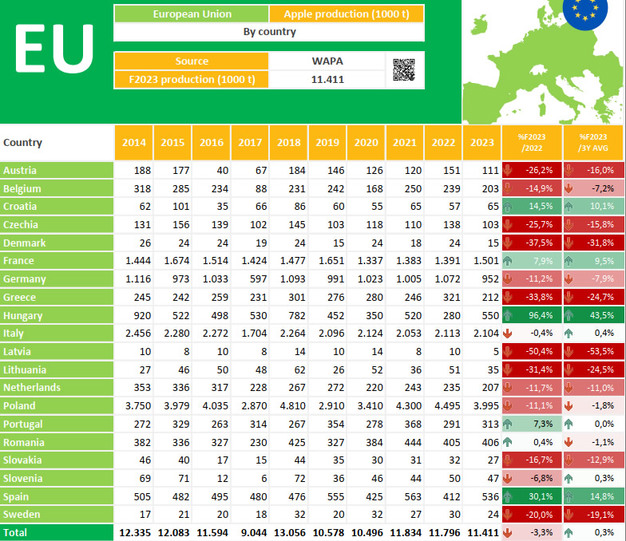
In Europe, this year's apple production reached about 11,411,000 tons. That is quite low, Prognosfruit announced yesterday. The various apple varieties' harvest estimates have clearly shifted. The expected lower Elstar crop in Germany seems to offer additional sales opportunities for Dutch growers. The low EU stocks also create a good starting position for next season.
Europe's Elstar harvest will probably be 21.4% (296,000 tons) lower than last year. That is mainly due to a lower Dutch harvest (82,000 tons). Germany, too, had a lower harvest, where estimates show that 50,000 tons fewer Elstars will be harvested. "That can give Dutch Elstar growers sales opportunities," says NFO director Siep Koning.
Variety estimates
In the European Union, there will be 7.8% fewer Jongagold apples this year - 371,000 tons. Jonagored will see an 18.5% drop to 168,000 tons. Red Jonaprince harvests will arrive at roughly 493,000 tons this year, 14.8% lower than last year. The EU harvest of Boskoop (Golden Delicious) is estimated at 74,000 tons, down 12% from 2022. Golden Delicious remains the top EU apple variety. Its production is up 11.7% to 2,168,000 tons. The number two variety, Gala, will have a 1,527,000 ton-production (+4.8%).
High demand for industry apples
In his market outlook, AMI's Helmig Schwartau indicates that things like decreasing apple consumption and consumers' lower willingness to buy - due to inflation - are affecting the apple market. "However, on a positive note, the economic situation is slowly improving. The industry apple market is recovering too. There's a high demand for products to make apple juice. That should drive up prices," says Helmig.
The situation differs for organic apples, where there is less demand for industry apples. "Many traders still have plenty of stock. In that respect, there's a difficult season ahead."
Good starting point
According to Helmig, another positive is that the EU stocks were meager on July 1 of this year. "These were 310,000 tons, as opposed to 2022's 517,000 tons," he says. On July 1, Dutch apple stocks stood at 21,000 tons versus 25,000 tons in 2022. "The lower apple stocks in the EU create a good starting position for next season. Take advantage of those opportunities in the coming months. In other words, don't forget to sell in the fall."
Also good: imports from overseas areas fell by around 30%, and ripeness in the coming season should be good. "As I assess it now, the apples probably won't be too ripe," Helmig explains.
Luc Vanoirbeek of VBT commented that the lower Belgian apple yields are primarily due to further acreage shrinkage combined with lower production. Belgium's apple acreage has decreased by 1,089ha to 4,896ha since the 2018/2019 season. It is mainly Jonagold (-620ha) and Jonagored (-569ha) orchards that have disappeared.
Next season, for the first time, these two varieties will make up less than half of the Belgian apple acreage. "Still, there's a strong increase (+40%) of other, non-traditional, apple varieties. The apple growing trend is undoubtedly shifting," says Luc.
"Belgium's pear acreage expanded again to 10,630 ha (+65ha) this year. In pear cultivation, too, there's a strong commitment to innovation and supply diversification with a range of pears. There will be 412 million kg of pears produced in our country this year. That's 19% more than last year. Belgium has become the EU's leading pear-producing country. With its associated droughts, heat waves, and floods, global warming puts extreme pressure on Italian and Spanish pear production."
Challenges
Nonetheless, the 2023/2024 season will pose the necessary challenges. "First, of course, there are the climate challenges our sector has been facing for the last few years. We, as a sector, and the research institutions must respond to these challenges," Luc continues. "But the fruit sector will also have to keep looking for new sales opportunities in new markets and further modernization of the fruit companies (new varieties, risk management, diversification, etc.)."
"Also, the sector must keep focusing on trying to increase apple and pear consumption. Of crucial importance here is the Belgian wholesale distribution and consumer support. They must deliberately choose Belgian-grown apples and pears. Hopefully, these efforts will result in better grower prices. That's necessary for the continued viability of our companies faced with ongoing disrupted international trade," Luc concludes.
Source: NFO / VBT