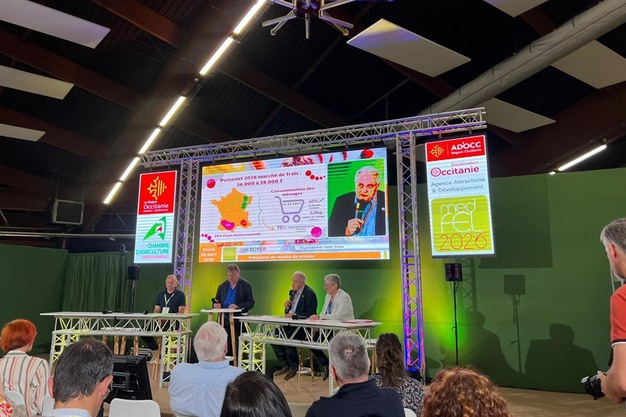
For the third year running, the French plum sector presented its harvest forecasts at medFEL. After announcing its inclusion in the Ecoresponsible Orchard scheme in 2024, the French plum sector is now embarking on its first campaign under this label.
 © FreshPlaza
An estimated potential of 56,000 to 58,000 tons for the fresh market in 2026
After a normal production in 2025 for the July varieties, and sometimes an overload on the August varieties (TC Sun, Grenadine), the return to flower was good this year, even if some very heavy plots, especially for the Grenadine variety, showed an alternation phenomenon. Most varieties flowered under fairly favorable conditions, with the exception of the African Rose, which flowered well ahead of the others during a long period of rain. Subsequent flowerings were more spread out, with a significant gap between early and late varieties.
"We were not affected by spring frost or any major weather hazards, which means that we can expect a sufficiently early harvest," explains Jérôme Capel. "We also have a very favorable size trajectory and a head start on organoleptic quality."
The French potential is estimated at 56,000 to 58,000 tons for the fresh market, compared with 54,000 to 58,000 tons in 2025. In detail, the southwest of France has around 90% of a normal year, the east (Lorraine) is at 70-80% due to a phenomenon of alternation linked to the overload in 2024, while the southeast has a potential of 100%, with a quality considered satisfactory.
"We are heading for a campaign close to potential, with quality to match," explains Jérôme Capel.
Purchase prices to match production efforts
Faced with market expectations and growing consumer demands, the plum sector has invested heavily in recent years: adapting growing practices to climate change, organizing efforts to limit price volatility, renovating orchards, modernizing fruit stations, innovating with varieties, and developing quality and CSR initiatives. "The upstream work has been done," explains Jérôme Capel, who also emphasizes the involvement of the downstream sector. "For some years now, distribution has been playing the game in general. From the start of the French harvest in July, we have seen a rapid switch to the French origin, despite the presence of Spain, which comes earlier on the shelves. We would like to thank supermarkets, retailers, and wholesalers for promoting the French origin."
While the 2024 and 2025 campaigns have "on the whole enabled upstream links to be remunerated fairly for their ongoing efforts," the sector is calling for this momentum to be maintained in 2026, against a backdrop of sharply rising production costs. "Since 2024, we have been faced with a significant increase in costs, whether for energy, fertilizers, logistics, or transport, with an estimated rise of over 15% today," explains Jérôme Capel. "All the levers have been activated, and all the possible economies of scale have been achieved. There are no fifty solutions for preserving profitability and maintaining a sustainable base." For example, for a red plum of size 50 in 5kg packaging leaving the station, "building the 2026 campaign will require the first releases to be negotiated on the basis of a purchase price of approximately €2.07/kg [2.43 USD/kg]," explains Jérôme Capel.
Moving from impulse buying to programmed buying
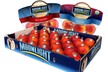
Visibility is "the key to a successful campaign," warns the association of plum producers. Visibility that relies heavily on the work of retailers to showcase the product. "We need visibility on the shelf, enough square meters of display space, as well as an attractive shelf," explains Jérôme Capel. "It is possible to create very attractive shelves, with beautiful displays that make consumers want to buy the products. In this respect, plums offer real opportunities for revitalizing the shelf. "We also have the opportunity to make the plum aisle attractive, thanks to two quality flagship products - the PGI Mirabelle de Lorraine and the Red Label Reine-Claude - and by segmenting the aisle around four colors, as well as segmentation based on eco-responsible orchards or by brand.
Attractiveness is all the more necessary now that plums are still an impulse purchase. "The aim is to gradually transform this impulse purchase into a programmed purchase," explains Jérôme Capel.
Partnership signed with Coopérative U
This week, the association of French plum producers also announced the signing of a partnership agreement with Coopérative U. The agreement provides for 95% of plums to be sourced from France, with 80% coming from eco-responsible orchards. The commitment also covers the promotion of the product, by both the association and the retailer, through displays on the shelves and work on colors and flavors.
"The discussions at the International Agricultural Show in Paris were very constructive. We asked ourselves how we could show our commitment to this sector. So it seemed logical for us to become partners in this approach. There is a co-construction and a co-commitment, and that is what we liked," explains Jeff Mahintach, director of the fruit and vegetable division at Coopérative U.
The association of French plum producers has 36 member operators (producer organizations and marketers), with 8 new members joining in 2025. It represents 30,000 tons of plums for the fresh market, or 60% of national production, spread over three production areas: southwest, southeast, and east of France.