At its annual press conference, the Solarenn cooperative, based in Ille-et-Vilaine and bringing together 25 growers, took stock of the past campaign and looked ahead to 2026, with new product ranges, diversification, industrial investment, and a focus on energy issues.
 © Solarenn
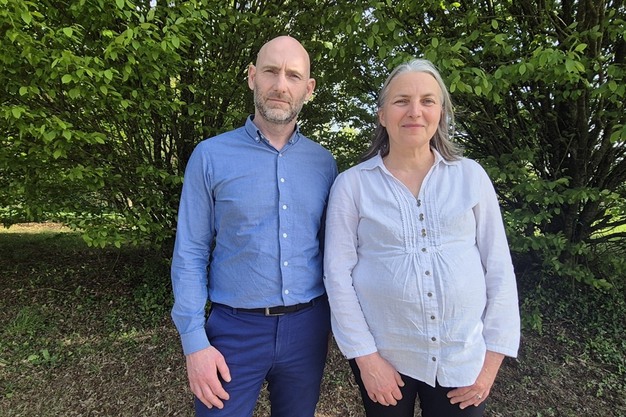
Ronan Collet and Isabelle Georges
A mixed 2025 campaign
"The 2025 campaign was a reflection of the weather in Brittany," explains Ronan Collet, chairman of Solarenn. "It was a rather mixed year, with periods of fine weather and others that were a little less fine. In 2025, the cooperative recorded sales of 55 million euros [64.5 million USD], compared with 57 million euros [66.8 million USD] in 2024. The cooperative sold 22,000 tons of tomatoes, 150 tons of strawberries, and 25,000 tons of mini watermelons.
The difficulties are concentrated in the small fruit segment, particularly cherry tomatoes. Despite a satisfactory production, marketing became tense from May onwards, due to competition, mainly from Morocco, "especially as the marketing calendar for Moroccan tomatoes gets longer every year." After a break during the summer, the early arrival of autumn once again dealt a blow to the demand. "Consumers quickly turned away," explains the chairman. The presence of the ToBRFV virus - with seven cases recorded - also weighed on the campaign, with yield losses, as well as a drop in strawberry volumes due to the reduction in the area under cultivation.
 © Solarenn
The sovereign tray initiative
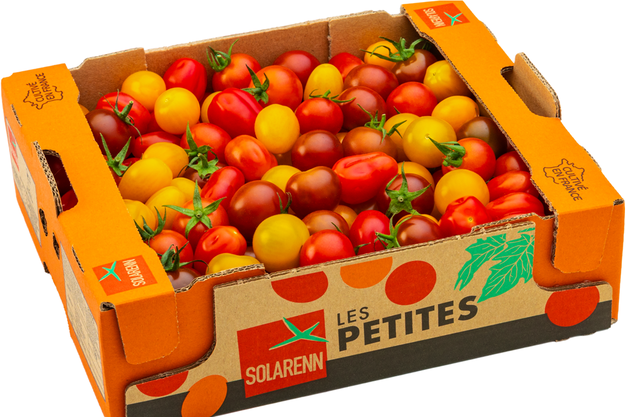
The cooperative also looked back at the sovereign tray initiative, launched at the beginning of 2025. This common 250g format is supported by a number of French operators grouped under the national association of producers of Tomatoes and Cucumbers of France. This sovereign tray aims to raise the profile of the French origin on the shelves in the face of competition from Morocco. "The idea is to encourage consumers to act responsibly," explains Ronan Collet. Priced at €1.29 [1.51 USD], compared with around €0.99 [1.16 USD] for its Moroccan equivalent, it carries the slogan "Oui à la souveraineté alimentaire française" ("Yes to French food sovereignty"). How is the initiative doing a year after its launch? "It is neither dazzling nor exceptional, but it is rather encouraging for a start-up," according to Ronan Collet. Solarenn sold just over 800,000 trays in 2025, for a total of around 4,000 tons nationwide. "Some retailers have played the game, others a little less so." For 2026, the cooperative hopes to double or even triple its volumes. "We already have commitments from supermarkets, so we know we will sell more, but we do not know how much," adds Ronan Collet, in the absence of contractual commitments on precise volumes.
The gourmet range gains ground
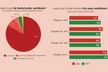
Conversely, the gourmet range is making its mark. Made up of ribbed, heirloom, and oxheart tomatoes, it will account for 35% of volumes in 2025, compared with 33% in 2024. "It is a segment that is doing very well, and really catching on with consumers," explains Ronan Collet. The campaign ran smoothly until mid-August, before also suffering the impact of the weather. Faced with this dynamic, growers opted in 2026 to reduce their cherry tomato acreage in favor of ribbed varieties.
The classic range, dominated by grape tomatoes, remains stable with no real change. "It is neither exceptional nor bad," according to Isabelle Georges. "It is the ultimate promotional product all year round, a staple on the shelf." Despite its high yields, which can be two to three times higher than those of small fruit, it is losing interest with growers because it is not sufficiently valued in supermarkets. As a result, volumes are falling. "We are back to the tonnages of the early 2000s."
Meanwhile, the "Blue Tonic" tomato, launched in 2025 on small areas, will be continued in 2026 with a slight increase in production. "It has found its place with wholesalers," confirms the manager.
 © Solarenn
What is the outlook for the French tomato market in 2026?
Initial indicators for the 2026 season look encouraging. The favorable weather, combined with the drop in volumes of Moroccan tomatoes - the result of bad weather in the Souss-Massa region at the end of February - "gives us greater confidence," explains Ronan Collet. The ramp-up in French volumes is underway and should continue gradually over the coming weeks.
However, one major uncertainty remains: production costs. "We know that our costs are going to rise, but we do not know by how much." Energy remains the biggest expense in the greenhouse, and growers are adjusting their practices accordingly. "We know how to adapt by using less energy when necessary," explains Ronan Collet. However, the trade-offs are specific to each farm. "Producers adapt according to the market, their constraints, and their heating systems." Another unknown factor is the behavior of consumers who, faced with soaring fuel prices, "will certainly be forced to make trade-offs in their purchases."
Resilience and diversification on the R&D agenda
"With the creation of the Quality-Technology and R&D department in 2024, we now have a real strategy," explains Isabelle Georges. Solarenn is co-funding trials at the regional CATE and Terres d'Essais experimental stations. The aim is twofold: to meet market expectations and improve resistance to ToBRFV. By 2025, the cooperative will have 80% resistant varieties. It is also pursuing its diversification objectives. After the mini watermelons, it is now exploring blueberries. "The aim remains to offer crops adapted to existing tools, which have become less effective for tomatoes," explains Ronan Collet.
At the same time, Solarenn is testing an automated pest detection solution, particularly for whiteflies, based on artificial intelligence and developed by Biobest (Trap-Eye solution). The system uses sticky panels fitted with cameras positioned opposite each other to identify the insects trapped and quantify their presence. "This makes it possible to pinpoint outbreaks and take targeted action quickly," explains Isabelle Georges.
Reducing energy consumption
The energy issue has been at the heart of the cooperative's thinking for several years now. "In 25 years, we have managed to produce as much, if not more, while consuming half as much energy," explains Ronan Collet. At the end of 2024, the cooperative recruited an engineer dedicated to environmental, energy, water, and waste management issues. As a result, Solarenn has been able to reduce its energy consumption by 3% at the station, using AI-powered software to control the refrigeration unit.
Individual work is also being carried out with each greenhouse operator on the energy challenges facing each farm, in order to adapt strategies according to equipment and heating methods. Among the options being explored are photovoltaics and heat pumps. The aim is to reduce dependence on natural gas by betting on the energy mix - recovery of waste heat, methanization, electrification of energy sources... To date, 68% of Solarenn's greenhouses are equipped with cogeneration boilers that produce electricity and heat. Ten hectares of greenhouses are partly heated with biogas from 2 methanization plants, and two wood (biomass) boilers have been installed at the producers' sites.
 © Solarenn
Robotization serving performance and people
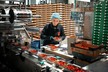
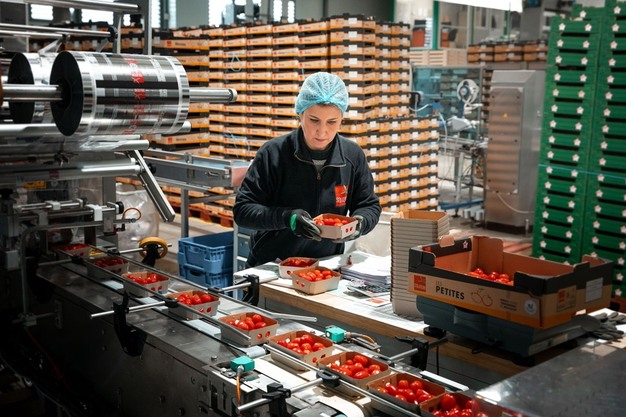
The cooperative has also invested €500,000 [586.150 USD] to modernize its packaging equipment. A packing robot has been installed to increase production capacity and reduce labor. It can handle 80 trays per minute, with the arm able to pick up 10 trays at a time. A new packaging line has also been installed for 1 kg packs. Finally, a digital traceability tool (portable terminals) has been installed to ensure real-time monitoring of flows and production. "We are now able to track tomatoes from the greenhouse right through to packaging," explains Isabelle Georges.
Zucchinis join the organic range
The organic range, which accounted for 2% of sales in 2025 and was based mainly on cherry tomatoes, is being expanded this year with the arrival of zucchinis. Launched in 2025, 5 tons of zucchinis were sold this year. Cocktail tomatoes, as well as black and red ribbed varieties, absent for three years, are also making a comeback. These developments are part of a market recovery. "We can feel that the organic market is picking up again," confirms Isabelle Georges. "We work mainly with supermarkets, where we are definitely seeing a demand for these products."