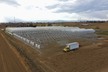
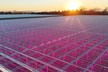
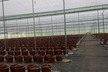
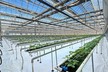
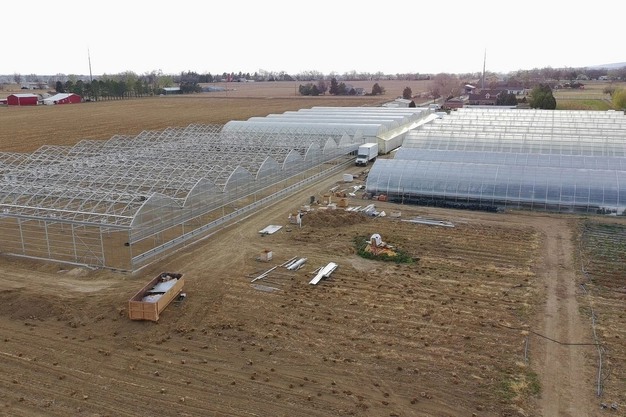
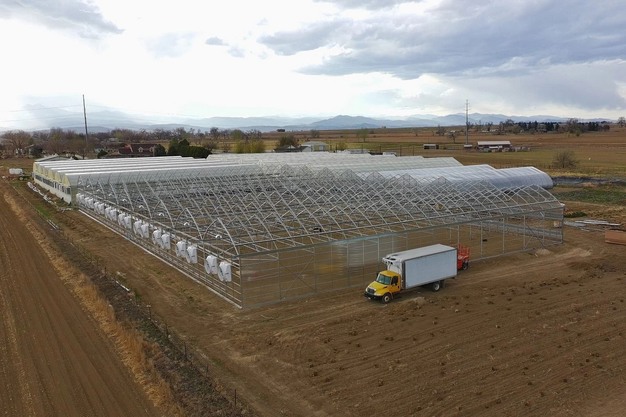
A diversified greenhouse development in Colorado, developed by Harnois Greenhouses, integrates a 1-hectare Luminosa gutter-connected greenhouse for tomato production with two 42-foot Ovaltech IV structures dedicated to cactus cultivation.
According to Vincent Douville of Harnois, the project reflects a deliberate engineering approach tailored to both crop biology and regional climate constraints. "The Luminosa gutter-connected greenhouse is uniquely engineered to address the specific demands of commercial tomato production in a high-altitude, four-season climate," he explains, pointing to the structural design requirements driven by wind and snow loads reaching 101 mph and 35 psf, respectively.
 © Harnois Greenhouses
Structural design for high-altitude tomato production
The Luminosa system is designed to manage the environmental extremes typical of Colorado, where high solar radiation and rapid temperature swings can affect fruit set and crop stability.
Vincent emphasizes the importance of passive and active climate regulation through the structure itself. "Hot and humid air can escape efficiently at the ridge," he notes, describing how the gothic arch profile and mid-roof ventilation system reduce heat stress during peak summer conditions.
Maintaining stable night temperatures remains critical for tomato physiology, with optimal ranges typically between 18°C and 29°C. The greenhouse design supports this balance through controlled ventilation and insulation strategies that reduce thermal fluctuations.
Energy efficiency through double-poly and insulated systems
A central feature of the Luminosa system is its double-inflated poly covering, which creates an insulating air layer between films.
He describes it as a "double-layer air-inflated barrier" that reduces heat loss during winter while maintaining uniform climate conditions at crop level. The inclusion of anti-drip treatments further minimizes condensation risks, which are particularly important for tomato crops sensitive to moisture-related disease pressure.
Twin-wall 8 mm polycarbonate sidewalls add additional thermal stability at the perimeter. These components reduce cold infiltration and help maintain more consistent humidity conditions throughout the structure.
 © Harnois Greenhouses
Light optimization and structural efficiency
Light transmission is a key design driver in high-latitude and high-altitude production systems. The Luminosa structure integrates oval tube framing technology to minimize shading and improve light distribution.
Vincent notes a direct relationship between light availability and yield: "We see that 1% more light translates directly to 1% more yield." The design prioritizes wider spans and fewer structural members to maximize usable light while maintaining structural integrity.
The system's geometry and covering materials are engineered to approach the light performance of glass, while retaining the insulation advantages of poly-based systems.
Ovaltech IV greenhouses for cactus cultivation
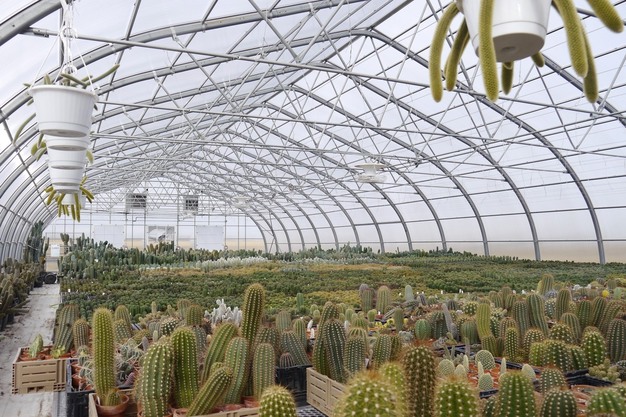
The project's two Ovaltech IV greenhouses are designed for specialty cactus and succulent production, offering a contrasting operational model to the high-tech tomato facility.
With a clear-span width of 42 feet and no internal posts, the structure provides unobstructed growing space essential for high-light crops. Douville explains that this is particularly important for avoiding plant deformation: "Cactus and succulents require high light intensity for healthy growth and to prevent etiolation."
The structures operate without active heating, relying instead on passive thermal buffering created by volume and height. This makes them well-suited for seasonal production cycles where environmental control demands are lower.
 © Harnois Greenhouses
The Ovaltech with cactus
Diversified production strategy and operational implications
By combining heated food production with unheated specialty crops on a single site, the project introduces both operational complexity and strategic diversification benefits.
He highlights "complementary revenue streams" as a key advantage, noting that year-round tomato production stabilizes cash flow while cactus production provides higher-margin seasonal output. Shared infrastructure such as irrigation, power supply, and access roads further improves capital efficiency.
However, he also points to operational challenges. "Tomatoes in the Luminosa require precise temperature, humidity, and CO₂ management; cacti in the Ovaltech prefer dry, high-light, lower-humidity conditions," he explains. This requires strict environmental separation and specialized staff expertise across production systems.
Engineering adaptation across crop types
Harnois' approach to multi-crop site design is based on matching greenhouse technology to crop requirements rather than standardizing infrastructure.
Vincent explains that the Luminosa system is selected for high-performance food production requiring integrated heating, ventilation, and cooling systems. In contrast, the Ovaltech IV is chosen for crops that benefit from simpler, passive environmental control combined with high light transmission and structural openness.
This differentiation allows growers to optimize both capital investment and operational complexity based on crop-specific needs.
Material innovation and structural longevity
A key engineering component across both greenhouse types is the oval tube structural system, which increases strength while reducing material mass and shading impact.
He notes that oval tubing provides about 30% more strength than round profiles, enabling wider spans with fewer supports. The reduced surface friction also extends the lifespan of covering materials.
All structures use high-grade galvanization designed for long service life, reflecting an industry-wide shift toward greenhouse infrastructure being treated as a 25–30 year capital asset rather than a short-term installation.
Lastly, Vincent points to increasing institutional support for local food systems. "Governments are increasingly providing financial support to make it happen, recognizing controlled-environment agriculture as a strategic infrastructure investment."
 © Les Industries Harnois Inc.
For more information:
Harnois Greenhouses
1044 Principale
St-Thomas, QC J0K 3L0
Canada
(450) 756-1041
Email us: [email protected]
www.harnois.com/en/greenhouses/