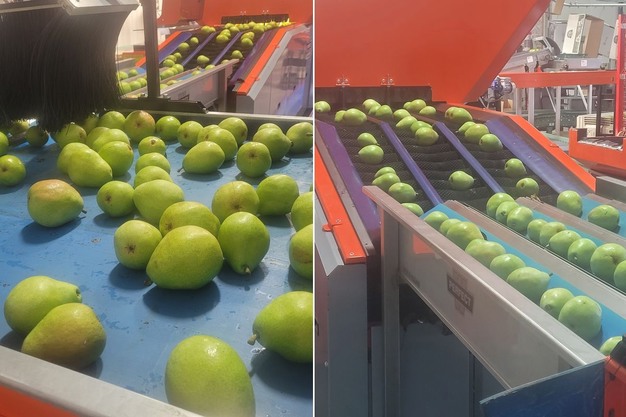
Across all varieties, British Columbia (B.C.) saw a much higher volume of pears this season compared to the province's 2024 harvest. "We expect to continue packing for another five to eight weeks," says Kevin Day with Day's Century Growers. The company packs pears for 10 growers, representing about 90 percent of all pears grown in Western Canada. While the popular Bartlett variety finished in November, Green Anjou is now the main variety left to pack and Day reports excellent quality.
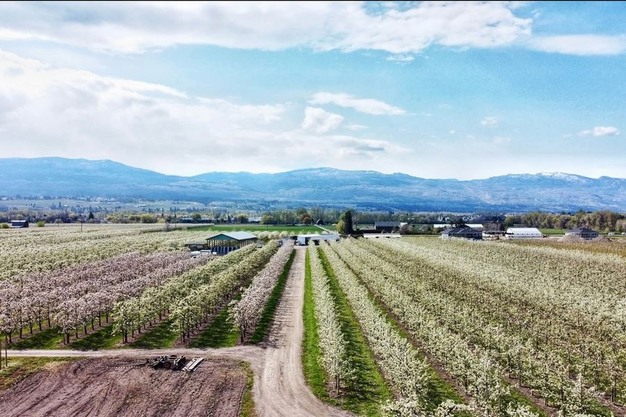 © Day's Century Growers
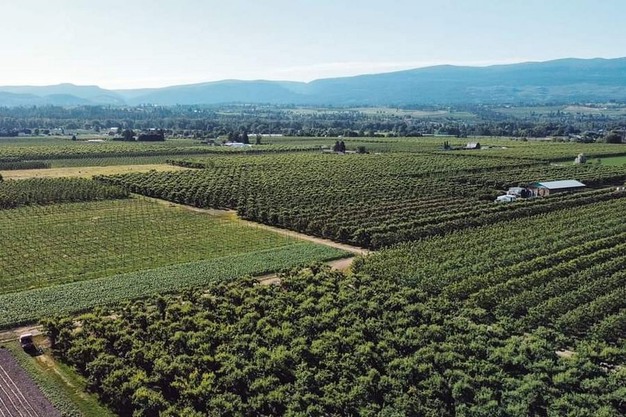
Day's Century pear farm.
Competition with southern hemisphere
"However, due to the longer window, we now run into supply from the Southern Hemisphere," commented Day. While B.C. has about 15 percent of its Green Anjou supply left to pack, the Southern Hemisphere has started to ship Bartlett pears. "Bartletts from the Southern Hemisphere are of really nice quality, and it is unfortunate we compete with them on the shelf." There is always some overlap, but B.C.'s larger 2025 volumes have resulted in increased competition this season. At the same time, Day is very thankful for the great relationships with both their marketing partner The Star Group and with Canadian retailers who continue to provide shelf space to locally grown B.C. pears. "Main retailers like Walmart, Sobeys, Loblaws, and Costco keep on supporting us through the end of the season, something we are very grateful for."
The overlap results in some pressure on pricing. Although the grower return on Green Anjou will be somewhat reduced, the overall return on pears per acre this season is very good. "Yields were high and growers harvested a lot more bins per acre compared to the previous growing season," shared Day.
 © Day's Century Growers
Preparations for the 2026 season
In the meantime, preparations for the 2026 season are well underway. Pruning has finished and the trees have been sprayed with a non-toxic dormant oil solution. This layer of film protects the trees by denying overwintering insects laying sites for early pest control. "The trees look very healthy. They received enough chilling hours, and we haven't had any extreme weather events this past winter."
Dwarf rootstock
Day's Century Growers is investing in the development of a new training system. About 90 percent of pears grown in B.C. and the Pacific Northwest are on the same winter hardy rootstock, growing a full-size tree. "However, we are transitioning to growing two leaders from one rootstock system, which will allow for a higher density planting by splitting the vigor of one rootstock." These trees could grow in a fruiting wall, enabling the use of platforms for automatic harvesting. Due to the climate, growers need winter hardy rootstock. While there is lots of winter hardy dwarf rootstock available for apples, that combination is virtually non-existent for pears in Western Canada. "Some growers have higher dwarfing, but really for microclimates," commented Day. The large majority of rootstock grows a full-size tree that limits automatic harvesting.
Happi Pear
In addition to new rootstock, Day's Century Growers also keep investing in new pear varieties. Together with five growers, the Happi Pear® is being trialed. This upcoming season, about 10 to 15 tons are expected to be picked, but that number will exponentially increase in the coming years. The Happi Pear is expected to be commercially harvested in four to five years.
On a personal note, Day explains that the pear farm has been in the family for many decades. He and his sister own the farm, and their children are also involved, now representing the 5th generation of growers.
 © Day's Century Growers
The farm in British Columbia.
 For more information:
Kevin Day
Day's Century Growers
[email protected]
www.dayscenturygrowers.ca