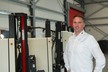
The use of automated guided vehicles (AGVs) in the fresh produce sector is increasing. While internal transport in many packing stations and sorting companies still relies on forklifts and personnel, more companies are seeing opportunities to automate this logistics link. According to Bastiaan Krijger, founder of robot and system integrator KV-Techniek, his company is responding to this with AGV solutions developed in-house. "You can think of it as a moving forklift, but without a driver," he says. KV-Techniek's AGV solutions are housed under a separate operating company, GO, The AGV Company.
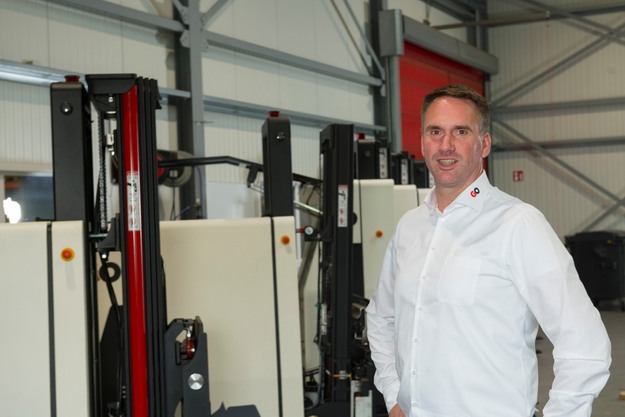 © GO-AGV
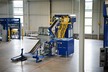
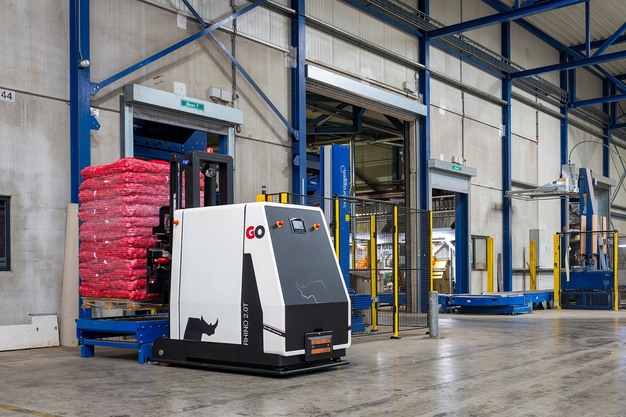
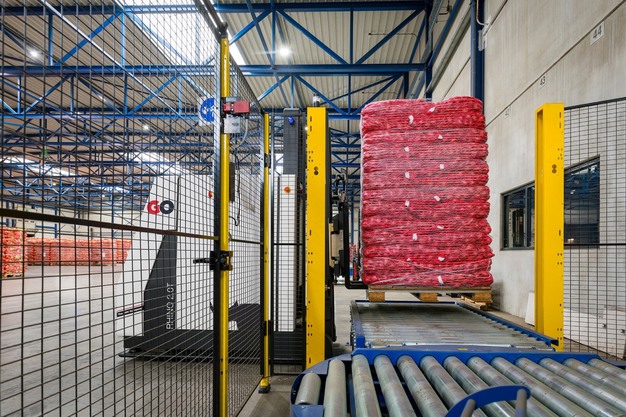
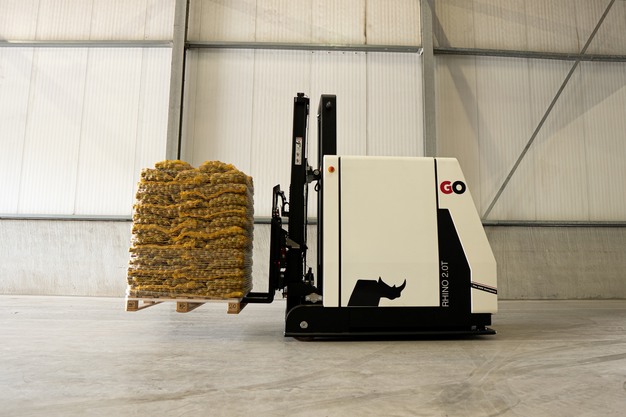
Goes-based GO-AGV has been developing and building AGVs for several years for applications in the onion sector and other parts of the fresh produce industry. The vehicles are used to transport pallets from, for example, a palletizing line to the loading dock. "Where a forklift truck is often used to pick up and store pallets, we can fully automate that," says Bastiaan.
Compact stacking as a differentiator
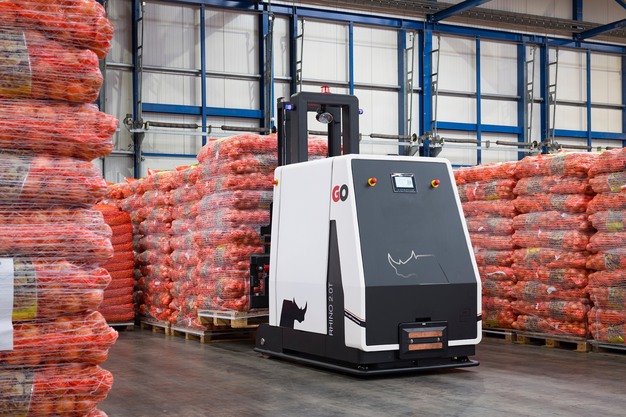
According to Bastiaan, the added value is not only in replacing labor, but mainly in how AGVs utilize available space. "A key issue in the fresh produce sector is that pallets often need to be placed as close together as possible," he explains. "With many standard AGVs, this does not work well. You end up with ten centimeters between each pallet, for example. That may seem small, but with a full load you can quickly lose more than a meter."
"We have developed our system so that pallets can be placed just as tightly together as with a forklift truck," he continues. "So you get the same storage quality, but automated."
 © GO-AGV
That functionality, he says, cannot be taken for granted. "This is exactly where the fresh produce sector presents challenges, with varying pallet sizes and bags that can sag or protrude. We have paid a lot of attention to that in recent years."
Developed from practice
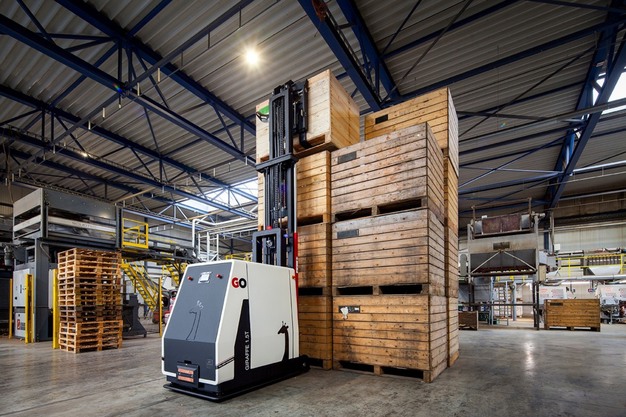
The AGV solutions were not developed in isolation from real-world conditions, Bastiaan emphasizes. "We developed this together with an onion company. We received a lot of input from practice, and that is how we made it work step by step."
 © GO-AGV
He says this hands-on approach is necessary in a sector with specific requirements. "You are dealing with products that are not always uniform. Sometimes pallets need to be stored blocked, lengthwise, or, on the contrary, widthwise. You see that much less in other sectors."
Investment versus labor
Using AGVs requires an investment, Bastiaan acknowledges. "It strongly depends on the situation. How many pick-up and drop-off points do you have? The more complex the routing, the higher the investment."
However, he notes that the business case can often be established quickly. "A forklift with a driver leads to ongoing annual labor costs, and those costs will continue to rise rather than fall."
 © GO-AGV
"If you operate several hours a day, you can often expect a payback period of around four years," he says. "Not to mention that staff is increasingly difficult to find." According to him, the growing popularity of AGVs is therefore also linked to tight labor market conditions.
In addition to cost savings, Bastiaan highlights safety. "By using AGVs, you can prevent collisions. In many companies, forklift trucks move back and forth across the production hall, creating unrest and risks," he says. "Our AGVs follow fixed routes, are highly predictable, and operate without damage. They give signals, and people know where they are. That creates calm, as well as safety and organization in production."
From pallet transport to box handling
GO-AGV offers various types of AGVs, such as the Rhino (for heavy loads up to 2,000 kilos), the Giraffe (with a high lifting height), and the Donkey (for lighter applications). These are now in use at multiple locations. "There are now around 20 in operation across Europe, including in the fresh produce sector," says Bastiaan.
He mentions applications at companies in the Netherlands, Belgium, and abroad. "At companies operating 24 hours a day, the benefits are even greater. In those cases, the payback period is often shorter."
 © GO-AGV
According to him, development is ongoing. "We are now also fully focused on automatic crate handling. This is in high demand in the fresh produce sector. We can already pick up and stack crates, and we expect to make further progress in this area soon."
Practical approach
According to Bastiaan, both KV-Techniek and GO-AGV stand out mainly because of their practical approach. "We build our AGVs ourselves and keep everything under our own control. This allows us to respond quickly to customer requirements."
He contrasts this with larger providers. "There are large players active in this field, but they are often less flexible and think in terms of standard solutions. We look instead at what the customer needs and how we can make it work."
 © GO-AGV
"If something is difficult, we look at whether it can still be done," he says. "That fits well with the fresh produce sector, where people take a practical approach."
Automation continues
The use of AGVs in the sector is expected to increase further. "Autonomous vehicles are here to stay," says Bastiaan. "Just like further robotization in sorting processes, for example."
According to him, the added value lies in the overall picture. "It is not just about technology, but about improving the entire process. Less manual work, more predictability, and consistent quality."
He says feedback from the field has been positive. "If I don't hear anything, it is usually a good sign," he says with a laugh. "Then it is simply running, and the process works as intended. That is what we aim for."
For more information:
Bastiaan Krijger 
GO, The AGV Company
Columbusweg 66
4462 HB Goes
Tel: +31 (0) 113-405070
[email protected]
www.go-agv.nl