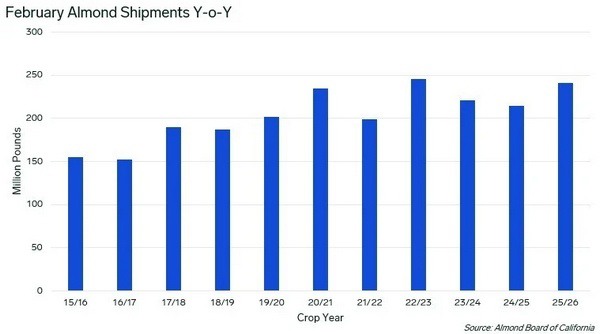
The Almond Board of California released its February position report, showing total shipments of 241.1M pounds in February 2026, up 12.2 per cent from 214.9M pounds in February 2025. The figure represents the second-highest February shipment total on record and is in line with pre-report estimates of 243M pounds.
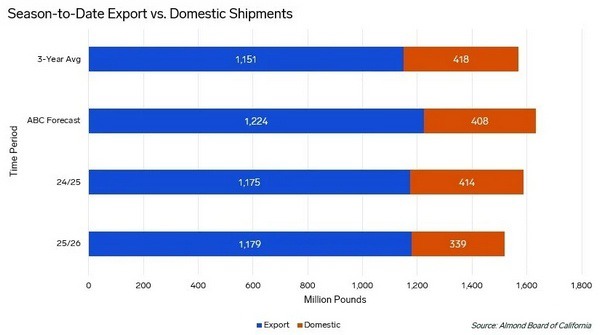
Season-to-date shipments for August to February total 1,517.8M pounds, down 4.4 per cent year on year, compared with a 7.1 per cent deficit in January. Of the February total, 45.0M pounds were shipped domestically, down 19.8 per cent, while 196.1M pounds were exported, up 23.5 per cent. Exports account for 78 per cent of total shipments, above the annual forecast of 75 per cent and the three-year average of 73 per cent. Domestic shipments remain down 18.1 per cent season to date.
 © Almond Board of California
Key export markets include India with 41.3M pounds in February and 213.1M pounds season to date, down 4 per cent. Europe received 74.2M pounds in February, bringing the total to 384.0M pounds, up 1 per cent. The Middle East recorded 28.1M pounds in February and 233.1M pounds season to date, up 5 per cent, with part of the volume linked to markets affected by current shipping constraints. China and Hong Kong received 3.6M pounds in February, with season-to-date shipments at 20.2M pounds, down 52 per cent.
Total commitments reached 593.4M pounds at the end of February, up 2.8 per cent. New sales for the month totaled 246.2M pounds, up 11.5 per cent year on year, although down from January's 298M pounds.
Crop receipts reached 2,679.1M pounds through February, down 0.1 per cent year on year. February receipts totaled 52.8M pounds. Industry estimates continue to use a normalized crop of 2.7 billion pounds, with receipts nearing completion.
 © Almond Board of California
Market participants report improved supply visibility as receipts near completion. The reduction in the shipment deficit from 9.5 per cent in December to 4.4 per cent in February reflects progress in carryover management. Export demand continues to offset lower domestic demand.
Trade flows remain influenced by purchasing patterns, inflation, and developments in the Middle East affecting logistics. Market participants are monitoring shipment execution, geopolitical conditions, and early 2026 crop development as the season progresses.
Source: Mintec/Expana