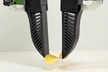
Researchers at The University of Texas at Austin have developed a robotic hand capable of handling fragile items such as potato chips or raspberries without crushing them. The technology, called Fragile Object Grasping with Tactile Sensing (FORTE), combines tactile sensing with soft robotics to improve the handling of delicate objects.
"Right now, robotics is starting to be able to do large motions around the house, but struggles with really fine and delicate movements," said Siqi Shang, lead author of a paper published in IEEE Robotics and Automation Letters and a doctoral student in the Cockrell School of Engineering's Chandra Family Department of Electrical and Computer Engineering. "Robots can fold a shirt, but may struggle to carefully pick up your glasses or unpack fruit from your groceries. We believe sensing signals will give robots a sense of touch to handle these objects carefully."
 © The University of Texas
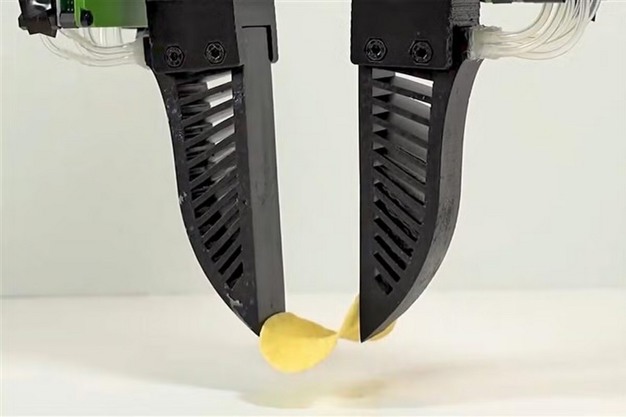
The robotic fingers are based on the fin-ray effect, a design principle derived from fish fins. The fingers were produced using 3D printing and contain internal air channels that function as tactile sensors.
When the fingers move to grasp an object, the air channels shift, causing changes in air pressure. Small sensors detect these pressure changes and provide real-time feedback to the robot. This feedback allows the system to detect whether an object is slipping.
Researchers tested the grippers on 31 items, including raspberries, potato chips, jam jars, billiard balls, soup cans, and apples. The system achieved a 91.9% success rate in single-trial grasping experiments. It also recognized 93% of slips with 100% precision.
"Humans pick up objects with just the right amount of force; too much and you'll crush it, but too little and it'll slip out of your hand," said Lillian Chin, assistant professor of electrical and computer engineering at UT.
The sensors are 3D printed and can be adapted to different shapes. The system's slip detection capability allows the robot to adjust its grip when needed while avoiding excessive force.
Potential applications include food processing, where machines could handle fragile items such as fruit, vegetables, and baked goods; health care, where robots could manage medical instruments or biological samples; and manufacturing, where delicate components such as electronics or glassware require careful handling.
The hardware designs and algorithms have been released publicly to allow further research and development. Future work will focus on reducing sensitivity to temperature changes and improving the system's ability to detect and respond to slipping objects.
The project team includes Yuke Zhu, associate professor in the Department of Computer Science, and doctoral student Mingyo Seo. The research received support from the Texas Robotics Industrial Affiliate Program, the National Science Foundation, the Office of Naval Research, the DARPA TIAMAT program, and South Korea's Institute of Information & Communications Technology Planning & Evaluation.
For more information:
Mike Rosen
The University of Texas
Email: [email protected]
www.news.utexas.edu