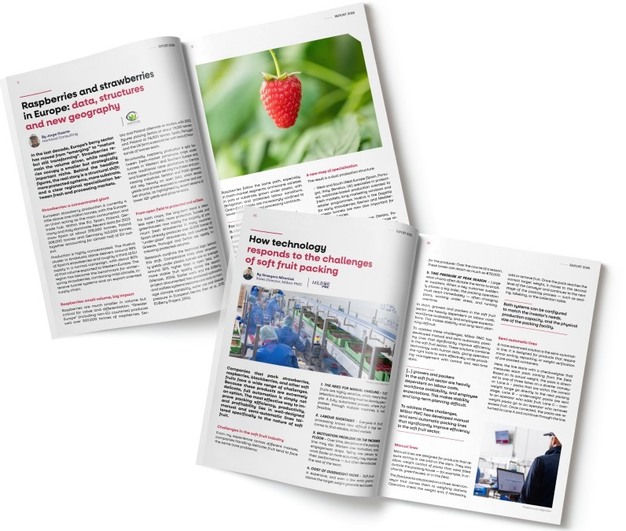
The newly released 2026 edition of the Soft Fruit Market Report examines the forces reshaping the strawberry, raspberry, and blackberry markets. With Cindy van Rijswick, Jorge Duarte, Marco R. Butera, Matteo Molari, and Agnieszka Orzeł among its authors, the report offers a comprehensive view of the soft fruit sector. The publication is available free of charge.
While this article briefs each part of the publication, the full soft fruit report can be downloaded here . The report's international scope combines 8 expert insights and 3 grower case studies. What is in the report?
"Raspberries and strawberries in Europe: data, structures and new geography"
Jorge Duarte of Hortitool Consulting maps the structural transformation of the European berry sector. Strawberry production remains highly concentrated, with Spain, Poland and Germany playing leading roles, while raspberries — though smaller in volume — are crucial for value creation. The key trend is the shift from open-field to protected and soilless systems. Western and Southern Europe increasingly specialise in tunnel and substrate production for fresh markets, while Central and Eastern Europe retain a strong processing orientation. Duarte argues that future competitiveness will depend on targeted investment in protected cultivation, varietal innovation and closer integration between fresh and processing segments.
"Table-top and tunnel cultivation – when is it worth investing?"
Cindy van Rijswick of Rabobank analyses the economic logic behind protected cultivation. In Northwestern Europe, tunnels and table-top systems have already become standard; elsewhere they are gaining ground as climate volatility and retailer demands intensify.
Investment costs are significant, but higher yields, improved labour efficiency and more predictable supply can justify them — provided growers secure suitable market outlets. Van Rijswick stresses that there is no universal model: successful adoption depends on grower skills, local climate, capital access and customer structure. At the same time, new proprietary varieties and seed-based breeding innovations may further reshape production economics.
 © Milbor sp. z o.o
"The importance of Polish blackberry and raspberry varieties in the soft fruit market"
Agnieszka Orzeł (Dr Berry) highlights the growing strategic importance of Polish breeding programmes. Rising domestic consumption and export potential are closely linked to new high-yielding, firm and resilient cultivars adapted to tunnel production and extended seasons. She outlines the evolution of public and private breeding initiatives, the role of National Register and Temporary Protection (both Polish) systems, and the rapid influx of new genetics. Climate resilience, machine harvest suitability and sensory quality are emerging priorities. Poland, she argues, is becoming a key innovation hub for Rubus varieties in Central Europe.
"New varieties reshaping the raspberry market"
Matteo Molari (G-Berries) examines the explosion of new raspberry cultivars and the growing need for market-oriented breeding. Shelf life, firmness, colour and targeted harvest windows dominate selection criteria, especially in winter-production regions and continental climates. However, Molari warns against neglecting flavour — a critical factor for long-term consumer loyalty and market segmentation. He advocates closer collaboration between breeders, growers and retailers, with customised varietal strategies replacing the old "one variety fits all" model. The future, he suggests, lies in integrated breeding platforms aligned with specific commercial needs.
"The importance of precision fertilization in modern strawberry and raspberry cultivation"
Marco R. Butera (Better Berries) focuses on the technical backbone of modern soft fruit production: precision fertigation. In substrate systems, where soil buffering is absent, nutrient and water management must be highly controlled and data-driven. Computerised fertigation, real-time EC and pH monitoring, and sensor-based irrigation allow growers to optimise yield, fruit firmness and shelf life while reducing waste. Although requiring investment and expertise, precision fertilisation ultimately enhances efficiency, sustainability and operational stability — turning berry production into a measurable, optimisable process.
 © Milbor sp. z o.o
"Trends in the soft fruit packaging market"
Justyna Bąk of the Guillin Group explores how sustainability and logistics are reshaping packaging. Mono-material RPET solutions, lighter packs and top-seal technology are becoming dominant, reducing plastic use while maintaining compatibility with automated lines. While fibre-based alternatives are developing, plastic remains prevalent due to cost, transparency and logistical advantages. Automation and recyclability are expected to drive the next phase of packaging innovation, alongside growing demand for customised branding solutions.
"Tray sealing technology for soft fruit: reflections from the field"
Neil Ashton of Packaging Automation Ltd. argues that tray sealing has become a core technology for protecting fragile berries. Reliable seals, flexible material handling and compatibility with modified or atmospheric packaging systems reduce waste and increase supply-chain stability. Drawing on field experience, he shows how incremental engineering improvements — such as adapting machines for paper films — enable sustainability transitions without compromising efficiency. For peak-season operations, consistency and process stability remain the decisive performance factors.
"How technology responds to the challenges of soft fruit packing"
Grzegorz Mironiuk of Milbor PMC addresses the labour-intensive reality of soft fruit packing. Full automation is unrealistic; instead, well-designed manual and semi-automatic lines offer the optimal balance between human handling and technological control.
Integrated weighing systems and production-monitoring software reduce overweight losses, improve productivity and support better workforce management. In a sector marked by labour shortages and tight margins, data-driven packing solutions provide measurable gains in efficiency and profitability.
Additionally, the report contains opinions from 3 growing companies, including Lymouna Matysha (Morocco), Yami Fruits (Romania), and Gospodarstwo Ogrodnicze Chenczke (Poland).
For more information:
Milbor
https://milborpmc.com/